
 E-Paper



Exhibition displays 100 years of Art Deco in Delhi
An exhibition, "Art Deco 100: Delhi Edition," highlights Delhi's Art Deco architecture, showcasing its evolution and need for preservation through March 7.

 Prefer HTon Google


From Shankar Terrace in Chandni Chowk, built in 1936 and considered possibly the first multi-storey commercial complex in reinforced cement concrete (RCC), to the symmetrically balanced façade and extended porch of Kota House (1938), or the stepped roof and recessed profiles of the Ram Roop Tower (1938–41), Delhi at the time began to see an influx of architectural styles and none was more prominent than Art Deco.
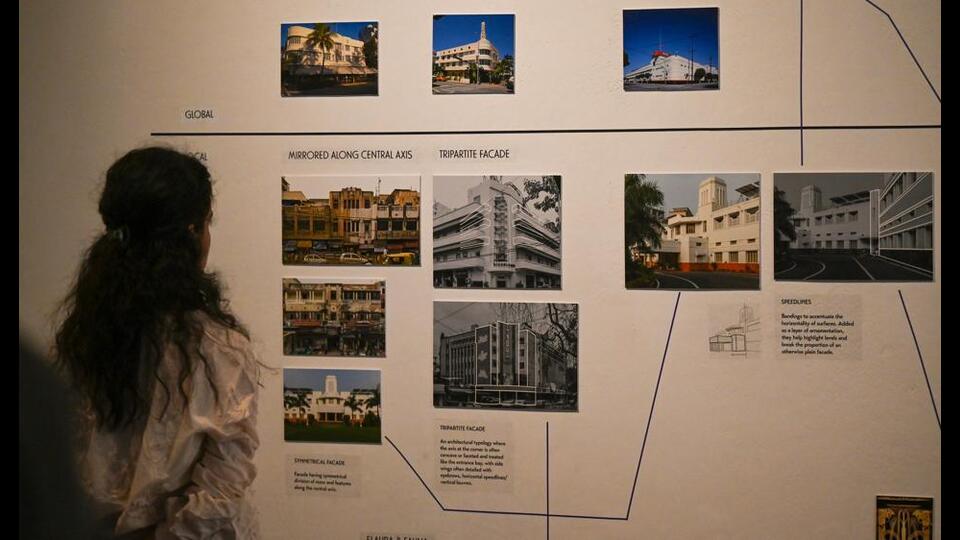
Completing 100 years last year, the architecture is now the focus of an exhibition titled “Art Deco 100: Delhi Edition”, which opened at the Galerie Romain Rolland at the Alliance Française de Delhi and will run till March 7. Organised by the Indian National Trust for Art and Cultural Heritage (INTACH)’s architectural heritage division in collaboration with Alliance Française, the show documents the journey of the style from the 1925 Paris exposition to Delhi’s neighbourhoods, where it adapted to local materials, climate and craft traditions.
Drawing on research by the Deco in Delhi collective — architects Geetanjali Sayal and Prashansa Sachdeva — the exhibition brings together archival material, photographs and documentation mapping the spread of the style across the capital’s built fabric. While Delhi’s architectural narrative is often framed through its Sultanate, Mughal and Lutyens’ landmarks, the show shifts attention to what it calls the “everyday city”, encompassing cinemas, commercial complexes, residences and institutional buildings that absorbed modernist impulses in the early to mid-20th century.
Panels trace how Art Deco, with its emphasis on geometry, symmetry, stylised ornament and streamlined forms, offered a vocabulary for expressing efficiency and aspiration at a time when RCC was gaining currency in Delhi.
Sachdeva, from Deco in Delhi, said two 1936 projects — Shankar Terrace and the Safdarjung (then Wellington) Airport — are believed to be among the earliest instances of Deco in the capital.
“Both are from 1936. However, while Shankar Terrace is a pure example of Deco, Safdarjung airport only incorporated traces of the style. Construction for both likely began a year or so before 1936, coinciding with RCC reaching Delhi,” she explained.
HT had, on May 17 last year, highlighted Delhi’s key Art Deco landmarks that still survive, including the Ram Roop clock tower, Delite Cinema, Hotel Bloomrooms (previously Airlines Hotel), Kanika House and a residential home on Pusa Road.
The exhibition, which opened on Monday, also situates Delhi within a wider national story, noting that while Mumbai emerged as the epicentre of the movement in India, the architectural firm Master, Sathe and Bhuta brought similar inspirations to Delhi.
The panels further highlight how reinforced concrete enabled curved balconies, cantilevered chhajjas, sunshades and stepped parapets to emerge in Delhi’s architecture — elements that balanced ornament with functionality.
Rather than a singular stylistic moment, the show argues, Art Deco in Delhi evolved through negotiations between global references and local materials, climate and craft traditions.
Professor Miki Desai, architect, academic and researcher, who delivered the opening lecture following the launch of the exhibition, said regional responses to Deco varied widely. He recently documented examples in Hyderabad that differ markedly from those in Delhi and Mumbai. “To bring decorative aspects into Indian architecture is not an easy thing, as our architecture is already full of it,” Desai said.
However, he cautioned that many such structures are being lost. “Such buildings are slowly being demolished. I recently saw a theatre in Mumbai and another in Benaras being demolished. The owners did not know much or care about the architecture,” he said, calling for the preservation of these works for future generations.


Stay updated with all top Cities including, Bengaluru, Delhi, Mumbai and more across India. Stay informed on the latest happenings in World News along with Delhi Election 2025 and Delhi Election Result 2025 Live, New Delhi Election Result Live, Kalkaji Election Result Live at Hindustan Times.


