
 E-Paper



Why ‘green crackers’ are deceptive and dangerous
The chemistry behind these so-called green crackers is equally deceptive. They often replace barium nitrate with potassium nitrate or strontium-based oxidisers.

 Prefer HTon Google


The Supreme Court on Wednesday permitted the sale and bursting of firecrackers in the Delhi-NCR region between October 18 and 21, limiting the timings to 6-7 am and 8-10 pm, in what the top court described as a “balanced approach” between celebrating festivities and protecting the environment
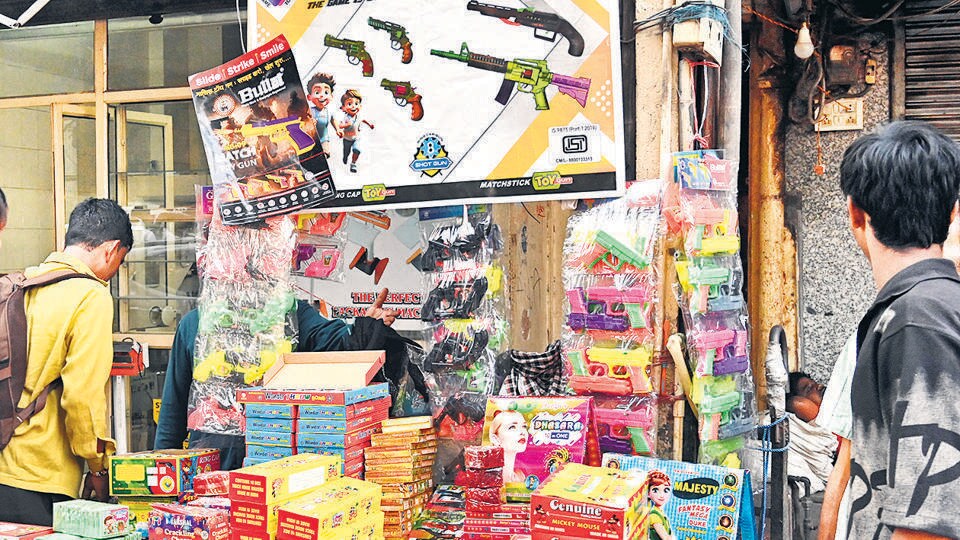
Bhavreen Kandhari, an advocate for environmental rights, explains how the “chemistry behind these so-called green crackers is equally deceptive”. The views expressed are personal.
The battle to ban crackers has raged for three decades – from classroom campaigns to online petitions to courtroom battles. “Our lungs have not yet fully developed and we cannot take further pollution through bursting of crackers,” was the statement of three toddlers in their petition before the Supreme Court in 2015, seeking a ban on firecrackers. It was perhaps the first time that the country truly heard its youngest citizens speak the language of survival.
And then, after decades of resistance, in 2021 it was accepted that crackers are toxic at every level – of production, storage and use. For many who had been part of this movement, it felt like justice had found breath again. We hoped the next step would be clear – courts and governments would question whether crackers should exist at all. We hoped that by now, this argument would be behind us, that governments, corporations, and citizens alike would recognise that true progress lies in clean air, clean water, and collective well-being. But unfortunately, that didn’t happen.
This year, with the Delhi government approaching the Supreme Court to allow certified “green firecrackers” for Diwali, we find ourselves reopening what should have been settled long ago – our children’s right to breathe. The so-called green cracker is neither green nor safe. CSIR-NEERI’s own data shows they emit only up to 30% less particulate matter – and that too under laboratory conditions, not in open air. On Diwali night, Delhi’s PM2.5 levels typically spike between 800-1,500% above WHO’s safe limits. In such toxicity, a 30% cut from one source amid many – stubble fires, vehicles, and trapped winter air – is statistically meaningless. With toxic baselines, relative improvement does not equal real-world safety just as “low tar” cigarettes did not make tobacco safe.
The chemistry behind these so-called green crackers is equally deceptive. They often replace barium nitrate with potassium nitrate or strontium-based oxidisers. These substitutes may reduce some metal emissions but increase others, like chlorine compounds and ozone precursors. Independent lab reviews, including from TERI and IIT-Delhi, have found that these alternate formulations still release toxic gases and trace heavy metals. “Green” here means only chemically rearranged toxicity.
Even the certification process meant to ensure compliance is unreliable. PESO and NEERI approvals are batch-specific, but India’s cracker industry – with nearly 400 units, mainly in Sivakasi – has no transparent batch-tracking system. Batches mix, labels are reused, oversight collapses, and enforcement agencies have no portable kits to verify chemical composition. What is certified in theory becomes unverifiable in practice.
In 2019, the Supreme Court itself noted that Delhi Police could not distinguish green crackers from conventional ones. There are no visual markers, no reliable handheld scanners, and less than 0.1% of crackers are ever lab-tested. A rule that cannot be enforced is scientifically meaningless and administratively dishonest.
From a policy standpoint, allowing “green” crackers contradicts every other pollution control measure in place. The Environment (Protection) Act, 1986, mandates progressive pollution reduction, not selective relaxation. To fine burning leaves and construction dust – both of which emit far less – but to excuse fireworks in the name of tradition, is irrational. Policy consistency demands that the most intense, toxic, and short-duration pollution sources be eliminated first, not excused.
The economics are equally stark. A 2021 study by AIIMS and SAFAR estimated that post-Diwali pollution spikes add ₹1,000–1,500 crore in health costs annually in Delhi alone – from ER visits to medication and lost productivity. The social cost far outweighs any claimed benefit to the fireworks industry. Reports from Delhi hospitals have shown a 30-40% spike in respiratory cases post-Diwali, involving mostly children in paediatric wards and the elderly.
And science tells us why timing makes everything worse. Between October and December, Delhi’s boundary layer height drops to under 300 metres, trapping pollutants close to the ground. In such conditions, even small emissions amplify exponentially due to poor dispersion – which is why Diwali’s “one-night” pollution lingers for days. Timing matters more than emission rate. In stagnant air, even “30% less” emissions can push AQI from “poor” to “severe.”
Ultimately, permitting so-called “green crackers” amounts to policy tokenism, not environmental progress. The law, grounded in Article 21, cannot endorse symbolic gestures that dilute the fundamental right to life and clean air. The Supreme Court must reaffirm that half measures have no place in matters of public health and justice.
Bhavreen Kandhari is an advocate for environmental rights. The views expressed are personal.

Stay updated with all top Cities including, Bengaluru, Delhi, Mumbai and more across India. Stay informed on the latest happenings in World News along with Delhi Election 2025 and Delhi Election Result 2025 Live, New Delhi Election Result Live, Kalkaji Election Result Live at Hindustan Times.


