
 E-Paper



Industrial discharge still hampering Yamuna clean-up, shows DPCC report
Delhi, which has 28 planned industrial areas, currently has only 13 CETPs. The remaining industrial pockets channel untreated waste into stormwater drains that ultimately empty into the Yamuna, sharply amplifying the river’s toxic load

 Prefer HTon Google


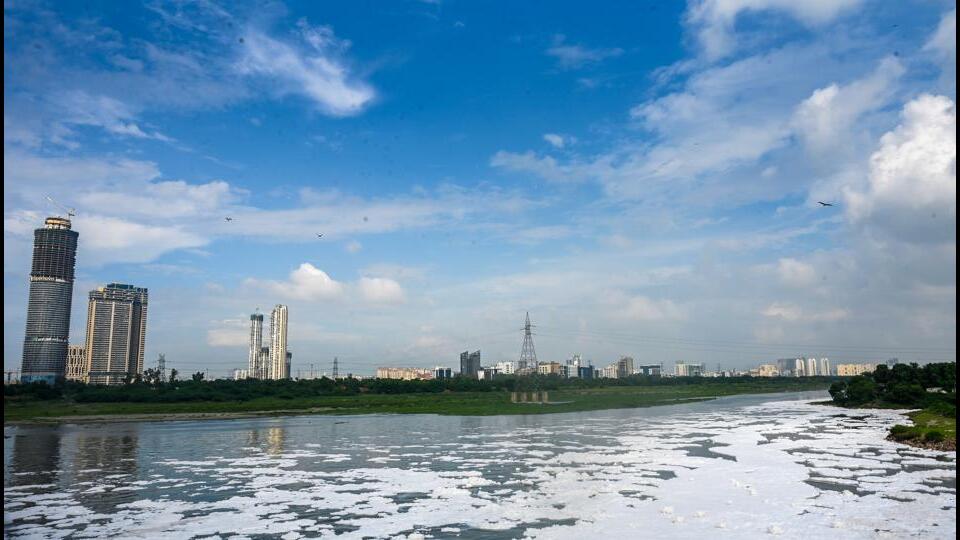
Even as Delhi gears up to upgrade and modernize its sewage treatment plants in an effort to clean the Yamuna, untreated discharge from the industrial areas remains a key concern, showed the latest monthly report of the Delhi Pollution Control Committee (DPCC).
Of the 13 installed common effluent treatment plants (CETPs) meant to process wastewater from 28 approved industrial zones, six have failed to meet Environmental Protection Agency (EPA) standards for key pollution markers.
The CETPs at Badli, Lawrence Road and GTK Road breached biochemical oxygen demand (BOD) norms, while plants at SMA Industrial Area, Narela and Okhla did not meet prescribed sulphide or sulphide-linked standards.
The maximum permissible BOD level for discharged water is 30mg/L. Against that benchmark, Badli recorded 35mg/L, GTK Road 38mg/L and Lawrence Road 33mg/L.
For sulphides, where the limit is 2mg/L, SMA logged 2.3mg/L, Narela 2.1mg/L and Okhla 2.5mg/L. CETPs in Jhilmil, Wazirpur, Naraina, Mayapuri, Mangolpuri and Nangloi were compliant, the DPCC report states.
CETPs are centralised units designed to collect and treat industrial wastewater from multiple small-scale industries operating in clusters, ensuring discharge meets environmental safety norms before being released into public drainage channels.
Delhi, which has 28 planned industrial areas, currently has only 13 CETPs. The remaining industrial pockets channel untreated waste into stormwater drains that ultimately empty into the Yamuna, sharply amplifying the river’s toxic load. The 13 CETPs are currently operating at less than half of their cumulative installed capacity, the report has revealed.
The report also details enforcement action. “Environmental compensation of ₹19.10 crore has been imposed by DPCC on 11 CETP societies and two CETP operators at Narela and Bawana from time to time in the past for violations and for not meeting prescribed standards,” the report said. However, the fines have triggered multiple legal challenges. “CETP societies of Okhla, SMA, Mayapuri, Mangolpuri, GTK Road, Naraina, Jhilmil and Lawrence Road have approached the court against these penalties, and cases are currently at various stages,” the report added.
The report on industrial pollution,which has been submitted to the Union water ministry, states that there are 28 approved industrial areas in Delhi which have 29,823 industrial units.
Of these 28 areas, the effluents from 17 areas is being diverted to the 13 CETPs while the remaining 11 industrial areas with 3,419 units do not have a CETP. The report notes that the overall capacity of the 13 CETPs is 212.3 MLD (million liters per day) but only 39.12% of their total capacity is currently being utilised.
A government official explained that besides the 28 approved industrial areas, there are 26 unplanned industrial areas which are non-conforming clusters of industries earmarked by the Delhi government for redevelopment.
These areas -- Anand Parbat, Shahdara, Libaspur, Peeragarhi, Khyala, Shalimar Village, Nawada, Rithala, Karawal Nagar, Mundka and Mundka Udyog Nagar, and Tikri Kalan, among others -- lack CETPs despite their dense industrial activity.
“Most of the industries in these areas are dry and there are not many water polluting industries.These areas lack infrastructure facilities and they are to be developed. Accordingly, the redevelopment of these 26 industrial areas is to be done by concerned local body and landowning agencies,” the Delhi government report states.
Bhim Singh Rawat, member of the South Asia Network on Dams, Rivers and People (SANDRP), said that industrial effluents are far more detrimental for the river health as compared to sewage as they also destroy the self cleaning capacity and ecosystem of the river and Delhi has completely failed to tackle this governance issue. “The industrial waste if dumped and mixed with sewage can not be treated by the STPs. All units should have smaller effluent treatment plants and CETPs should act as a larger backup for industries. In 2018-19, the government had said it would enforce zero liquid discharge policy for industries under which no effluent will be released but we have failed to implement it after six years. Chemicals in industrial effluents are far more lethal for the river ecosystem. Even our existing CETPs are not equipped to tackle heavy metals like lead and mercury.”
Rawat said: “Besides these approved and non-conforming clusters, a large number of industries are operating illegally from residential areas and agricultural land which are not even accounted for. We have also seen cases where effluents were being dumped in borewells contaminating ground water.”

Stay updated with all top Cities including, Bengaluru, Delhi, Mumbai and more across India. Stay informed on the latest happenings in World News along with Delhi Election 2025 and Delhi Election Result 2025 Live, New Delhi Election Result Live, Kalkaji Election Result Live at Hindustan Times.


