
 E-Paper



Learning will be hit, say students who will take board exams next year
For government school students, the situation is more challenging as the final examinations of class 9 and 11 students are yet to take place — effectively meaning that they are yet to start their Class 10 and 12 lessons.


The Delhi government’s order to continue teaching-learning activities in online and semi-online mode for the new academic session in view of the rising number of Covid-19 cases in the city has left students of Class 10 and 12 worried.
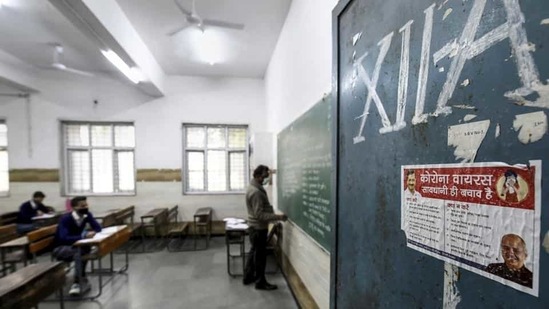
On Sunday, the city recorded over 4,033 cases with a positivity rate of 4.64%.
Students said that the recent order by the government, will impact their board examination preparations for next year and leave them at a disadvantage.
One such student, Vansh Arora, 15, a Class 10 student of The Indian School, said he too was looking forward to going to school as his seniors had been called back for practical classes and doubt-clearing sessions in January. However, the Delhi government latest circular, released on Thursday, left him “disappointed.”
“Unstable internet connection leads to constant disruptions, which impacts our concentration. Our teachers are trying their best to use various technological tools, but offline classes are more suitable for senior classes. Besides, there is little clarity if we will have the entire syllabus to study or if the reduced syllabus introduced last year will continue,” he said.
For government school students, the situation is more challenging as the final examinations of class 9 and 11 students are yet to take place — effectively meaning that they are yet to start their Class 10 and 12 lessons. Tanya Garg, 16, a student of Rajkiya Pratibha Vikas Vidyalaya, Shalimar Bagh, who will be appearing for her Class 11 final examination in May, said, “The classes in the previous years started in April. All my classmates are stressed because we will start our session in July this year and may have to cover the entire syllabus in a shorter duration of time, that too in online mode. I study using my smartphone and there are a lot of distractions during online classes. Offline classes would have helped students more.”
A primary concern among several students is whether the syllabus rationalization that was introduced by the Central Board of Secondary Education (CBSE) in July last year would continue. The CBSE, in order to mitigate academic losses caused by the Covid-19 pandemic and the ensuing lockdown, had reduced the syllabi of classes 9 to 12 by 30% for the academic session 2020-21, while retaining core concepts.
Sanyam Bhardwaj, controller of examinations of CBSE, said, “The syllabus rationalisation was a one-time measure only for the extraordinary situation last year, which caused academic losses. Last year, people did not have the methodology to conduct classes. But this year, schools are better prepared to conduct online classes so there may not be academic losses. So as of now, the entire syllabus is in place.”
Teachers at Delhi government schools are also concerned as many among their students would have to continue to rely on worksheets and WhatsApp lessons during a crucial academic year.
Vandana Mittal, who has been teaching Mathematics in Class 10 at Sarvodaya co-ed Vidyalaya in Rohini Sector 8 for the last two decades, said the teachers will be forming new strategies to help students.
“We have learnt something about the learning pattern of children in the last one year, even after they returned to school for two months. So the focus during online classes will be on core concepts, which we can explore once they come to school for offline lessons in a staggered manner. However, since we may have to cover the full syllabus, we expect the number of working days [in school lessons] to be more than last year. Otherwise, it will be difficult.”
Jyoti Arora, principal of Mount Abu Public School in Rohini, also expressed concern for students starting their class 10 and 12 in the 2020-21 academic session. “For these children, contact with teachers, peers and regular classes has been limited for over a year. It is an area of concern, because these students need a few physical classes with their teachers even if it is in smaller batches and in a staggered manner.”
Aprajita Gautam, president of Delhi Parents’ Association, however said it was better to hold online classes. “Most parents approve of the decision and are satisfied with the order considering the rising number of cases in the city,” she said.
Lalit Kant, former head of the epidemiology and communicable diseases department in ICMR, said, “Younger children don’t get the illness but are spreading the infection. Children in adolescent and higher age groups are spreading infection and also getting ill and we need to be careful about them. If we open schools for higher classes, chances of spread can increase.”

Stay updated with all top Cities including, Bengaluru, Delhi, Mumbai and more across India. Stay informed on the latest happenings in World News along with Delhi Election 2025 and Delhi Election Result 2025 Live, New Delhi Election Result Live, Kalkaji Election Result Live at Hindustan Times.


