E-Paper



Delhi MCD polls: Affluent areas call for better civic services
Preliminary data from the Delhi state election commission showed that the Capital 50% clocked a turnout of 50% in the civic polls on Sunday, a dip from 53.5% in the 2017 municipal elections and 53.3% in 2012, but still higher than the 43.3% in 2007.

 Prefer HTon Google


A critical shortage of parking, burgeoning encroachments and poor sanitation — voters in Delhi’s high-income neighbourhoods on Sunday said they were desperate for improved civic services in their areas.
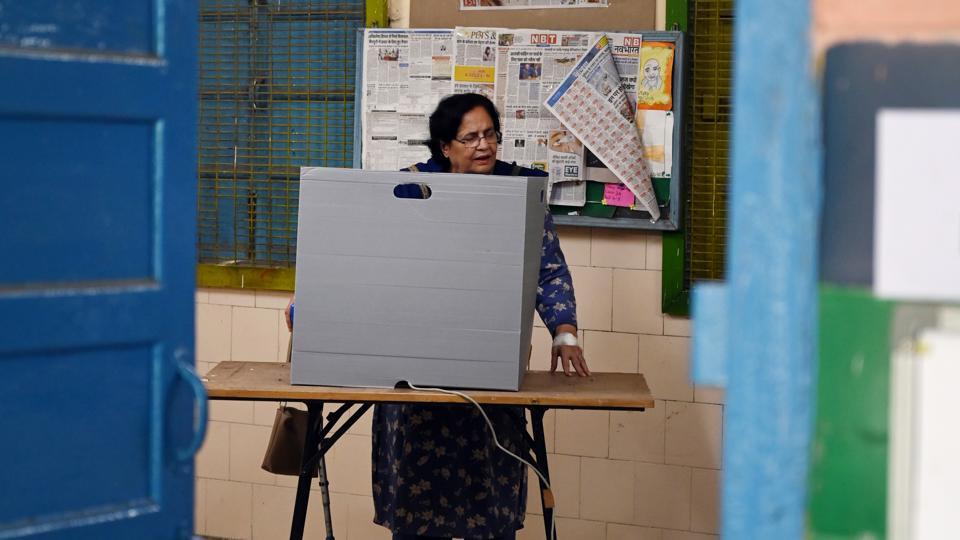
However, most polling booths in these localities were vacant for much of the day, as the Capital stepped out to vote in the Municipal Corporation of Delhi (MCD) elections, with officials saying that the eventual turnouts in these parts will be lower than the city’s overall average, as they historically are.
In south Delhi’s Vasant Kunj D Block, the polling station in a government senior secondary school saw around a dozen people waiting in the queue.
Rajen Ghalay, a 65-year-old voter, rued the routinely low turnouts in his ward.
“See, people do not seem to be bothered. Voting percentages in nearby slum clusters are much much better,” he said.
Another voter, Subhash Mehra (59), a businessman who owns properties in Vasant Kunj and Mehrauli, said municipal services in the latter left a lot to be desired.
“The level of civic services is much better in Vasant Kunj, but Mehrauli is deteriorating. No development is happening on the ground. The difference in residents’ aspirations also reflects in the voter turnout difference,” he said.
Preliminary data from the Delhi state election commission showed that the Capital 50% clocked a turnout of 50% in the civic polls on Sunday, a dip from 53.5% in the 2017 municipal elections and 53.3% in 2012, but still higher than the 43.3% in 2007.
However, every year, voting numbers in Delhi’s affluent neighbourhoods fail to keep up with the city’s overall figure.
For instance, in 2017, Vasant Kunj saw a turnout of 45.18%. It was 39.43% in 2012 and 25% in 2007.
The state election commission will release ward-wise voter turnouts for Sunday’s polls later this week.
Voting was especially slow in Vasant Vihar, with local polling officials at 2pm reporting a turnout of less than 25% in the voting station at The Shri Ram School. By that time, Delhi had clocked a turnout of 30%.
Keshav Garg, 74, a businessman, complained of stray cattle and the unregulated entry of street vendors.
“The private concessionaire appointed by the erstwhile south civic body was not working properly,” he added.
In south Delhi’s Greater Kailash-1, a polling station in the Kaultilya government senior secondary school had a moderately healthy footfall around 2.15pm.
RK Gupta, an elector at the booth, said there is a need for a more participative framework in the Delhi civic body.
“The idea of involving resident welfare associations seems a good one,” he said, referring to a poll pitch by the Aam Aadmi Party (AAP), which has promised to give residents’ groups “mini-councillor” status.
In west Delhi, Jitender Pal Singh (70), a resident of Punjabi Bagh West, said he was voting for change and better accountability from political parties.
“High-income neighbourhoods can sometimes be taken for granted and there is a need for better involvement of the local councillor. We are arranging to have our own waste lifted because MCD can be erratic,” he said.
Naveen Gupta, a 53-year old businessman from the same area, said street vendors had been gradually eating public spaces away, particularly outside neighbourhoods.
“There is very little space to walk now, and this is mostly down to street vendors operating on footpaths and sidewalks,” he said.
In west Delhi’s Rajouri Garden too, voters want councillors to focus on encroachments and improving waste management.
SM Manchanda, an 80-year-old resident of Rajouri Garden’s J Block said the local RWA was managing waste on its own through a private contractor.
“If the MCD was going from door to door, this would not be needed,” he said.
Umang Dwivedi (23), a first-time voter, said he came to cast his vote solely around the parking problem in the area.
“I find it difficult to park my car and most residents park on the main road, which eats up half of the driving space. The civic body can remove lots of encroachments outside houses, but they aren’t.” he said.