E-Paper



Most of Capital’s forest cover loss was in N-W, S-W Delhi: ISFR 2021
While “necessary” construction projects led to a slight decline in the two districts, saplings planted in the past are likely to have matured in both east and northeast Delhi, adding to overall forest cover, a Delhi forest department official said.

 Prefer HTon Google


Delhi lost just about 0.44 sq km of forest cover in the past two years, findings of the latest India State of Forest Report 2021 revealed, much of it in the northwest and southwest parts of the city. An expert, however, said data using satellite imagery could sometimes be misleading.
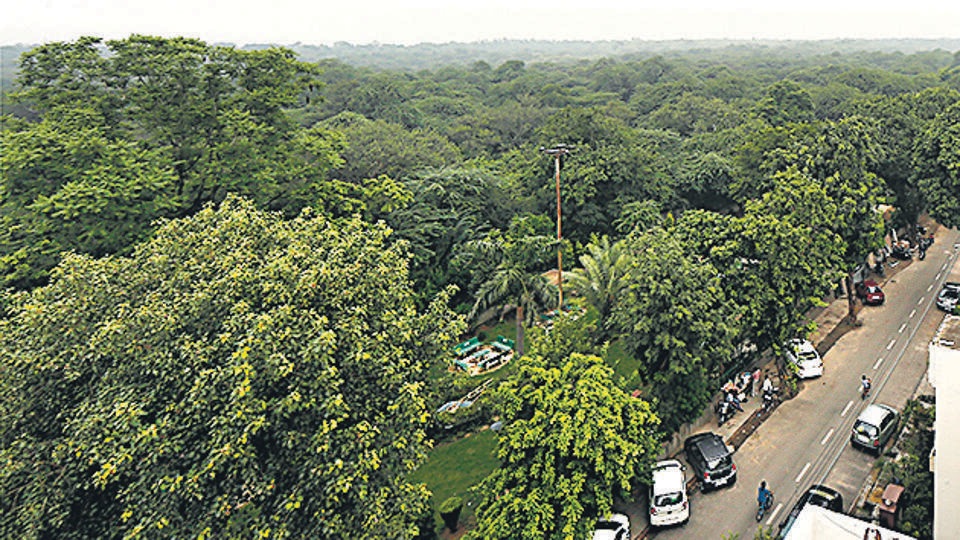
While 0.51 sq km of forest was lost in northwest Delhi, southwest Delhi lost 0.38 sq km of forest, the report said. There was an increase of 0.15 sq km of forest in northeast Delhi, followed by 0.13 sq km in north Delhi.
While “necessary” construction projects led to a slight decline in the two districts, saplings planted in the past are likely to have matured in both east and northeast Delhi, adding to overall forest cover, a Delhi forest department official said.
Among the districts, New Delhi had the most forest cover, with 47.06% (16.47sq km) of its 35 sq km area under some form of canopy. This included 1.69 sq km of very dense forest. The other two districts to have very dense forests were south Delhi (2.59 sq km) and southwest Delhi (2.35 sq km). The south Delhi district had a total forest cover of 34.27% at 84.64 of its 247 sq km area.
Tree canopy density is more than 70% in a very dense forest, according to the Forest Survey of India.
“If permission has to be given to fell trees for a construction project, for example Phase-4 of the Delhi metro, it will sometimes pass through a deemed forest, or a notified forest,” the forest official said, requesting anonymity. “In such cases, permission was given where the project was beneficial to the city and compensatory saplings were planted elsewhere.”
Delhi gained 18 sq km of tree cover in the last two years, according to the report. “Over the last 4 to 6 years, large-scale plantation has taken place and a number of trees have matured now, adding to the existing forest cover,” the forest official said.
However, prosopis juliflora (vilayati kikar), an invasive species, was the most dominant tree within Delhi’s reserved forests, the report found, followed by acacia lenticularis (babool). Outside Delhi’s forest areas, one in every 10 tree was found to be a neem (azadirachta indica) in urban Delhi, while vilayati kikar (29.52%) was the most dominant tree in Delhi’s rural areas.
Using satellite imagery may be misleading at times because the report, for instance, classified an area between the Safdarjung Tomb and Rajghat to have both a moderately dense forest and an open forest, pointed out Raj Bhagat, senior program manager, Geo Analytics for Sustainable Cities & Transport program at World Resources Institute India, a research organisation.
“Based on the density of the plantation, the area has a forest as per the definition, when in reality, this stretch of land does not have a forest,” bhagat said. “This leads to a fundamental question as to what constitutes a forest and whether ornamental and plantation trees can be called forests.”