
 E-Paper



60% of homes not getting water bills; DJB plans system overhaul
The gap has weakened the water bill amnesty scheme, with officials planning a billing overhaul and smart metering to prevent sudden, massive dues.

 Prefer HTon Google


If you have received a massive water bill after not getting one for months or even years, you are likely not alone. An internal assessment by the Delhi Jal Board (DJB) has found that nearly 60% of its consumers are not receiving physical water bills at their homes, exposing serious gaps in the utility’s billing system and prompting the Delhi government to plan a complete overhaul.
Officials said the flawed billing mechanism has also blunted the impact of the government’s water bill amnesty initiative, with many consumers unaware of their pending dues. Delhi currently has around 2.9 million registered water connections, a figure officials acknowledge is far lower than the actual number of households in the Capital.
Delhi water minister Parvesh Verma said on Thursday that the existing system is outdated and ineffective.
Also read: Delhi govt orders intensifying water quality checks to curb contamination | Latest News Delhi
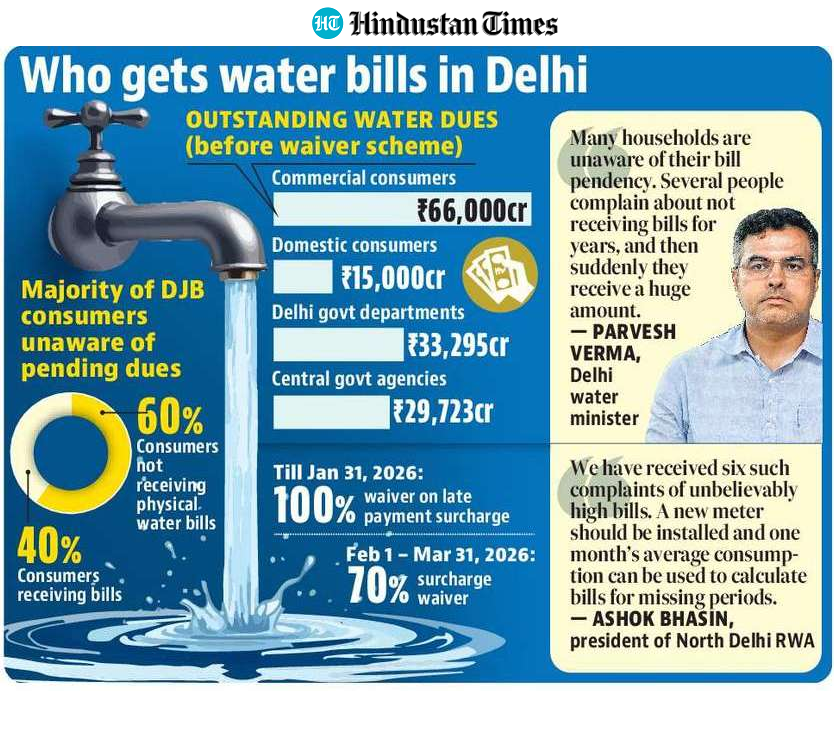
“We are planning to completely overhaul the DJB’s outdated billing system. Currently, only about 40% of registered customers are receiving physical water bills. Many households are unaware of their bill pendency. Several people complain about not receiving bills for years, and then suddenly they receive a huge amount. Hence, software changes are required to make the system more efficient,” Verma said, adding that timely and accurate billing was crucial for both consumer awareness and revenue recovery.
He said the response to the Late Payment Surcharge (LPSC) Waiver Scheme for domestic consumers had been satisfactory and that a separate one-time scheme for the commercial category could be rolled out within the next 15 days.
Also read: Disruption in water supply likely in South Delhi and North Delhi | Latest News Delhi
Officials said billing lapses were particularly acute in unauthorised colonies, where residents often continue to use water services without formal connections despite the presence of pipelines and other infrastructure.
Ashok Bhasin, President of North Delhi Residents’ Welfare Federation said that the problem of no bills coming for long periods followed by massive bills plagues large numbers of households. “We have recently received six such complaints of unbelievably high bills. People assumed that they may have zero bills under the 20KLD free water scheme. Before the elections, no bills were being received as local contract workers were not issuing bills but they are now coming cumulatively with massive amounts. People are making rounds of local ZRO offices with no relief.” He added that in such cases, as per the past practice, a new meter should be installed and one month’s average consumption can be used to calculate bills for missing periods.
The billing failures have also affected the implementation of the LPSC Waiver Scheme. A government official said that since bills are not being delivered properly, many consumers have struggled to understand their outstanding principal amount and the waiver applicable to them. The Delhi government introduced the LPSC scheme last year for domestic consumers, with plans to extend it to commercial users.
Under the scheme, domestic consumers are eligible for a 100% waiver of late payment surcharges if they clear their outstanding principal water dues by January 31, 2026. Payments can be made either in a lump sum or in instalments, but the waiver applies only after the full principal amount is paid.
Before the launch of the one-time waiver scheme on October 14, 2025, unpaid dues from commercial consumers stood at around ₹66,000 crore, while domestic consumers owed approximately ₹15,000 crore. Government establishments account for a significant portion of these arrears, with Delhi government’s own departments owing ₹33,295 crore and central government agencies responsible for ₹29,723.37 crore.
An official, speaking on condition of anonymity, said that under the domestic-only scheme, the DJB has so far received over ₹250 crore in principal payments, while rebates worth nearly ₹1,000 crore have been granted through the waiver of late payment surcharges.
A DJB report submitted to the central government flagged the low number of registered connections as a major concern. “Only 2.9 million households in Delhi have water connections, which is very low compared to the number of households and electricity connections. Most consumers are not submitting water bills, which is very worrisome. The billing system also has many flaws. There is a proposal to move to smart metering and a new bill collection system,” the report said.


Stay updated with all top Cities including, Bengaluru, Delhi, Mumbai and more across India. Stay informed on the latest happenings in World News along with Delhi Election 2025 and Delhi Election Result 2025 Live, New Delhi Election Result Live, Kalkaji Election Result Live at Hindustan Times.


