E-Paper



NGT-appointed panel calls for expanding of Delhi’s noise monitoring network
At present, only the Delhi Police can taken penal action, while agencies such as the Municipal Corporation of Delhi (MCD), New Delhi Municipal Council (NDMC) and Delhi Cantonment Board have no powers to take on-the-spot action against noise polluters.

 Prefer HTon Google


Mandated with devising a legal framework to regulate noise pollution in Delhi, the expert committee appointed by the National Green Tribunal (NGT) has submitted its final report, calling for the expansion of Delhi’s current noise monitoring network of 31 stations in proportion to the city’s area and population, while also suggesting that agencies other than the Delhi Police be empowered to act against violators.
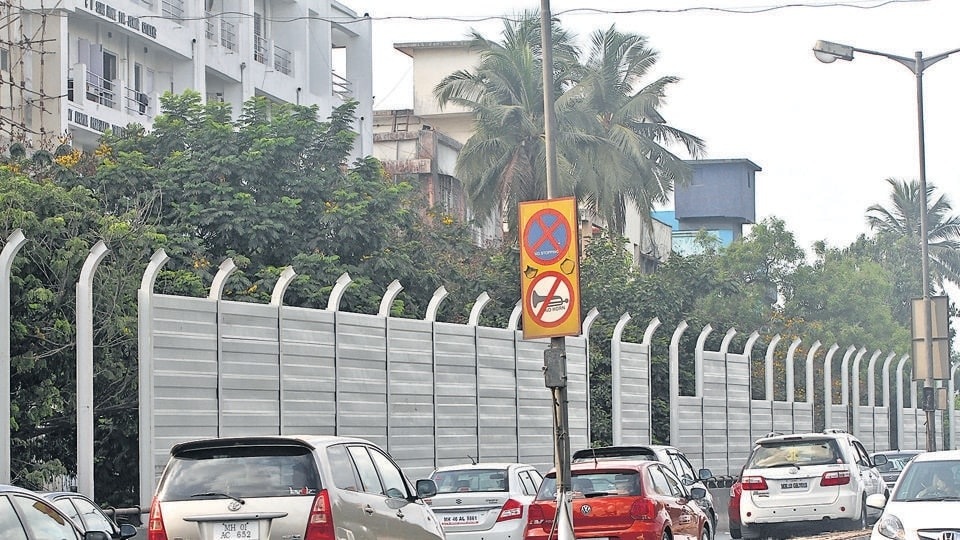
At present, only the Delhi Police can taken penal action, while agencies such as the Municipal Corporation of Delhi (MCD), New Delhi Municipal Council (NDMC) and Delhi Cantonment Board have no powers to take on-the-spot action against noise polluters.
The expert committee, headed by justice (retd.) SP Garg, has also asked for all agencies to increase the number of sound level meters (SLMs) currently available with them so that real-time measurement of ambient noise levels could take place.
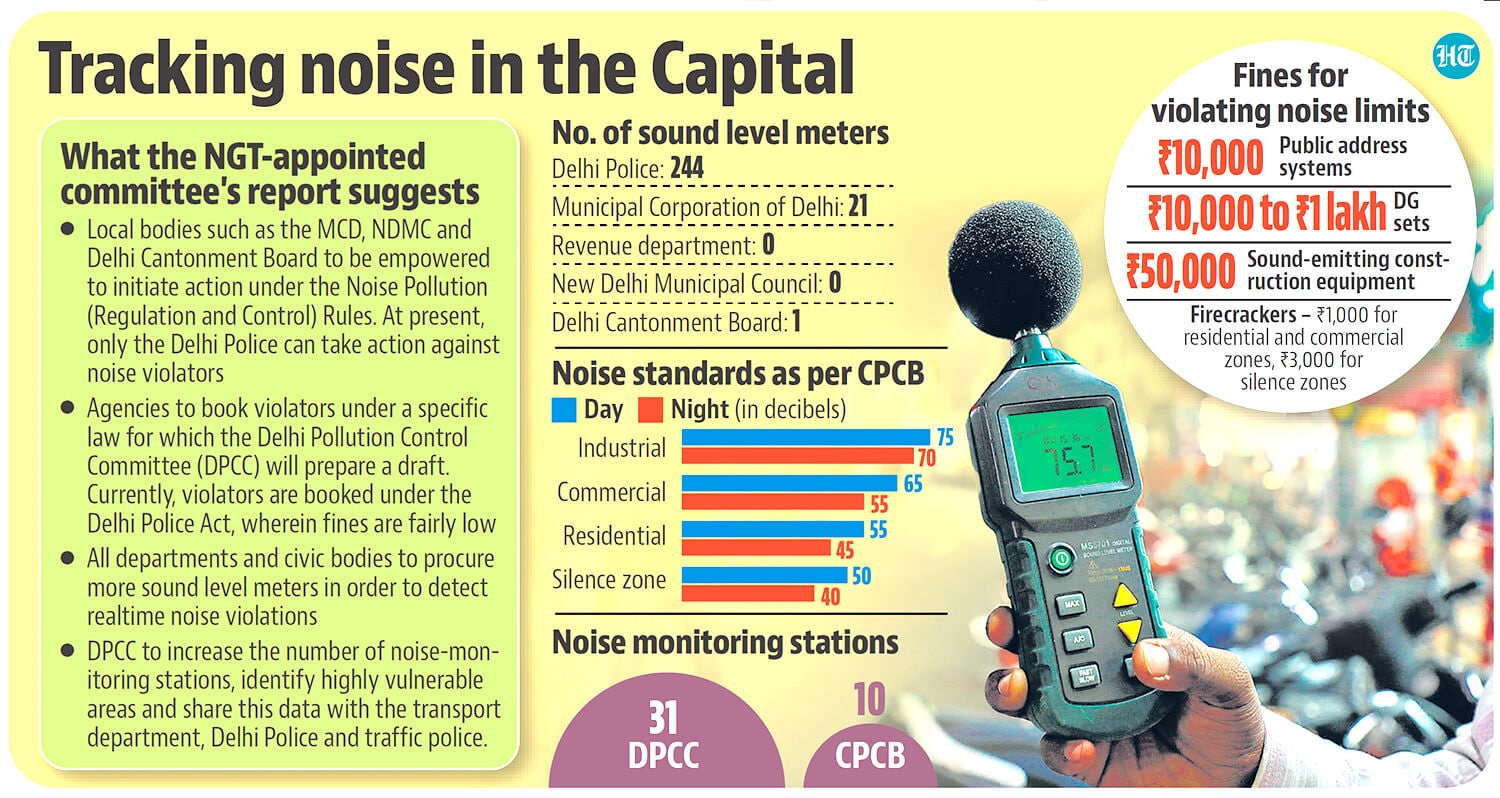
According to the report, while the Delhi Police has 244 SLMs, the now unified MCD has a total of 21 SLMs. The NDMC and the revenue department has none, while the Delhi Cantonment Board has only one.
“The committee has noted that the procurement of SLMs by the concerned local bodies has been highly unsatisfactory. Directions have been given to the local bodies to procure more SLMs at the earliest and the DPCC was directed to increase the number of monitoring stations proportionate to the area and population of Delhi,” the report, dated April 29, and put in the public domain on June 10, 2022, stated.
The report further stated that in addition to civic agencies and other local bodies not having punitive powers under the Noise Pollution (Regulation & Control) Rules, there is often confusion with regards to permissions being granted for the usage of loudspeakers. So, to clarify the situation, the environment department has been asked to issue a fresh notification.
“Though this notification is yet to be issued, Delhi Police has been designated as an ‘authority’ and directions have been issued that compliance of noise rules should be made mandatory in the prior permission (for using loudspeakers) and an undertaking may also be obtained,” the report said.
The permissible decibel levels in Delhi during the day range from 55 decibels (dB) in residential areas to 65dB in commercial areas and 75dB in industrial areas. During nighttime, these levels are supposed to be below 45dB in residential areas, below 55dB in commercial and below 70dB in industrial areas.
Violating these standards can warrant fines ranging from anywhere between ₹10,000 and ₹1 lakh, as per the Central Pollution Control Board’s noise norms, which has a fine of ₹10,000 for loudspeakers not adhering to the norms or operating without permissions, fines of ₹10,000 to ₹1 lakh for generator sets violating sound norms, a fine of ₹50,000 for sound-emitting construction equipments and a fine of ₹1,000 to ₹3,000 for firecrackers causing noise pollution.
The report also finds traffic to be the biggest contributor to Delhi’s noise pollution -- about 60% to 70% of the total pollution in the city is resulting from road traffic, it said. To mitigate that, an increase in green cover on the roadsides, smoother road surfaces and a reduction in speeds have been proposed by the committee.
It has also asked the DPCC to identify vulnerable areas where noise levels are high and to share this data with the police.
“DPCC should identify monitoring stations, which are highly vulnerable and susceptible on a random basis and share the monitoring data with local bodies, transport department, traffic police and Delhi Police for further action.”
A DPCC official, when contacted, said monthly noise pollution data from each noise monitoring station was already being shared with the Delhi Police for local-level action. “Our analysis of the data has revealed that noise from traffic, especially horns, is a major reason for the high decibel levels during the day. In silent zones, such as schools and hospitals, there may be traffic outside, which is difficult to act upon, but most violations at present are linked to the use of loudspeakers and pressure horns, which can be pin-pointed,” said the official, on condition of anonymity.
On the directions of the NGT in 2019, the Delhi government had launched a noise complaint web portal -- ngms.delhi.gov.in -- along with a helpline number - 155271.
D Saha, former head of CPCB’s air laboratory, said an expanding noise monitoring network, similar to a dense network of air quality monitoring stations, makes it easier to identify local hot spots across the city. “While traffic cannot be reduced, certain interventions can be taken in areas where the levels are exceedingly high,” he said.