E-Paper



Political row erupts over Delhi ‘O2 audit’
The report suggested there was “gross discrepancy” in recording the requirement of medical oxygen by 183 of Delhi’s hospitals, which asked for 1140MT as opposed to the actual requirement of 209MT.

 Prefer HTon Google


A political battle has broken out between Delhi’s Aam Aadmi Party (AAP) government and the Bharatiya Janata Party (BJP) over an interim report by a group under the Supreme Court-appointed panel to audit oxygen utilisation in the Capital -- even as questions remained about whether this version of the report was meant for submission to the court, and whether everyone in the panel had signed off on it.
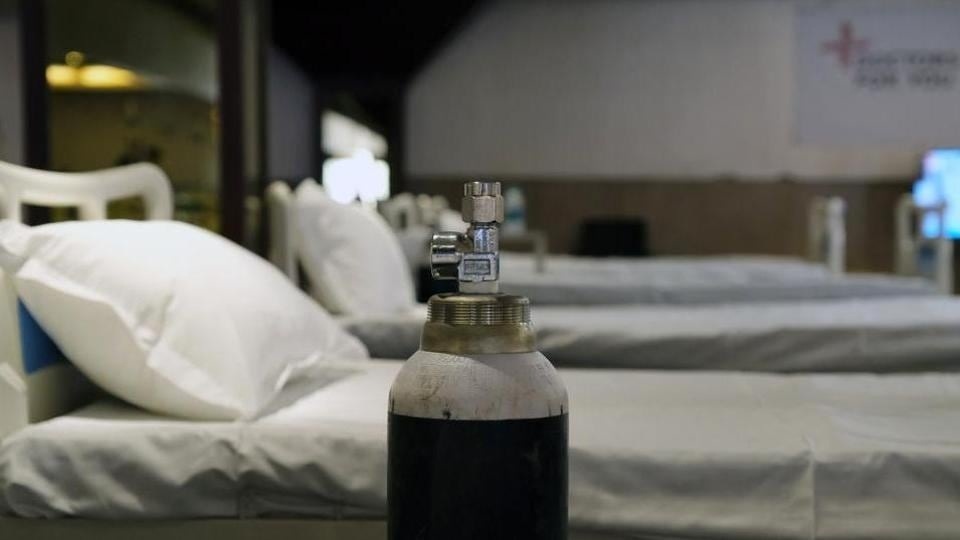
The report suggested there was “gross discrepancy” in recording the requirement of medical oxygen by 183 of Delhi’s hospitals, which asked for 1140MT as opposed to the actual requirement of 209MT. It also assessed the oxygen demand in a meeting on May 13 as 290-400MT at a time when representatives of the state government continued to seek 500MT of oxygen.
The Delhi government has said that the report was invalid, and its findings incorrect.
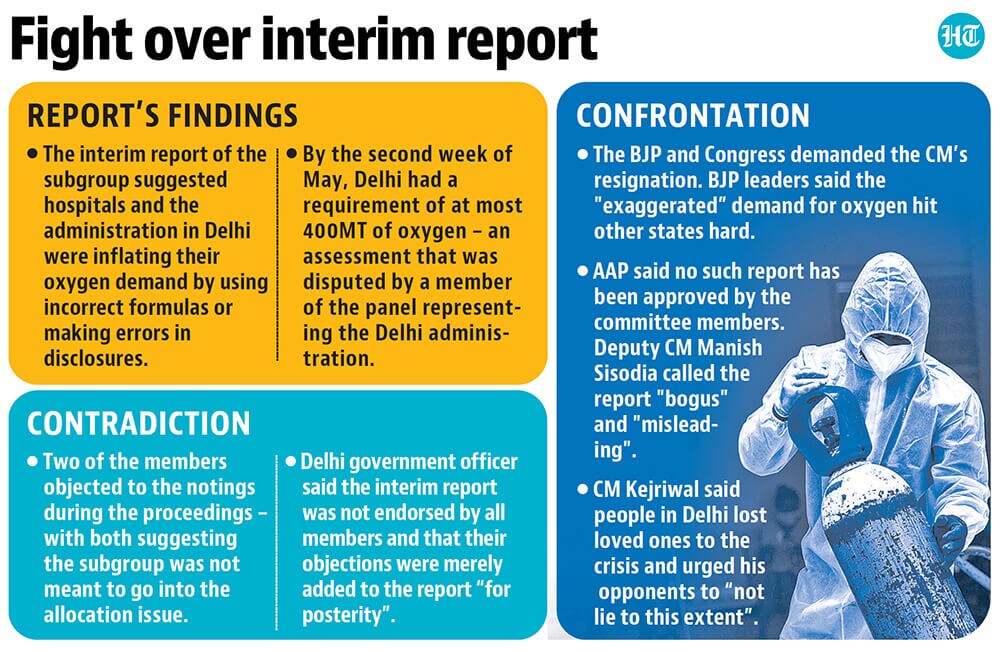
“The Supreme Court set up an oxygen audit committee. We spoke to members of the committee. They said that they have not approved or signed any report till now. Then what report is it? Where has it come from? I challenge the BJP to get a report which has been signed and approved by the oxygen audit committee,” Delhi’s deputy chief minister Manish Sisodia said.
The panel is technically a subgroup headed by AIIMS director Dr Randeep Guleria. Its other members are Subodh Yadav, a joint secretary in the Jal Shakti ministry, Dr Sandeep Budhiraja from Max Healthcare, Bhupinder S Bhalla, principal secretary, home, Delhi government, and Sanjay Kumar Singh, the controller of explosives at the Petroleum and Explosives Safety Organization (PESO).
Dr Guleria could not immediately be reached for comment. In the annexures attached with the report, two of the members — Dr Budhiraja and Bhalla — submitted discordant notes on the procedure and details of the findings. They also could not be reached for comments, but an internal note by Bhalla on Friday evening suggested some of the members of the panel had not approved the report.
The BJP was quick to respond to the leaked report. “It is unbelievable to see that Arvind Kejriwal and Delhi government politicised oxygen supply when Covid was at its peak. This is such petty politics. The data presented by Oxygen Audit Committee in the report is shocking,” party’s national spokesperson Sambit Patra said in a press conference.
“The demand for four times more oxygen was made by the Delhi government, due to which the oxygen tankers remained on the road. Had this oxygen been used in other states, many lives could have been saved. This is a heinous crime committed by Arvind Kejriwal ji,” he added.
Also read | Over 166,000 get Covid-19 jabs in Delhi as drive hits another one-day high
The Delhi CM shot back. “My crime — I fought for the breath of my two crore people. When you were doing an election rally, I was awake all night arranging for oxygen. I fought, pleaded to get oxygen for people. People have lost their loved ones due to lack of oxygen. Don’t call them liars, they are feeling so bad,” he said in a tweet in Hindi.
The controversial report marks the latest chapter in a long-running spat between the Union government and the Delhi government that has been fought across the Delhi high court and the Supreme Court. The Delhi government’s position, in the arguments in court, held against the backdrop of the raging second wave of the coronavirus disease pandemic in the Capital, was that the Union government was not allocating it enough oxygen. The Centre’s position was that Delhi’s needs were overstated and that the local government wasn’t able to lift supplies that had been allocated to it.
With social media filled with pleas of people and hospitals scrambling for oxygen, the courts stepped in. While the issue was resolved with Delhi finally receiving adequate oxygen, the apex court also constituted an expert panel to look into the usage of the precious medical commodity. The interim findings of the audit subgroup of that panel, now leaked, have become the subject of controversy.
In a response in the report itself, the Delhi government describes the panel’s proceedings as “a perfunctory desktop exercise, conducted hurriedly” which resulted in “erroneous entries and even more erroneous conclusions”. Terming the allegation of excess supply “incorrect,” it told the panel that it was “sad and shocking” that the panel arrived as “sweeping conclusions” without lending it an opportunity to explain.
The subgroup was constituted by the Supreme Court-appointed 12-member national task force. The task force was set up by the apex court on May 8 when the bench, led by justice Dhananjaya Y Chandrachud, called for an immediate oxygen utilisation audit in Delhi. At the same time, the bench also directed that Delhi should get 700 metric tonne (MT) of the life-saving medical input every day despite the Union government’s reluctance.
The interim report -- HT has seen a copy -- cited a study by PESO and responses, gathered via Delhi government officials, from 183 hospitals in the national capital regarding their oxygen requirement to observe that while this data claimed actual consumption of oxygen as 1,140 MT on May 12, it turned out to be just 209 MT after correcting faulty reporting by four city hospitals.
If the Centre-recommended formula for oxygen allotment was employed, the requirement would have been 289MT and with the Delhi government’s formula, it would have been 391 MT, stated the report.
It noted that four hospitals, Singhal Hospital, Aruna Asaf Ali Government Hospital, ESIC Model Hospital and Liferays Hospital erroneously claimed extremely high oxygen consumption with very few beds, “leading to extremely skewed information and significantly higher oxygen requirement for entire state of Delhi”.
HT has reached out to the four hospitals and while representatives of two of them did not offer a comment, the others said they did not use liquid medical oxygen and were unaware of what was claimed in the report.
The subgroup’s report was submitted to the court by the Union health ministry. An official, who asked not to be named, said the health ministry had no role in the drafting and only “played the role of a messenger”. “A committee cannot directly approach the Supreme Court to submit the report. It was submitted to the health ministry, which, through its appointed nodal officer for the purpose, helped place it before the Supreme Court,” the official said.
This person said the committee decided its own methodology and designed the necessary template “that they approached hospitals directly to fill”.
The panel met seven times between May 11 and May 21.
The panel cited a PESO study that contended that actual requirement of Delhi during the peak of second Covid-19 wave was much less than what was demanded, making other states such as Rajasthan, Uttar Pradesh, Haryana, Himachal Pradesh, Punjab, Uttarakhand and Jammu and Kashmir “suffer badly”. The report, prepared after carrying out a study between May 5 and 11, also contended that AAP government was neither auditing its usage of oxygen nor was assessing its realistic demand.
The interim report attached documentary replies of the Delhi government to the findings of the subgroup as well as to the PESO report.
Disagreeing with the formula used by the subgroup to compute oxygen requirement, the Delhi government, in its communication to the panel, said: “The finding that Delhi received excess oxygen is incorrect. Delhi has never received excess oxygen. Only on May 5, it received 730 MT which was more than its requirement. Moreover, the oxygen requirement is dynamic and as soon as Delhi’s requirement decreased, a proactive communication was sent to the Central government restating its current requirement.”
In another letter, it added: “The manner in which the proceedings of the subgroup have been conducted, suggests that the purpose of proceedings was to justify a preconceived and predetermined conclusion and narrative, to recommend a lower quantity of a LMO to Delhi, and to further portray an impression that the assessment by the GNCTD before the Hon’ble High Court of Delhi and the Hon’ble Supreme Court was exaggerated or not genuine.”
The Delhi government also disputed the subgroup’s assumption that only 50% of non-ICU beds used oxygen which was not correct in the context of a respiratory disease like Covid-19. “The (audit) committee needs to begin with the GNCTD calculation of 568 MT, which is the scientifically modelled and data-driven estimate (arrived at by the Delhi government) and then points out where it feels that our requirements could be higher or lower. This fact cannot be determined through an armchair paper exercise but through an actual survey on the ground,” it said.
It also disputed a minute of the meeting on May 13 when Guleria expressed “anguish” over the fact that the oxygen tankers in Delhi were not able to upload oxygen and were lying idle since oxygen tanks in various hospitals were completely filled. The Delhi government called Guleria’s observations “strange”, pointing out that several SOS calls had been received for tanker supplies for his own institutions, AIIMS-Delhi. “It is only when the system has stabilised that this strange narrative is finding place in the committee of experts,” it said.
The Supreme Court is yet to hear this matter after May 6 and the court website, as on Friday, also did not indicate any next date of listing.
An internal statement, signed by Bhalla, later refuted excerpts from the subgroup report that was leaked, and said the data on LMO consumption was a mere collation from hospitals and “was not claimed by government of NCT of Delhi”.
The statement, which was accessed by HT, listed several other recommendations that Bhalla made as a member of the subgroup and cited examples to support Delhi’s position that the city needed more oxygen (such as supplies for people in home isolation). “Hence, the total oxygen consumption for Delhi was 550 MT around 12-13th May 2021, about 10 days after the peak of Covid-19 in the Capital,” he said. Dr Naresh Trehan, also a part of the 12-member overarching national task force, said he was unaware of the findings of the Delhi audit as the committee directly submits its reports to the Supreme Court without any overview from the National Task Force. “If Guleria did it, it must be reliable,” he said.
(With Inputs from Rhythma Kaul, Anonna Dutt, Abhishek Dey and Malavika PM)