
 E-Paper



‘Pre-monsoon’ dust storm shrouds Delhi
The storm pushed PM10 levels—particulate matter 10 microns or less in diameter—to dangerously high concentrations

 Prefer HTon Google


A sudden burst of strong winds late Wednesday night carried dust from the Thar desert into Delhi, plunging the Capital and its surrounding areas into a 12-hour apocalyptic haze that blanketed the city until early Thursday afternoon. The dense cloud of dust sharply reduced visibility, left millions gasping for breath, and triggered a massive spike in pollution levels, according to the India Meteorological Department (IMD).
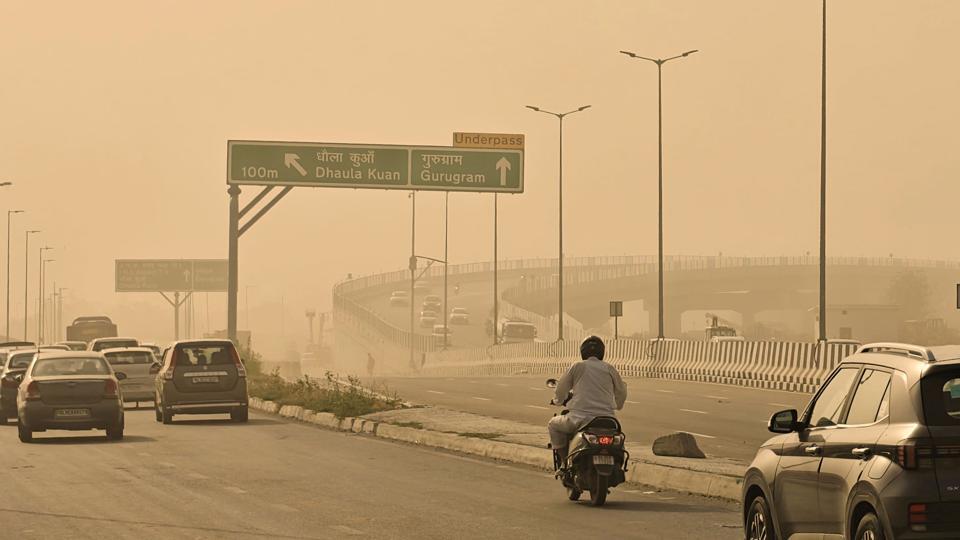
The storm, which again caught forecasters and residents off guard, pushed PM10 levels—particulate matter 10 microns or less in diameter—to dangerously high concentrations. Between 11pm and noon the next day, Delhi’s only two functioning air quality monitors recorded PM10 levels consistently hovering around 1,000 micrograms per cubic metre (µg/m³), more than 10 times the safe limit. At one point, levels at Najafgarh shot up to 2,969µg/m³.
Visibility dropped precipitously—from 4,500 metres at 10pm to just 1,200 metres by 11.30pm—and remained poor into Thursday morning, with wind speeds falling to a near-calm 3-7 km/hr, allowing the dust to linger over Delhi-NCR.
Senior IMD scientist RK Jenamani said winds of 30-40 km/hr raised dust from the arid Thar region, which was then carried across Rajasthan, Punjab, and Haryana into Delhi. “The wind then slowed significantly, trapping the dust in the air. Visibility at Safdarjung and Palam remained between 1,200 and 1,500 metres,” he said.
An IMD statement explained that a strong north-south pressure gradient over northwest India had caused dust-raising surface winds of 30-40 km/hr from the night of May 14 to the morning of May 15. “This led to dust advection from west Rajasthan to Delhi NCR via north Rajasthan, south Punjab, and south Haryana,” the statement noted.
“This blanket of dust was the result of dust storms that developed over parts of Rajasthan, combined with strong south-westerly winds sweeping across the region. These winds, originated from the arid Thar desert and brought large volumes of dust into as far as Delhi,” said Mahesh Palwat, vice president of private weather forecaster, Skymet. The Indira Gandhi International Airport reported its lowest visibility—1,200 metres—during this period.
By 1pm on Thursday, visibility had improved to around 4,000 metres as the dust drifted eastward.
Krishna Mishra, another IMD scientist, confirmed that conditions had begun easing by the afternoon.
Data from the Delhi Pollution Control Committee (DPCC) showed a dramatic spike in PM10 levels across its 24 ambient air quality monitoring stations. The highest hourly reading was recorded at Najafgarh, with 2,969µg/m³ at 8am, followed by 2,396µg/m³ at Ashok Vihar at 9am. The 24-hour safe standard for PM10 is just 100µg/m³.
This spike pushed Delhi’s average Air Quality Index (AQI) to 292 (‘poor’) by 4pm Thursday—more than double the AQI of 135 (‘moderate’) recorded the previous day. The last time pollution reached this level was on May 4, when the AQI was 232.
Abhishek Kar, senior programme lead at the Council on Energy, Environment and Water (CEEW), said such storms are common in pre-monsoon months. “These are natural sources of pollution. The focus now should be on protecting people from exposure. Authorities must use forecasting tools like the Air Quality Early Warning System and IMD bulletins to warn citizens early so they can take precautions like wearing masks,” he said.
Temperatures in the city also remained high, with the maximum recorded at 40.6°C, a degree above normal and slightly higher than Wednesday’s 40.4°C.
For Friday, IMD has forecast very light rain, thunderstorms, and gusty winds of up to 50 km/hr during the night. Day temperatures are expected to hover between 40°C and 42°C.
The toxic haze quickly became political fodder. Former chief ministers Arvind Kejriwal and Atishi of the Aam Aadmi Party (AAP) blamed the BJP-led Delhi government for worsening air quality. Kejriwal, citing a private app that recorded AQI at 500, posted on X: “Air pollution was never this bad during AAP regime at this time of the year.”
Atishi said that the CPCB’s own data showed Delhi’s AQI on May 15 never exceeded 243 between 2022 and 2024. “Where is the environment minister now?” she asked.
Delhi environment minister Manjinder Singh Sirsa hit back, blaming the AAP for the Capital’s environmental crisis. “The AAP should be renamed ‘Aage Aaye Pollution’ party for how they singlehandedly contributed to Delhi’s pollution and waste crisis. While they let pollution grow unchecked, we’re working to eliminate it,” he said.


Stay updated with all top Cities including, Bengaluru, Delhi, Mumbai and more across India. Stay informed on the latest happenings in World News along with Delhi Election 2025 and Delhi Election Result 2025 Live, New Delhi Election Result Live, Kalkaji Election Result Live at Hindustan Times.


