
 E-Paper



‘Satish Gujral 100: Architecture’ exhibition opened to public in Lajpat Nagar
On January 30, his son, Mohit Gujral opened the doors of Gujral House — as this building on Feroze Gandhi Marg is called — to the public to commemorate his father’s centenary year. ‘Satish Gujral 100: Architecture’ highlights 12 projects, including cultural spaces, embassies and institutions, using drawings, models, photographs and archival documents to demonstrate a little-known aspect of the polymath’s oeuvre.


Overlooking narrow lanes of the Lajpat Nagar market lies an elegant exposed-brick bungalow that sits calmly in the midst of surrounding bustle. Few, who have paused outside its façade would be aware that the structure was designed more than five decades ago by Satish Gujral as his home and studio.
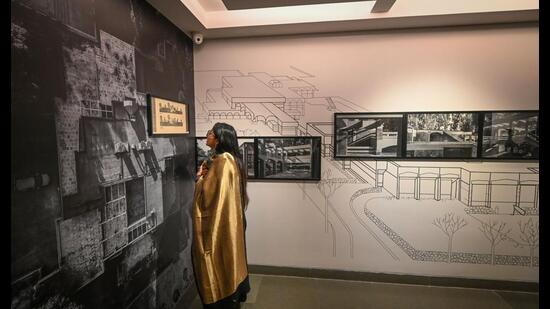
On January 30, his son, Mohit Gujral opened the doors of Gujral House — as this building on Feroze Gandhi Marg is called — to the public to commemorate his father’s centenary year. ‘Satish Gujral 100: Architecture’ highlights 12 projects, including cultural spaces, embassies and institutions, using drawings, models, photographs and archival documents to demonstrate a little-known aspect of the polymath’s oeuvre.
The shift from residence and artist studio to cultural space was long-imagined and fated, Gujral said.
“My father and I had spoken about opening the house as a space for people, as an exhibition or a place for ideas and conversations. He loved the idea. We started working on this after my mother passed away two years ago,” Gujral, an architect, said.
Satish Gujral, a Padma Vibhushan awardee and brother to former prime minister Inder Kumar Gujral, died aged 94 during the Covid-19 pandemic in 2020. Born on December 25, 1925, Satish Gujral was not only a renowned artist, sculptor and muralist but also designed many iconic buildings through the course of his storied career. His own home, built with the help of a much younger Raj Rewal, stood as an icon of his practice: monumental, grounded and emphatically human. It was both dwelling and artwork that shape-shifted to accommodate the needs of its residents, and expanded to include other creative minds who found themselves drawn to Satish Gujral’s side.
Growing up in the house, Gujral added, felt less like living in a conventional family home and more like inhabiting an ever-shifting studio.
“I’ve not really had a fixed bedroom. At least five different spaces have been used as a dining area at different points in time. We lived like nomads in an artistic world. One fine day he would say, this room is a studio, and the entire setup of that room would move somewhere else,” he said.
That ethos now shapes the exhibition. Spread across the basement, ground floor, upper ground and first floor, each room focuses on a key phase or project from Satish Gujral’s architectural journey.
The exhibition begins in the basement, where early works and murals from the 1930s to the 1960s establish Satish Gujral’s artistic inspiration. Wall texts trace his formative years in Mexico, spent around the likes of artist Diego Rivera and poet Octavio Paz, where he encountered Latin American muralism and absorbed the idea that walls were not boundaries but carriers of memory and narrative. This sensibility would later define his architecture, where brick and concrete are shaped as sculptural mass rather than surface decoration.
“The family had an exact idea of what was expected from the space. The execution was the difficult part as we had to ensure minimum damage to the walls with nails or any other materials. The house is over 60 years old,” said Reha Sodhi, who has curated the exhibition for the Gujral Foundation.
The exhibition’s emotional centre is the large family living room on the first floor, a space that both Gujral and Sodhi identified as the house’s beating heart. With floor-to-ceiling glass windows that open to the lawn, the room has always blurred the line between indoor and out. A curved ceramic wall anchors the space, a major contribution by Gujral’s wife, Kiran Gujral, whose work in ceramics deeply influenced his architectural vocabulary. On display here are Satish Gujral’s murals on CMC Hyderabad, a building that he also designed.
Through the house, which also includes a ground and upper-ground floor, visitors encounter detailed studies of landmark projects like the Ambedkar Sthal in Lucknow, the Modi House and Factory in Modinagar, Uttar Pradesh as well as the Belgian Embassy in New Delhi, which is recognized as one of the 1,000 best buildings of the 20th century. A floor plan of Gujral House is also displayed to underscore how the building was conceived as a living sculpture, its levels split, spaces staggered and circulation deliberately fluid.
One room is dedicated to Gujral’s international work, including projects in Riyadh and Saudi Arabia from the 1990s, while another examines his association with UNESCO in New Delhi in the 2000s.
When the exhibition closes the house will not retreat into privacy again. Gujral said. “This will continue as a space for ideas, discussions, forums and creativity, exactly the way my father always imagined it,” he said.
The exhibition is free to the public and open Tuesday to Sunday, 11 am to 7 pm (Mondays closed), at Gujral House, 16, Feroze Gandhi Road, Lajpat Nagar III, New Delhi. It closes on March 23. A major retrospective of Satish Gujral’s artworks is also on display at NGMA, Delhi till March 30.
Stay updated with all top Cities including, Bengaluru, Delhi, Mumbai and more across India. Stay informed on the latest happenings in World News along with Delhi Election 2025 and Delhi Election Result 2025 Live, New Delhi Election Result Live, Kalkaji Election Result Live at Hindustan Times.


