
 E-Paper



Spate of burglaries the latest bane for Delhi
In this series, HT puts the spotlight on the Capital’s biggest crime challenges, and explores how the city can be made safer

 Prefer HTon Google


“You are a father of two. You have no criminal record. Why did you decide to rob and murder her?” a Delhi Police officer posted at the Vasant Vihar police station on Monday asked Suraj Budhe, 36, arrested for the July 6 murder of Kitty Kumaramangalam, 70.
Budhe told the police that he joined his two friends in the robbery and murder -- laundryman Raju Kanojia, and another friend Rakesh Raj -- to cover losses that he suffered in his used car business due to the lockdown.
The three men entered her house in Vasant Vihar’s A Block, smothered her to death with a pillow, and fled with cash and jewellery. Kumarmangalam, 70, was the wife of former Union minister PR Kumaramangalam.
Less than 24 hours later, about 17km away, in west Delhi’s Uttam Nagar, five men entered the house of a businessman and held the family hostage. CCTV footage of the Uttam Nagar robbery, showed the five armed men inside the flat, holding guns, pointing them at family members, tying the hands of a man, and ransacking the house while a four-year-old child played on a sofa.
In Tilak Marg, the police this week arrested a man involved in at least six burglaries in the New Delhi area over the past few months. Sonu Kumar, 28, told police that he quit crime and started working as contractual labour in Uttarakhand, but returned to committing burglaries after failing to find work due to the lockdown.
The spate of burglaries has struck fear in the Capital’s residents, especially because many of the crimes are being committed by people who lost jobs during the pandemic, or suffered losses in the lockdown. As a result, they are not in police records and difficult to track.
Though police do not maintain specific data, several senior police officers said the suspects caught for many of the recent burglaries took to crime after losing their livelihood in recent, pandemic-hit months.
Fear in colonies
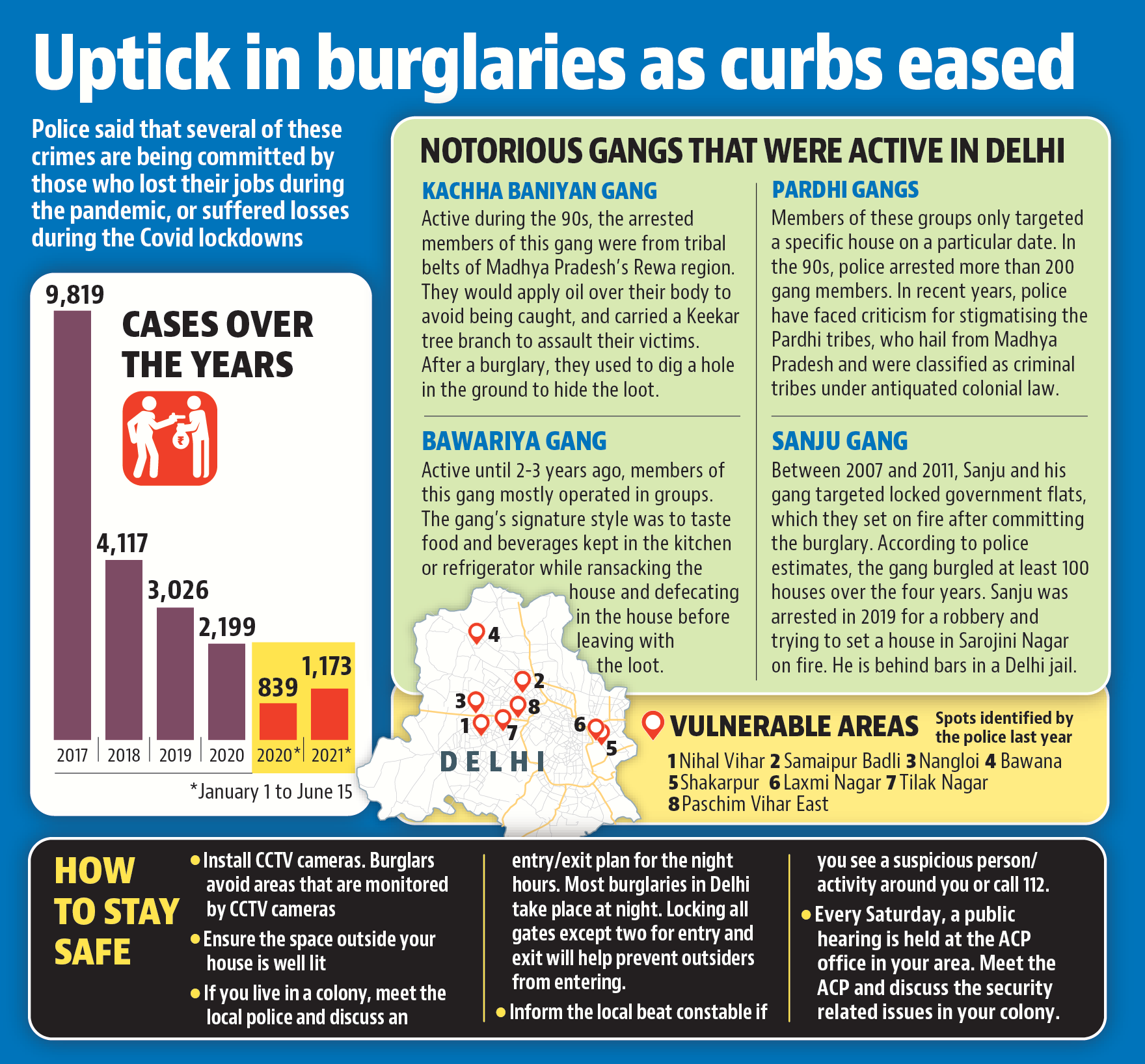
In the first six months of 2021, 1,173 burglaries were reported, 40% more than the corresponding period in 2020. In all, 2,199 cases were reported last year, 3,026 in 2019 and 4,117 in 2018.
The burglaries have left Resident Welfare Associations (RWA) worried, especially because many criminals break into houses during the afternoon hours, and don’t hesitate even if the home is occupied.
“During the afternoon, often women, children and even senior citizens stay alone at home, and we fear for their safety. We have requested local police stations to conduct some safety workshops for residents to tell them ways about what to do when a stranger knocks on the door and insists on coming inside, even if it is a trusted service provider or a known person,” said Ramesh Kukreti, general secretary of the north Delhi wing of RWA Unity, a group of resident welfare bodies.
At Shalimar Bagh -- where five men broke into a businessman;s house, held his 24-year-old daughter hostage and robbed cash and jewellery worth over ₹20 lakh on Tuesday -- residents installed barbed wires on the boundary wall and hired more security guards.
BS Vohra, president of the Joint Forum East Delhi RWAs, said despite the lockdown in April, his team installed barbed wires on the gates and boundary walls to stop outsiders from entering the colony.
“After Covid, many people from economically weaker sections do not have money and are willing to go to any extent. Residents are living in fear because these men are now not afraid to attack and kill you,” said Vohra.
Experts say rising burglaries by younger people who have lost jobs or suffered crippling losses in business mirrors a global trend caused by economic devastation due to the pandemic. “Many youngsters who were on the edge financially, probably doing odd jobs that earned them some livelihood, are now unemployed with the burden of supporting large families. The government should expand social welfare net for financially weak families; work on employment generation, and skill development programmes,” said Murugan Palanichami, a sociologist from the University of North Carolina.
Former Delhi Police commissioner Ajai Raj Sharma, who headed the force between 1999 and 2002, said economic factors are always an important reason for crimes such as break-ins and burglaries.
“We keep reading reports of jobless youngsters turning to crime. Not all out of job people resort to crime but even if a few of them have then, police have a tough job at hand. These people do not have crime records. It will be like finding a needle in a haystack,” he said.
HT spoke to several Delhi Police officers who agreed with Sharma’s assessment.
“It is easy to arrest a hardened criminal or bust an organised gang, but it is difficult to trace a person who has committed only one or two crimes. It is likely that a burglar steals a big amount in one heist and then goes underground. Maybe he/she decides to stop,” said an officer from crime branch who asked not to be named.
Police agree that apart from crime fighting, social measures are needed to arrest the fresh rash of burglaries.
“We are an enforcement agency but we run the YUVA programme to stop vulnerable youngsters from taking to crime. We run training programmes by tying up with different institutes to skill train such youngsters. Police has trained over 10,000 unemployed youth,” said deputy commissioner of police Chinmoy Biswal.
He said the police had increased road patrols, random checks, pickets, mobile teams and emergency response vehicles. “Beat constables across the city coordinate with security guards under the Prahari scheme to make the colonies safer at night. Separately, our teams also monitor the activities of some suspected habitual burglars. There is a collection of criminal intelligence and surveillance on the activities of criminals has been stepped up. Delhi police has launched a crackdown on burglars, which is why the cases have consistently dropped over the years,” he said.
Gangs of the past
The phenomenon of unorganised burglaries by first-time criminals is fairly recent in Delhi, which was terrorised by gangs synonymous with violent crime till a decade ago.
Notorious among them were the kachha baniyan gangs from Madhya Pradesh. Dressed in boxers and vests, the gang members would break into homes, steal, eat food from the refrigerator; and sometimes brutally beat their victims to death.
“There were multiple murders across the city. It was done by gangs from Madhya Pradesh. TV shows were made …Delhi residents were terrified. These gangs would beat residents to death if anyone saw them in the act. They wore only vests and underwear, and oiled their bodies so that they could not be caught,” said retired assistant commissioner of police Narendra Chawla.
“The fear among residents in south Delhi was such that people started hiring security guards, but even the guards were also afraid to do their jobs,” he said.
In the space of two days in December 1998, the gang murdered two elderly couples in south Delhi’s Saket and Malviya Nagar, prompting then Union home minister LK Advani to take up the case.
The last recorded crime by the kachha baniyan gang in Delhi was in July 2014, when five men murdered a woman in Narela, grievously injured her mother, and stole their belongings.
Also infamous were the Pardhi gangs, who only targeted a specific house on a particular date. “Burglars today do not have a modus operandi. Anyone in need to money could do it when they feel like it,” said an officer. Chawla said in the 90s, more than 200 gang members were arrested.
In recent years, police have faced criticism for stigmatising and targeting the Pardhi tribes, who hail from Madhya Pradesh and were classified as criminal tribes under antiquated colonial law. They are classified as denotified tribes and fight economic and social marginalisation.
In the early 2000s, a new crop of gangs emerged. Notorious among them was Sanju’s burn-and-burgle gang that hit at least 100 government flats in south Delhi and set them on fire between 2007 and 2011. “Sanju mostly targeted locked government flats and set the house on fire after the burglary. It was his signature,” said a Delhi Police inspector who asked not to be named. Sanju was arrested in 2018.
Social relations upended
The recent spike in burglaries underlines a pervasive loss of trust that has upended social relations and left even traditionally safe parts of the city vulnerable. No case highlights this phenomenon more than Kumaramangalam’s grisly murder.
Last year, Delhi Police conducted a survey and divided the city into red, blue, green and white zones in decreasing order of their vulnerability to burglaries. In the red zone were places such as Nangloi and Samaipur Badli, which recorded over 40 cases each in the first eight months of the year.
In the white zone, and marked as the safest parts of the city was Vasant Vihar, where Kumaramangalam was murdered.
One of her alleged killers, laundryman Kanojia, was a regular at her house. He suffered losses during the lockdown, needed to make a quick buck, and found two others who were ready to help him.
“If a trusted service provider, who was working in the locality for over five years can turn rogue, then who can the residents trust. No matter how many gates or security cameras we install, how do we ensure that we are not going to be targeted?” asked Kumaramangalam’s neighbour, Suresh Goel.


