
 E-Paper



Storm from northwest pollutes Delhi air, AQI at very poor
Agencies attributed this sudden spike in AQI to a convective storm in northwest India causing local upliftment and long-range transport of dust.

 Prefer HTon Google


Delhi’s air quality deteriorated into the “very poor” range on Wednesday, recording an air quality index (AQI) reading of 322 as per Central Pollution Control Board’s (CPCB) daily 4pm bulletin – the highest for Delhi since the 346 reported on February 1 and up from the 215 (poor) reported a day ago.
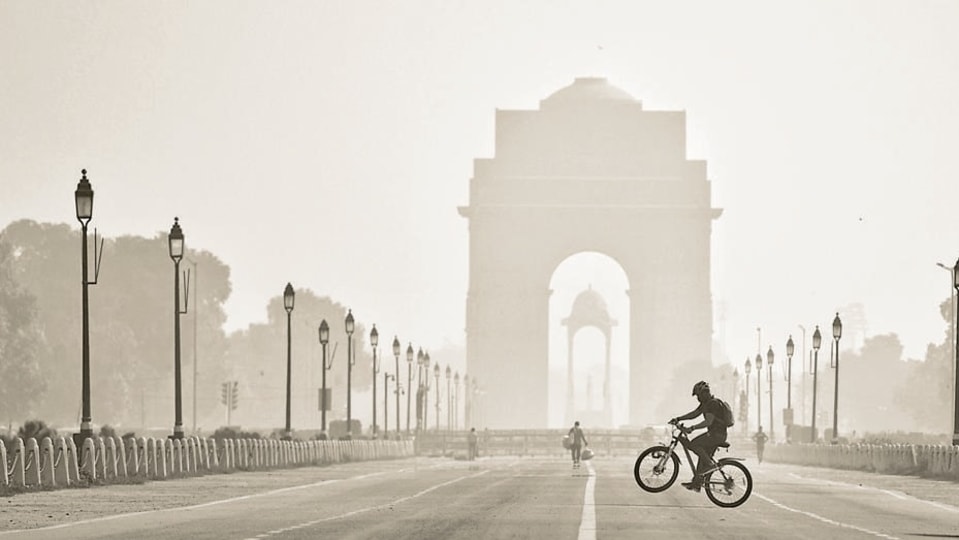
Agencies attributed this sudden spike in AQI to a convective storm in northwest India causing local upliftment and long-range transport of dust. While the impact of this storm receded by evening, forecasts show another such dust storm is likely to influence Delhi from Thursday evening, with the air quality expected to hover between ‘poor’ and ‘very poor’ for the next three days.
“The air quality has slipped to the ‘very poor’ category and the lead pollutant currently is PM 10. The reason: as part of western disturbances, there was a convective storm in the northwest India including Delhi which can be confirmed from satellite images. Due to this, the gusty winds led to high dust emissions having origin in Delhi and surrounding Haryana areas,” said Gufran Beig, founder project director at the Centre-run System of Air Quality and Weather Forecasting And Research (Safar).
“This episode is likely to subside by Wednesday night, but relief is predicted to be shortlived as another convective dust system is developing under persisting WD in the desert area of Rajasthan and therefore AQI may go back to the ‘very poor’ category from Thursday evening for two days, unless sufficient pre-monsoon showers occur, which is unlikely,” he added.
An AQI between 51 and 100 is classified as ‘satisfactory’, between 101 and 200 is ‘moderate’, between 201 and 300 is ‘poor’, between 301 and 400 is ‘very poor’ and over 400 is ‘severe’, according to the CPCB’s index.
Delhi did not record a single “very poor” day in May and only one such day was reported in April, when AQI shot to 317 on April 19. March too did not see any “very poor” days and three such days were reported in the prior month - on February 1 (346), February 2 (319) and February 24 (307).
Dipankar Saha, former head of CPCB’s air laboratory, said such dust storms are common during the summer months, with at least one-two such spells seen every summer. “Dust remains the primary pollutant during summers, which is why PM10 is generally the lead pollutant. These are episodic spells, highly influenced by meteorology,” he said.
Meanwhile, mercury rose slightly on Wednesday, with parts of Delhi touching the 45-degree mark. Safdarjung, Delhi’s base station for weather, recorded a maximum of 41.9°C – a degree above normal and 2.5 degrees up from a day ago. At 45.2°C, Mungeshpur was the hottest location on Wednesday.
Delhi’s minimum temperature was 24.9°C -- three degrees below normal -- and the relative humidity oscillated between 22% and 88% in the last 24 hours.
Forecast for Thursday shows Delhi could see very light rain and drizzle activity towards the afternoon or evening, with the maximum expected to hover around 42°C.


