
 E-Paper



Tales of settlement, displacement from village that came up in forest
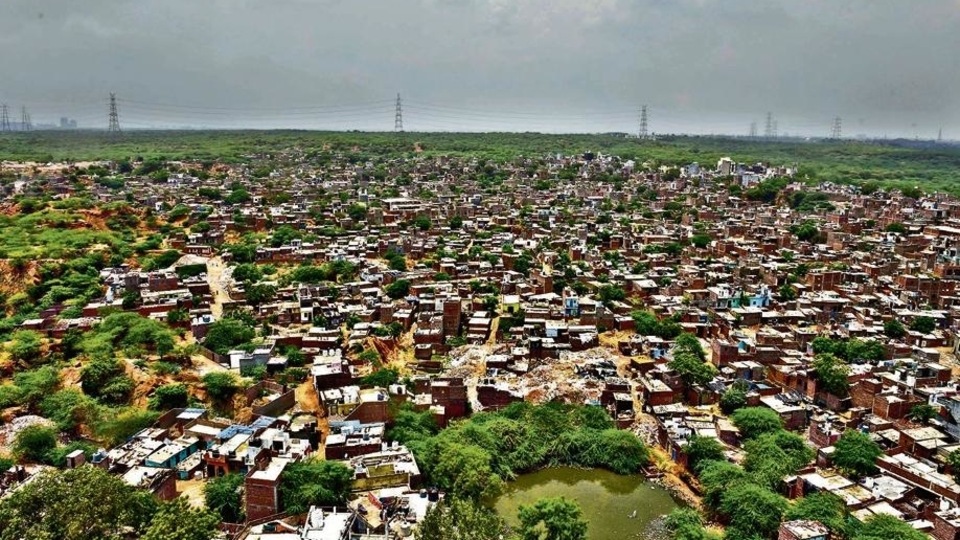
Khori, a village of dusty narrow streets, cramped houses in the middle of a forest clearing, vaulted into the news on June 7, when the Supreme Court ordered all illegal encroachment on forest land in the area to be cleared within six weeks.


In the early 1980s, Mohammad Saleem Khan migrated from Gaya in Bihar to the fledging edges of the national capital. A teenager, Khan found work at a bauxite mine in the forests of the Aravalli hills in Faridabad. For a few months, he commuted to the mining site from a local village but later asked his contractor, a local strongman, for a hut near the mine.
“The contractor asked me to return the next day with every penny I had saved. When I brought the money, he pointed to a small cluster of huts and asked me to set up my hut next to it. He said I didn’t need to worry about any other permission or document,” said Khan, now in his early 60s.
He remembers giving away some ₹500-700 at the time. Some of the other 2,000-odd labourers at the mine did the same. They had no electricity connection but three local wells served water to the residents there.
As the mine grew, more labourers surrendered their life savings to contractors in return for tiny parcels of land and protection. The local strongmen, who were paid off, promised that they’d prevent eviction.
Khan recalled how the contractors would demarcate land. “They would simply throw a stone and claim ownership of the land up to the point where the stone fell,” he said. At the time, most of these Aravalli foothills was forestland.
Of course, without authorised papers, no one could sell property or land – not legally, anyway. “Till the end, most sale deeds remained primitive in nature and had no legal standing. Property dealers would make the sales on plain pieces of paper, in front of their own four local witnesses. The land sold would be mentioned as a garbage dump yard. People were getting land for cheap, and everyone was happy,” said a local resident who didn’t want to be identified.
Over the next three decades, this tiny cluster of huts transformed into a large village comprising thousands of brick houses perched on the Aravalli hills on the southern fringes of Delhi.
Khori, a village of dusty narrow streets, cramped houses in the middle of a forest clearing, vaulted into the news on June 7, when the Supreme Court ordered all illegal encroachment on forest land in the area to be cleared within six weeks.
Days later, 3,000 policemen arrived at the village. By June 12, electricity connections were cut and water tankers stopped from entering the village. Demolitions began on July 17.
In June, the government estimated around 5,100 houses and 10,000 residents lived in Khori. unofficial estimates put the number between 30,000 and 50,000. Today, only a handful of structures remain, and most residents have relocated.
Prime location
Bauxite mining was first banned in the Aravallis in 1992, according to locals and activists. By then, there were already around 200-300 huts in the mines, and more were on the way, courtesy the proximity of the location to Delhi and Uttar Pradesh.
Mining continued sporadically till the Supreme Court issued a blanket ban in 2009, but the migrants – who were bringing their relatives from the hinterlands of Uttar Pradesh and Bihar – easily found other jobs.
“By 1998 or so, there were some 600 houses in this colony. It had taken the shape of a proper kachchi (unauthorised) colony. No one bothered to take action and the strongmen and property dealers had patronage of the politicians,” said Jitender Bhadana, who runs an NGO, Save Aravalli Trust, and has been fighting to restore the Aravalli forests.
In 1998, the Municipal Corporation of Faridabad moved to clear the encroachment – the first time since Khori came up in the early 1980s – but the demolitions stopped after a few dozen houses, said residents. “It was the first time I feared that there was something illegal in the land I had paid my life savings for,” said Khan, a former president of the Khori Residents Welfare Association.
Months later, some residents of the village, who were surviving on stealing from power lines and water tankers, got limited electricity and water connections. “The municipal corporation provided legal electricity connection to some 300 houses and permitted the digging of six borewells”, said Veer Shankar Singh, a resident.
Current MCF commissioner Yashpal Yadav did not respond to requests for a comment. His predecessor, Garima Mittal, who was in-charge during the demolition drive, refused to comment saying she has been transferred.
Seema Trikha, Bharatiya Janata Party MLA from Badhkal, under which Khori falls, blamed the “mafia of old times” who were “protected” by the (earlier) governments for allowing the illegal occupancy of the forest land.
“We have neither been involved in inviting buyers to this land, nor in selling any land in the forest area,” said Trikha.
Mahendra Pratap Singh, who served as the MLA of the area (it fell under Mewla Maharajpur constituency until 2004) five times between 1982 and 2014, said that it was wrong to blame any one party or government.
“But for the Supreme Court order, the BJP too was allowing the encroachment to continue. It is just that the poor began living on that land and none of the governments bothered to evict them,” said the five-time MLA from the Congress.
Rapid encroachment
By the early 2000s, Khori was thriving and large chunks of the forest on the hillocks had given way to residential plots. Some families sold their ancestral properties to buy land.
Mohammad Idris, a 65-year-old tailor, said nine members of his family moved to the village in 2001 after selling his property in UP’s Badaun. “Seven immediate and extended family members of mine followed me over the next decade to sell their ancestral properties and buy land here,” said Idris.
Idris and others were told by local touts that Khori, which was technically in Haryana, fell on the Delhi side of the border.
Adjacent to Khori is the Lal Kuan village, which falls on the Delhi side of the border. A rusting iron fence marks the border, but the demarcation is visible in only a few stretches. “The builders took advantage of this fact. They sold land to the people saying the Delhi government would eventually regularise the illegal colonies,” said Ishita Chatterjee, a PhD scholar studying the settlement. In the 2000s, the government in Delhi did regularise several low-income unauthorised colonies, giving hope to Khori residents.
Sube Singh, the spokesperson of Faridabad Police, said property dealers lured buyers. “To those buying land near the Delhi border, they sold the land saying it fell in Delhi jurisdiction,” said Singh. “The property dealers had strong backing financially and politically, As for the residents, they just followed each other,” Singh added.
Some residents who refuse to leave the now-demolished village continue to believe that they are Delhi residents. “I have been voting in Delhi all these years. My children are enrolled in a school in Delhi. What more evidence do you want?” asked Rama Devi, a woman who has set up a tent next to the rubble of her home.
Buyers were assured that a property in Delhi meant better access to electricity and water. But on the ground, electricity and water connections were arranged by a network of local strongmen and touts who divided the village among themselves.
“The mafia would get commercial electricity metres installed in private homes in Lal Kuan, and then pull illegal connections from there to our homes in Khori,” said Singh.
Khori residents eventually ended up paying as much as ₹14 per unit of electricity – the rate in Delhi is between ₹2 and ₹8 and Haryana ₹2 and ₹7 --- and a few relied on stolen connections from Haryana side.
Water was sold in tankers for ₹800-900 per 4,000 litres to those who didn’t have access to the six borewells, residents said.
A large number of Khori residents got documents made to show they were residents of Delhi.
The power of attorney was not only the preferred residential document, but also the only choice. “Residents did some ‘setting’. To execute a power of attorney deal, the property owner would find someone from the village itself to pass him off as the actual owner,” said Singh.
Chatterjee said the power of attorney documents wouldn’t stand the scrutiny of courts.
Similarly, many residents went on to procure voter identity, ration cards, gas connections and even Aadhaar cards -- most of them on Khori addresses.
Chatterjee said this was facilitated by property dealers, which included local residents.
Demolition worries
Between 1998 and 2021, the municipal corporation moved at least five times to demolish houses but since 2010, the Khori Residents Welfare Association got judicial relief. Assisting the petitioners was Nirmal Gorana, general secretary of Bandhua Mukti Morcha. “We are not against the SC order. Our fight is for the rehabilitation of tens of thousands of people being displaced,” said Gorana.
Residents believed that the government would never displace thousands of people. Thus, buying and selling of property continued unabated. Until the SC order, a single storey house constructed on a 50 square yard in Khori could cost as high as ₹20 lakh.
When the court order came in June, it sparked immediate protests. The police booked over 550 known and unknown persons and arrested about 20 of them.
Chetan Agarwal, an independent forest analyst, said the forest had a huge environmental value for the national capital region, but added that the human cost of the demolition was also too high.
Many residents have been forced to opt for rented accommodation in the surrounding neighbourhoods – Lakkarpur in Faridabad being the closest.
“I had to pay ₹4,000 as rent for a room which usually costs ₹2,000 in Lakkarpur village. Tenants are charging Khori residents double and triple of the usual rates and then treating us like beggars,” said Mohammad Saleem, a painter.
A few have stayed back, pitching tents amid the rubble. “Who do we trust now? All these years, politicians and officials kept assuring us that our homes were safe. Now, we have lost everything,” said Gendo Devi, a resident.

Stay updated with all top Cities including, Bengaluru, Delhi, Mumbai and more across India. Stay informed on the latest happenings in World News along with Delhi Election 2025 and Delhi Election Result 2025 Live, New Delhi Election Result Live, Kalkaji Election Result Live at Hindustan Times.


