
 E-Paper



Net loss: Surviving in an NCR city without mobile internet
August 1 to 5 in Faridabad were a near hark-back two decades, where lack of digital connectivity had no impact on currency transactions or traffic navigation

 Prefer HTon Google


On the sweltering afternoon of August 2, 40-year-old Faridabad resident stepped out of her home to walk to her local vegetable vendor. It was a path she had walked many times before , yet on this day, there was a little trepidation. The neighbouring district of Nuh was up in communal flames, and Faridabad had been affected too. The traffic was a little thinner; the shops more deserted. But quickly, Kwatra heaved a sigh of relief. The shop was open, she saw. She topped a basked with fruits and vegetables, walked to the counter, and watched the shopkeeper weigh and pack them in large polythene bags. Like she always did, she pulled out her phone to make an online payment.
Except, it dawned on her quickly, all mobile internet was shut in Faridabad. Over the years, she had stopped carrying cash, and did not remember her ATM pin that could have been a workaround. The shopkeeper knew her, but this had likely happened several times before in the day; enough for him to draw a red line. “I was a regular customer but he asked me to leave the packed produce behind,” Kwatra said.
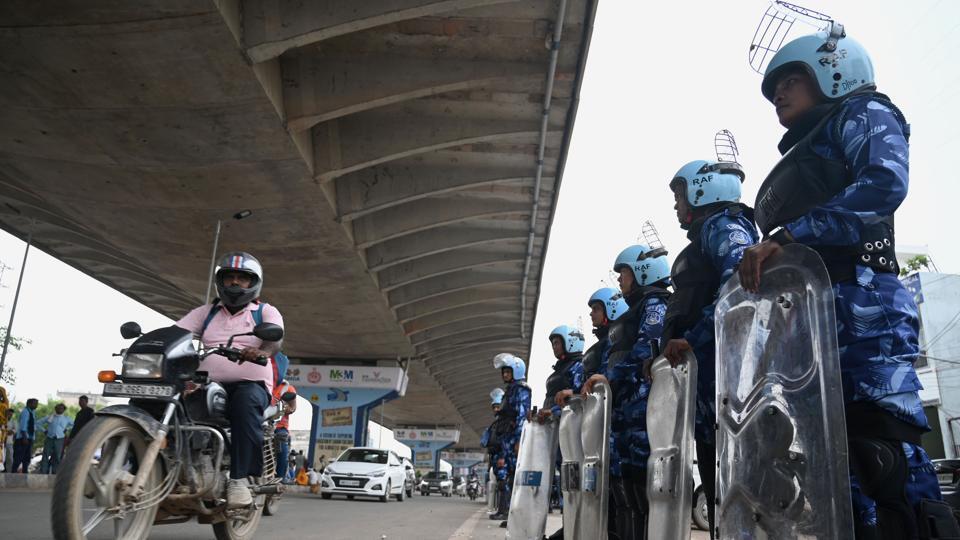
On July 31, communal violence erupted IN Nuh after an annual religious yatra was attacked in Nalhar village of Nuh, spreading over the next few days to of Gurugram and Palwal. No violence was reported from Faridabad. The last of the violence took place on August 8,but by then six people were dead, 88 were injured, and dozens of shops and homes gutted or vandalised.
But in many ways, Kwatra’s experience, and that of so many others, underlined a new cost to violence in urban settlements.
As is now established procedure, within hours of the violence, the district administration issued an order suspending mobile internet in Nuh, Palwal, Faridabad and parts of Gurugram districts. In Faridabad, from 7.30am on July 31 to 11.59pm on August 5, mobile internet remained suspended, save for a three-hour reprieve on the afternoon of August 3.
It is not as if internet suspensions are new to NCR. But these were either for brief periods such as in December 2019 during the anti-CAA protests, or in isolated pockets such as outer Delhi in January and February 2021 when the farmers agitation against three central farm laws were in full swing. But those four days between August 1 and 5 brought Faridabad, spread across 190 square kilometres, with its gated apartment complexes that proffer relatively affordable living in NCR, to a near standstill. It was a near hark-back two decades, where cash was still the currency of everyday transactions; where printed barcode readers were not ubiquitious; where directions were not dependent on GPS maps, and the lack of digital connectivity had no impact on trade.
For those five days, residents attempted to stay inside as much as they could, afraid that the embers of the communal violence could be outside their door. But online shopping platforms, their trusty allies even in the times of the pandemic, could not function without the internet. Apps that usually sent everyday essentials within minutes suspended their services. “On online shopping platforms, delivery dates of one-day delivery products were shown as deliverable after seven to ten days,” said P Sampath, a resident of New Industrial Township (NIT) of Faridabad..
But if consumers had it difficult, there were complications in the supply chain too. Locating shops, hospitals, essential for door to door delivery systems, were difficult to locate without GPS services. Those deliver agents that worked suffered without the ubiquitous Google Maps that had become an essential tool in their profession. Niranjan Singh, a driver with a cab aggregator platform, said he avoided travelling to Faridabad those five days, barring times when he received urgent requests from old customers. “Providing services in Faridabad without internet meant no access to GPS, no availability of OTP and problems in payments. The only time I serviced a Faridabad customer for the cab platform was when she promised me access to her wi-fi and compensated for the lack of customers during the return,” said Singh.
Violence is not good for business in any case, but without online transactions, customers walked in and out of shops without any business being conducted. NK Verma, president of Manufacturer Faridabad Association said that the internet suspension hit transportation hard in the industrial areas of the district that have nearly 2,500 registered working factories. “Several services, particularly transport-related, are heavily dependent on the internet. Without connectivity, our transport vehicles were stranded and manufacturing was disrupted,” said Verma.
Those with broadband internet or Wifi in their homes survived some of these challenges, but there were many that did not have this privelege. Leela Singhal for instance continued to go to work at the saloon she works in at Faridabad’s Nahar Paar. But business was thin, and there were many empty hours. For three days, she kept looking at her phone and refreshing it. On the fourth day, she lost her patience, asked a client who she knew if she could come to their home and access the wi-fi. “Even the music on my phone needed the internet,” Singhal said.
Still, those from the ruling administration said that suspension may have been painful, but was ultimately successful. Seema Trikha, BJP MLA from Badhkal constituency in Faridabad, said that the internet ban was necessary to save lives. “Saving lives and preventing violence was the top priority. The internet restrictions prevented rumours and ensured peace in Faridabad,” said Trikha.
Sube Singh, spokesperson for the Faridabad Police, said that the riots in the adjoining districts did not lead to any violence, or any casualties, in Faridabad.
Singh said that snapping mobile internet services helped prevent spread of rumours, gatherings and planning, or even making WhatsApp groups quickly to plan anything related to the event. “It slowed down the entire process of spreading hate, be it in terms of sharing hate speech, or assembling at any place,” said Singh. The police themselves faced hurdles in their daily duties, but they worked around it. “We used the Wifi services at the police stations, or even sought help form the public to access their Wifi in case of emergencies,” Singh said.
Two weeks later, internet services have long been restored, there is the cacophony of normalcy on Faridabad’s streets again; the UPI bar codes are in full function, and the delivery riders buzz around the city on their two wheelers. Yet, such was the suspension of daily life, that many have begun preparing for the next time the internet is switched off.
Days later, as Faridabad recovers from the internet gag, many are putting in place systems to ease their lives if the ban is enforced again. Many applied for stable wi-fi networks, and those relying on mobile internet opted for wi-fi services. Singhal has downloaded hundreds of songs on her phone. Kwatra has reset her ATM pins, and grudgingly now has them committed to memory. She may be prepared but there is one thing she is clear on. “Internet bans cannot be the norm,” she said.


