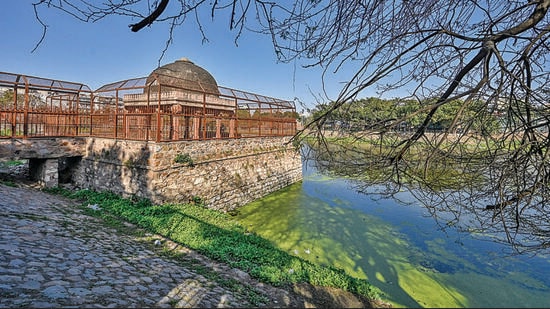
NEW DELHI: The Hauz-i-Shamsi — a reservoir in Mehrauli built by 13th century Delhi Sultanate ruler Shamsuddin Iltutmish due to a dream — has seen better days. Once, it covered over a hundred acres and was lined with red sandstone. Now, it is spread across a 7.05-acre land, according to the Archaeological Survey of India (ASI), the red sandstone is missing, its banks are fenced, and occasionally home to heaps of garbage.
The revival of the 13th century reservoir will be done in three stages, the first of which was concluded in the first week of February. From September to November last year, and then again, this month, 300 tonnes of water hyacinth, duckweed and algae was removed from the reservoir. (Raj K Raj/HT Photo)
By the end of 2024, however, the reservoir, which is protected by ASI, might reclaim its lost glory. ASI, along with Sustainable Environment and Ecological Development Society (SEEDS), an NGO, has taken up the project of restoring Hauz-i-Shamsi, popularly known as Shamsi Talab.
“The revival of the 13th century reservoir will be done in three stages, the first of which was concluded in the first week of February. From September to November last year, and then again, this month, we removed around 300 tonnes of water hyacinth, duckweed and algae from the reservoir,” said an on-ground team member of SEEDS, Delhi.
The second stage of the restoration will involve bacteria treatment and will commence in April. “Then we will move to the third stage, which will ensure that sewage water from neighbouring pipelines does not get leaked into the reservoir. We will also clean up the banks and tighten the fence around it to discourage people from throwing their garbage here,” said the member. According to the detailed project report, which has been approved by stakeholders such as the Municipal Corporation of Delhi, ASI, and the Delhi Jal Board, the restoration work should be complete by late 2024-early 2025.
There is also a pavilion — a domed chhatri supported on 12 stone pillars — on the bank of the Hauz-i-Shamsi. As per the “List of Muhammadan and Hindu Monuments, Volume III- Mahrauli Zila” compiled by Maulvi Zafar Hasan, assistant superintendent of the ASI in 1922, “it was erected by Iltutmish... at the same time when he built Hauz-i-Shamsi in 1229-30 AD...” but also mentions that its construction is ascribed to Alauddin Khalji in 1311-12 AD. This too is a protected structure.
The closest locality consisting of two wards, including ward eight completely and parts of ward six, starts about 100 metres away from the Shamsi lake, mostly tall buildings with apartments packed in neat lines, blocking the horizon opposite to the Jahaz Mahal. The Jahaz Mahal is on the north-east corner of the Hauz-i-Shamsi, a Lodhi-era structure, protected by ASI. While some historians believe that it was used as a mosque, others think that it was perhaps the residence of a holy man.
“Hauz-i-Shamsi is a historical water body, and so close to our homes. We hope that once the restoration work is done, people will come here to enjoy its beauty,” said Amar Kumar, 40, a teacher by profession, who lives in Mehrauli’s ward 6, about 200 metres away from the reservoir.
About a Dream
The belief is that Iltutmish, the 13th century ruler, built the tank after the Prophet appeared in his dream. As per Maulvi Hasan, “...Iltutmish intended to build a tank. He was very anxious to select a suitable site for it, when one night the Prophet appeared to him in a dream riding a horse and advised the king to build the tank, he desired, where the Prophet had appeared.”
Maulvi Hasan wrote that the next morning, Iltutmish went with saint Qutb Sahib to the place pointed in the dream and found that “a mark of one of the hoofs of the Prophet’s horse was imprinted on the spot where he had appeared in the dream, and that water was flowing from the mark.” The ASI listing mentions that the tank is “treated as a most holy spot.”
Attempts at restoration
In 2015, ASI had attempted to restore the reservoir but it did not go as planned.
“People keep throwing trash which pollutes the lake again and again. We ensure that the lake is cleaned periodically but lack of community awareness makes it very difficult,” said Misbah Noorie, an ASI engineer.
Finally, in 2022, ASI signed a memorandum of understanding (MOU) with SEEDS.
“Following the MOU, the NGO has been conducting routine clean-ups of the reservoir. It is of utmost importance that all historical structures are conserved properly,” said Misbah Noorie, an engineer with ASI.
For the residents of Mehrauli, the restoration plan brings with it some hope. “Sewage water gets leaked into the reservoir and leads to a lot of pollution. People also keep throwing trash on the bank, which leads to a terrible stink. The restoration, we hope, will solve these problems for us,” said Mini Gupta, 28, who lives in ward 5, about 500 metres away from the reservoir.

 E-Paper