
 E-Paper



We know pulse of nation, SC exists to guard citizens from injustice: CJI
“The history of the Supreme Court is a history of the daily life struggles of Indian people,” chief justice Chandrachud said at an event to commemorate 72 years of existence of India’s Supreme Court.

 Prefer HTon Google


The Supreme Court exists to protect citizens from injustice as it is in sync with the pulse of the nation, Chief Justice of India Dhananjaya Y Chandrachud said on Saturday on the occasion of the 73rd founding day of the apex court.
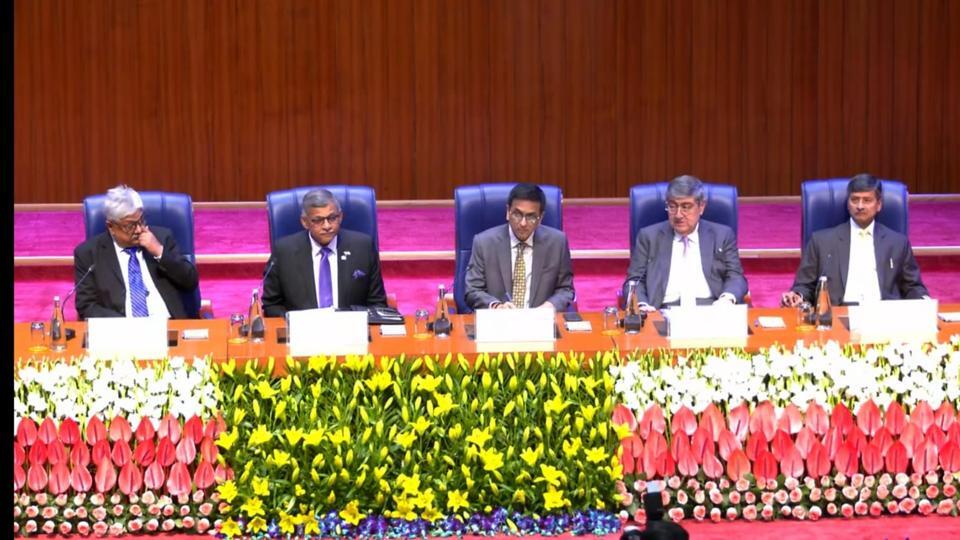
“The history of the Supreme Court is a history of the daily life struggles of Indian people,” chief justice Chandrachud said at an event to commemorate 72 years of existence of India’s Supreme Court.
“Through the seemingly innocuous requests that we receive through the daily mentioning of cases every morning, we can sense the pulse of the nation. In this uniquely citizen-centric initiative, the message we send out is of an assurance that this court exists to protect our citizens from injustice,” The CJI said. “Their liberties are as precious to us as to them and the judges work in close connect with our communities.”
In deciding seemingly small and innocuous matters relating to citizens, the Supreme Court performs its constitutional function, the CJI said. “Every matter is important,” he said. “No matter is big or small for the court.”
Highlighting the role of technology in increasing access to justice to the common man, particularly during the Covid-19 pandemic, the CJI pointed out that the recent proposal in the budget to earmark ₹7,000 crore for the third phase of e-Courts programme will bring the courts closer to the people.
“This will help to enhance the accessibility of judicial institutions and improve the efficiency of justice delivery system in India,” he said. “Such endeavours will ensure that the court truly reaches out to every citizen of our country.”
Since the Supreme Court first sat on January 28, 1950, the CJI pointed to the march of the top court over the years in developing the jurisprudence from interpretation of the Constitution to a broad, purposive interpretation in expanding the concept of access to justice through public interest litigation (PIL) and the more recent strides to rule in favour of privacy of citizens, decisional autonomy, sexual and reproductive choices, and the recent decisions on gender equality.
Three principles should guide the top court’s approach, the CJI said, which include applying the precautionary principle in the work it does, sustainable development principally applicable to judges to sustain the institution of judiciary, and the public trust doctrine as judges hold this office in public trust for the future. By this approach, “we will ensure to be vibrant despite climate change,” he added.
To commemorate the founding day of the Supreme Court, Sundaresh Menon, chief justice of the Supreme Court of Singapore, delivered the first Foundation Day lecture on the topic “Role of Judiciary in a Changing World,” where he spoke about the challenges facing the judiciary in modern times.
One of the several challenges facing the judiciary is the breakdown of trust in public institutions, he said. “Judiciary needs legitimacy to function well,” he said. “This is secured when it enjoys the confidence of the public.” Gaining public confidence is possible only when the public believes that judiciary acts independently, impartially and not for the wealthy and powerful, he added.
Chief justice Menon, who is of Indian origin and was appointed as the youngest chief justice of Singapore’s Supreme Court in 2012 at the age of 50, mirrored the views of the CJI in stating that the judiciary should be accessible to ordinary citizens.
“Nothing is more corrosive in our justice system than the perception that those systems are the preserve of a privileged few and priced out of the reach of ordinary people,” he said, pointing out that the core values of judiciary common to all systems is competence and legitimacy.
He warned against disinformation or devaluation of truth, which he coined as “truth decay”, seeping into court proceedings and diminishing the legitimacy of judgments and Courts.
“It is essential that findings of the court are generally accepted in the public sphere as generally reflecting the truth. If that is not the case, then our ruling becomes another voice in an endless clamour of opinions on the merits of a dispute,” he said. This gets exacerbated, he added, “when baseless allegations are made against judges suggesting that their rulings merely reflect their personal agendas.”
He further stated that public relies upon judgment as the courts are meant to be reliable truth finders who seek to do justice according to law. “If this trust falls away, then the courts are left to operate solely by the force of state power and the belief in and the respect for rule of law in our societies will collapse.”
He said that the judiciary must be equipped to tackle emerging legal issues such as cryptocurrency and disregard territorial boundaries. Further, the challenge of climate change and stagflation may initially appear to be political problems, but these disputes may end up in the courts for which judges must be ready.
While judges are known to speak only through their judgments, chief justice Menon was of the view that most judiciaries do not see a problem in public engagement. He cited examples of the chief justice of Canada, who holds an annual press conference to highlight judicial work, and judges of the UK Supreme Court giving television interviews on their work and home life.
Chief justice Menon accepted that Indian Supreme Court is the “busiest court” with “hardest working judges” of which he got a firsthand taste while presiding on the bench with the CJI on Friday.


