
 E-Paper



Will wait and see, say J&K students on special train in Delhi
Evacuees from Jammu express relief as they return home after a ceasefire announcement, but remain cautious and concerned about safety.

 Prefer HTon Google


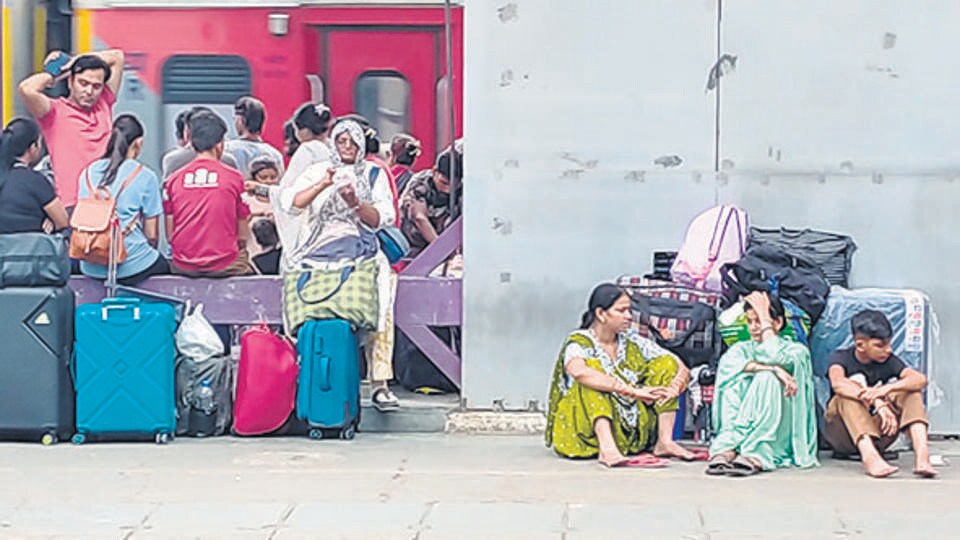
As the special train from Jammu pulled into New Delhi Railway Station late Friday night, a quiet sense of relief spread through the crowds of evacuees disembarking with bags in hand and plans to finally return home. Among them were students, tourists and Army families who had rushed out of Jammu after days of escalating tensions and missile strikes along the border. But with the announcement of a ceasefire on Saturday evening, many are now preparing to make their way home or back to their universities — albeit cautiously.
“I am still going home,” said Afsana Sheikh, a 20-year-old master’s student from Kerala who had boarded the Jammu Tavi Special train with her friend Akshay Kumar, also 20. “There’s only an announcement about a ceasefire. We will wait to see what our college says. But for now, I’m going to my family. I’m still scared. I hope nobody breaches the ceasefire.”
The two had decided to leave their university in Jammu when drone sightings and missile alerts near a hospital shook their neighbourhood.
“It was impossible to stay calm. We were trying to get on any train out,” said Kumar, who added that while he plans to return for exams, he would wait a few days to assess the situation.
“If the government says the war is over, they must be sure about it. I’ll go back once others start returning too,” he said. “My parents are worried, but I think we are okay now.”
More special trains were announced by Union railway minister Ashwini Vaishnaw on Friday to help clear the exodus. Northern Railways spokesperson Himanshu Shekhar Upadhyay said additional trains from Jammu Tawi to Delhi were arranged to handle the “extra rush”.
Some like Arya, a 21-year-old undergraduate student from Kerala, were already planning their next move. “Forty of us from the Central University of Jammu are heading home together,” she said. “We’ll take a connecting train soon. Our exams are suspended, and this was the safest choice.”
She described the night before the journey as chaotic and frightening. “We were locked inside our dorm. No one dared look out the window. There were sirens, blackouts, drones overhead. My parents were calling nonstop,” she said. “Even in the morning as we left, there were missile alerts.”
These experiences, however, occurred before foreign secretary Vikram Misri announced that all military action between India and Pakistan would cease from 5pm on Saturday.
Others echoed the same feeling: shaken, but now trying to resume normalcy.
Tourists stranded in Udhampur and Katra also packed into the trains. “We had given up hope,” said Mouly, 27, who was visiting Katra with a friend. “There were no cabs, no flights, no taxis. We had to walk to the station with our luggage. The moment we got on the train, I felt I could breathe again.”
Some were less sure about what came next. Army families from cantonment areas — who were among those asked to evacuate due to targeted shelling — said they were grateful for the escape but concerned about those left behind.
Neetu Yadav, whose husband is a naik in the Indian Army, was received at NDLS by her brother, her daughter clutching her tightly. “I didn’t want to leave, but we were told to. I just hope this ceasefire holds,” she said.
Her fears were echoed by Urmila Devi, whose husband is posted as a havildar. “We left after nights of sirens and silence, followed by more sirens. Civilians were being targeted. We’ve reached safety, but others are still stuck.”
For now, the mood among most passengers was one of cautious optimism — the worst may have passed, but for now they remain clinging to hope that the fragile peace holds.

Stay updated with all top Cities including, Bengaluru, Delhi, Mumbai and more across India. Stay informed on the latest happenings in World News along with Delhi Election 2025 and Delhi Election Result 2025 Live, New Delhi Election Result Live, Kalkaji Election Result Live at Hindustan Times.


