
 E-Paper



A man on a quest to save NCR’s last natural forests
His journey began in 2011 when threats of urban development appeared over Mangar Bani, a sacred grove among the vast urbanisation in Faridabad to its east, and Gurugram to its west and Delhi in the north.

 Prefer HTon Google


In the rocky stretch of the Aravallis, flanked by the urban sprawl of Gurugram and Faridabad, 39-year-old Sunil Harsana has taken it upon himself to become the custodian of North India’s last natural forests – a landscape that balances history, heritage, and biodiversity. Born in Mangar village, Harsana has become a determined conservationist, researcher, and community leader.
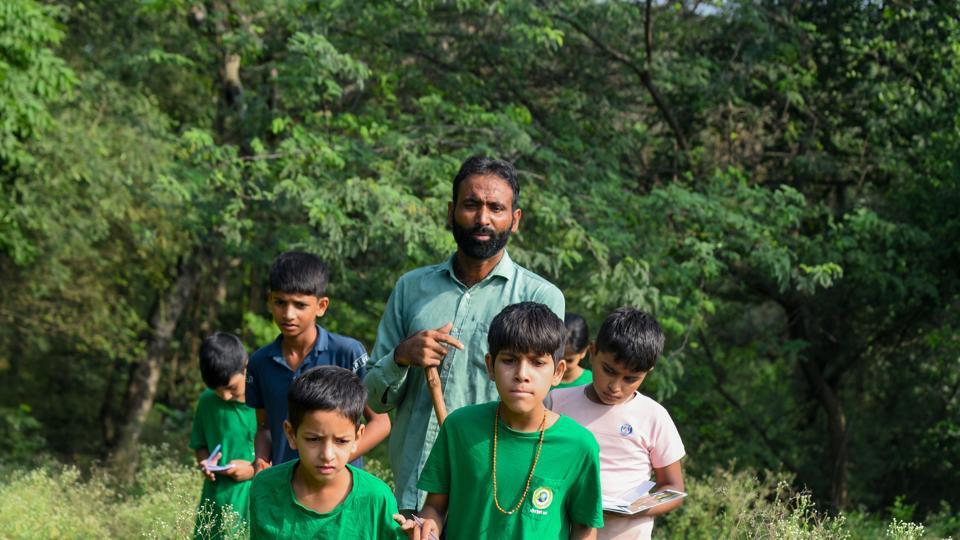
His journey began in 2011 when threats of urban development appeared over Mangar Bani, a sacred grove among the vast urbanisation in Faridabad to its east, and Gurugram to its west and Delhi in the north.
Alarmed by the possibility of losing his childhood playground and the ecological lifeline of his village, Harsana decided to act.
He has dedicated his life to protecting Mangar Bani and the Aravallis by planting native trees, documenting wildlife, and pushing back against illegal mining and dumping. Alongside ecological work, he has brought global attention to the region’s prehistoric heritage by discovering cave paintings and petroglyphs dating back to the Stone Age. Through research, community engagement, and persistent advocacy with authorities, Harsana has turned the Aravallis into both a living classroom and a reminder that history, culture, and ecology are inseparable.
Over the years, he expanded his focus beyond Mangar Bani to cover adjacent stretches of the Aravallis across Gurugram and Faridabad, including areas abutting the Asola Wildlife Sanctuary.
“Every tree I grew up with holds a memory—collecting fruits, grazing cattle, or simply sitting in the shade,” he said. “When I saw those same spaces being eaten away by mining and construction, I knew I had to fight back. If we let the Aravallis vanish, we don’t just lose forest cover—we lose our history and our future.”
While Sunil first entered conservation to protect forests and wildlife, his work took on a historical dimension. In May 2021, while carrying out a wildlife survey near Mangar, he stumbled upon ochre-coloured cave paintings etched into rock shelters. The figures of humans and animals were later confirmed by archaeologists as some of NCR’s oldest prehistoric art.
“At first I thought it was just random markings, but when I looked closer, I realised these were deliberate paintings,” he recalled. “That moment gave me goosebumps -- the forest wasn’t just alive with wildlife, it was speaking of its Stone Age past.”
Then in Badshapur Tethar village of Sohna, about 6km from Mangar, he discovered petroglyphs etched into quartzite rocks -- handprints, footprints, and animal carvings spread across a two-kilometre radius. When archaeologists examined the site, they confirmed the engravings dated back to the Paleolithic era, spanning from 2.5 million years to around 8000 BC. The finds included pebbles and flake-based Acheulean tools, suggesting the site could have been a centre for early tool-making. Experts believe this could be one of the largest prehistoric art sites in the Indian subcontinent.
“Standing there, seeing those carvings, I felt like I was shaking hands with our ancestors,” Sunil said. “I immediately informed the archaeological department because discoveries like these belong to all of us, not just to one village.”
Building awareness
In 2015, Harsana started the Mangar Eco Club, where every Sunday children from schools gather under his guidance and learn to identify birds, recognise trees, build small check dams, and understand the basics of conservation.
“Children are the best changemakers,” he said. “If they fall in love with the forest at the age of 10, they will protect it at 20. My aim is simple -- to make sure the next generation knows the value of what we still have.”
He often takes children to see cave paintings and carvings. “When they place their hands over ancient handprints carved into stone, they realise they are part of a story much older than our villages or cities,” he said.
These sessions have changed community perceptions. For many locals, Mangar Bani was once only a grazing ground or sacred grove. Today, it is seen as a living classroom, a heritage site, and an ecological treasure that sustains groundwater, biodiversity, and cultural identity.
Challenges ahead
Despite his efforts, challenges remain daunting. Illegal mining, unchecked construction, and waste dumping continue to threaten the Aravallis. Invasive species spread unchecked, and real estate pressure from Gurugram’s booming development makes every patch of green vulnerable.
Yet Harsana’s persistence has begun to yield results. Both the Haryana government and archaeological bodies are now considering ways to safeguard parts of the Aravallis. His discoveries have added new weight to conservation arguments, linking the forests not just to ecology but also to India’s ancient history.
Harsana embodies the idea of a changemaker—someone rooted in his land, unwilling to surrender to powerful interests, and able to inspire others to see value where they once saw none. His fight is not just about saving a forest but about reframing what development means in one of India’s fastest-growing urban frontiers.
“These forests are Delhi NCR’s lungs, but they are also its memory,” he said. “Protecting them is not charity -- it is survival. If the Aravallis fall, so will we.”


Stay updated with all the Breaking News and Latest News from Mumbai. Click here for comprehensive coverage of top Cities including Bengaluru, Delhi, Hyderabad, and more across India along with Stay informed on the latest happenings in World News.


