
 E-Paper



Gurugram’s air ‘poor’, MCG hires 35 tractor-trolleys for water sprinkling
Officials said the tractor-trolleys were hired after the air quality remained “poor” on Monday morning

 Prefer HTon Google


The Municipal Corporation of Gurugram on Monday hired 35 tractor-trolleys to sprinkle water on streets and trees to reduce dust pollution, even as the city’s air quality plummetted to the ”poor” category on Monday.
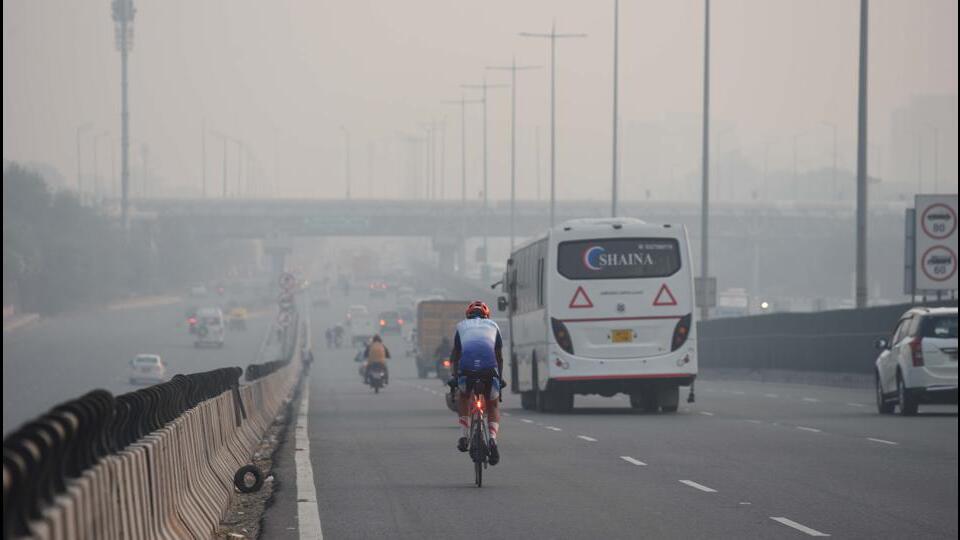
Officials said the tractor-trolleys were hired after the air quality remained “poor” on Monday morning and teams formed were assigned the task to check the major traffic spots and streets to control pollution.
Naresh Kumar, joint commissioner of MCG, said they have already identified the dusty stretches in the city and teams ensured that 35 tractor-trolleys sprinkled water on trees along high-traffic density stretches, such as Mahavir Chowk-Atul Kataria Chowk, Sohna Chowk-Rajiv Chowk, Dwarka Expressway, Vatika Chowk-Kherki Daula toll, Basai Chowk-Umang Bharadwaj Road, Khandsa Road, Rajiv Chowk-Mayfield Garden Chowk, and Cyber Park to Hero Honda Chowk.
Officials said that 73 persons have been penalised on Monday to the tune of ₹3.65 lakh for offences such as burning of firewood and coal, dumping construction and demolition (C&D) waste, storing uncovered construction material and open burning of garbage.
On Saturday, the Haryana State Pollution Control Board (HSPCB) imposed a ban on construction activities to curb air pollution in the city, as per directions issued by the Commission for Air Quality Management (CAQM).
However, the city’s air quality index remained in the ”poor” category, according to Central Pollution Control Board (CPCB)’s daily bulletin. It said the average air quality index (AQI) in Gurugram was 255 on Monday. On the CPCB’s Sameer app, of the four functional AQI monitors in the city, two hit ”poor” category on Monday.
Gurugram deputy commissioner (DC) Nishant Kumar Yadav said he has formed nine special teams on October 1, to check waste burning and sanitation across the city.
He said with the implementation of the graded response action plan (Grap) on October 1, the teams have been instructed to inspect all areas where waste burning is suspected or reported and to ensure compliance with Grap norms.
Grap was approved by the Supreme Court in 2016 and was first implemented in 2017 to check high levels of air pollution across the National Capital Region. Grap came into force in Gurugram on October 1, along with Delhi and the rest of the National Capital Region (NCR), to curb winter pollution. The activities banned under Grap include waste burning, unauthorised dumping of C&D waste and garbage in public places, leaving construction material uncovered and transporting material without covering it
“The joint teams of MCG, district administration and pollution control board have been conducting inspections at all vulnerable sites and action has been taken. We have given directions to officials to take strict action and impose fines on the spot on violators,” he said.
PC Meena, MCG commissioner, said the teams have been asked to report daily. “We are monitoring the city’s average AQI, which was reported ”poor” on Monday. The Sector 51 monitoring station has recorded “poor” AQI at 203 while Gwal Pahari station reported an AQI of 201,a lso in the “poor” category. Water sprinklers and mechanised sweeping machines have been deployed,” he said.
According to MCG officials, four mechanised sweeping machines were engaged in cleaning all major roads. On Monday, the MCG cleaned several stretches such as Iffco Chowk-Mahavir Chowk, Sector 30-Sector 45, Cyber Park-Huda City Centre Metro station, and Rajiv Chowk-Subhash Chowk.


