
 E-Paper



Masking the law: Gurugram cops use tapes and scratches to dodge e-challans
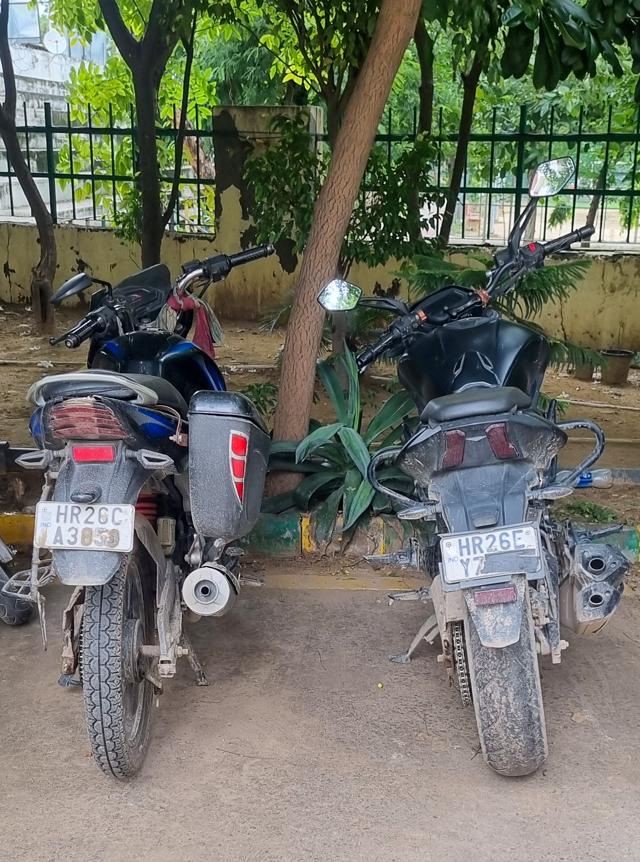
From the Gurugram Police Commissioner’s office to the Traffic Tower in Sushant Lok and the Anti-Corruption Bureau office in Sector 47, vehicles parked at these locations routinely display tampered number plates.


While Gurugram’s traffic police cracks down on everyday commuters for missing or improper number plates, a disturbing trend is unfolding within the law enforcement ranks themselves. Several police officials have been spotted driving vehicles with partially covered number plates – often using tape, paper, or even scratches -- to avoid being caught by the city’s network of automatic number plate recognition (ANPR) and red-light violation detection (RLVD) cameras.

From the Gurugram Police Commissioner’s office to the Traffic Tower in Sushant Lok and the Anti-Corruption Bureau office in Sector 47, vehicles parked at these locations routinely display tampered number plates. Over the past several weeks, HT made repeated visits to these premises and consistently found cars and bikes with masked, folded, or scratched plates, rendering them unreadable to surveillance cameras.
Even government vehicles, including police patrol two-wheelers, were seen sporting similar modifications. On Tuesday evening, HT spotted two Haryana Police personnel driving a white Maruti Swift with a Rajasthan registration on MG Road. One of the characters on the rear plate was obscured by masking tape and paper.
Some number plates were folded at one end, while others had critical digits scratched out, all in what appears to be a deliberate attempt to avoid triggering e-challans. This comes at a time when the Gurugram traffic police is aggressively penalising ordinary citizens for the very same violations.
In June alone, Gurugram police issued 22,215 challans for faulty or missing High-Security Registration Plates (HSRP), collecting ₹2.05 crore in fines, official data showed. Of these, 14,761 were penalised specifically for not upgrading to HSRPs—mandatory plates that make vehicles traceable in the cameras.
Yet, there is little evidence that similar zeal is being applied within the police department itself. Many officials appear to be using their position to evade detection—ironically, by undermining the very surveillance systems they are tasked with enforcing.
Action if caught: DCP
Rajesh Kumar Mohan, DCP (Traffic), said the department has issued clear orders to penalise anyone caught engaging in such violations, even cops. “I’ve held meetings with zonal traffic officers and instructed them to impose fines and seize vehicles of officials found using obscured registration plates. Such cases must also be reported to higher authorities for departmental proceedings,” he said.
Mohan called the practice “a blatant violation” of the rules. “HSRPs help us track criminal elements and enforce traffic rules through automatic challans. If the enforcers themselves flout the law, the system breaks down,” he added.
The effectiveness of electronic traffic enforcement relies on a network of over 1,200 surveillance cameras across Gurugram, including 300 ANPR and 115 RLVD units. These are installed at key intersections and roads, with 13 locations.
Once an offence is captured, the image is processed by an intelligent traffic management system, which reads the number plate. There, the registered vehicle owner’s details are pulled from a national database, and an SMS alert is sent with the challan.
But the catch is that this system depends entirely on clear, unobstructed views of vehicle number plates.
“Even if a single digit or letter is obscured the system flags the image as a ‘broken plate’, and the challan process stops,” said a senior Gurugram Metropolitan Development Authority (GMDA) official.
Police personnel stationed at the ANPR control room manually screen such images. If a plate is unreadable, the vehicle is excluded from the challan queue. “Those images are rejected during scrutiny and never make it to the NIC database. As a result, no fine is issued,” the official confirmed.
A growing culture of impunity
Experts working on the city’s surveillance network say this method of tampering has grown significantly in the past year. “Initially, it was limited. But now, we’re seeing it almost daily. The troubling part is that police officers are among the worst offenders. They know the system and its loopholes,” said a GMDA contractor associated with the traffic software.
He said that enforcement remains largely manual for these cases. “Unless an officer is stopped on the road and physically checked, they’ll get away. And often, being in uniform gives them an easy pass.”
What makes this more egregious is that while citizens face steep fines for minor non-compliances – as high as ₹10,000 –those meant to uphold the law appear to be manipulating the very rules they enforce.
The absence of disciplinary action or internal accountability mechanisms has emboldened this behaviour, say traffic experts. “This isn’t a loophole, it’s a misuse of institutional knowledge,” said an expert on traffic governance.
Stay updated with all the Breaking News and Latest News from Mumbai. Click here for comprehensive coverage of top Cities including Bengaluru, Delhi, Hyderabad, and more across India along with Stay informed on the latest happenings in World News.


