
 E-Paper



Red Fort blast probe: Car parked 11 days at F’bad medical college
The i20 used in the Red Fort explosion was traced to Al-Falah Medical College; over 800 police are sweeping Faridabad to uncover the wider network.

 Prefer HTon Google


Investigators have confirmed that the Hyundai i20 used in the Red Fort blast incident was parked for nearly 11 days inside the Al-Falah Medical College campus in Dhauj, Faridabad, before being driven to Delhi. The finding has brought renewed focus on a suspected “white-collar terror module” allegedly involving doctors and medical students linked to the college, already under scrutiny for stockpiling 2,900 kilograms of explosive material recovered from rented houses in Dhauj and Fatehpur Taga villages on Sunday and Monday, respectively, police said.
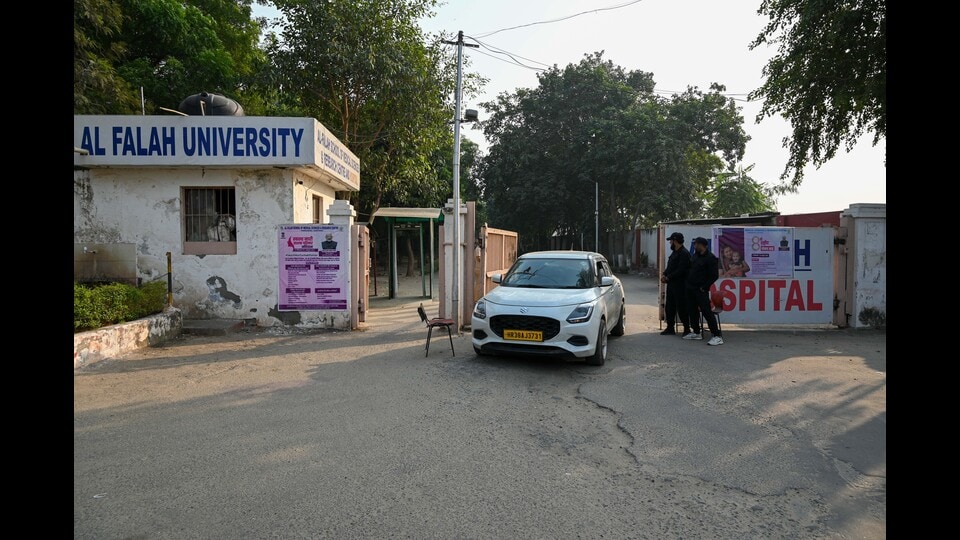
The car was parked inside the college premises from October 29 to November 10, police said, adding that over 800 police personnel have been deployed for extensive combing operations in the area. Police confirmed the car’s 11-day presence inside the medical college viaCCTV footages and witness accounts.
Teams are reviewing CCTV footage, checking hostel and rental logs, tracing phone records, and monitoring bank transactions, while also coordinating with the Jammu & Kashmir Police control room through video calls to pursue leads from the arrested suspects.
Officials involved in the investigation said Dr Mohammad Umar Un Nabi, a key suspect, had taken the car from the college campus to Delhi. Dr Muzammil Ahmad Ganaie, a fourth-year MBBS student from Pulwama, confirmed the car’s presence and movement during interrogation, police said.
A white-collar module and F’bad link
The case, which began with an intelligence input from Jammu & Kashmir Police, has since revealed what officials describe as one of the most sophisticated terror networks led by educated professionals. Investigators have identified Dr Mohammad Umar Un Nabi, a medical practitioner from Pulwama, as the suspected operative who transported explosives to Delhi in the i20 that exploded near Red Fort on Monday evening, killing at least 10 and injuring several others.
The blast, which took place near Sunehri Masjid at around 6:52 pm, was caused by a high-intensity mixture of Ammonium Nitrate Fuel Oil (ANFO), officials said. Umar allegedly worked with Dr Muzammil Ahmad Ganaie and Dr Adil Ahmad Rather, a former resident doctor at the Government Medical College, Anantnag, who was arrested in Jammu and Kashmir last week. Police believe the trio had planned multiple attacks across northern India using explosives stored in Faridabad, but their plans were foiled following the recovery of the cache.
According to Faridabad Police commissioner Satender Kumar Gupta, the explosives were discovered through coordinated raids by the Jammu & Kashmir Police, Intelligence Bureau (IB), and Faridabad Police, based on leads from Rather’s interrogation. “The network runs deep and is under active investigation. We are verifying how long Dr Umar had been employed in Faridabad and his connection with the other accused,” said Gurugram assistant commissioner of police (Crime) Varun Dahiya, who is supervising the probe in Faridabad.
Police said over 800 personnel conducted sweeping operations across Dhauj police station and Fatehpur Taga limits on Tuesday morning. “Our teams are sweeping every lane, house, and field to ensure nothing is missed,” Dahiya said. Officials believe the ammonium nitrate was stockpiled in phases and distributed to separate modules for planned coordinated blasts across NCR and beyond.
The car trail
Investigators said the Hyundai i20 was parked at Al-Falah Medical College for 11 days before being taken to Delhi. Students told police another Maruti Suzuki Swift car often parked near the hostel belonged to Dr Muzammil, though it was registered under Dr Shaheen Shahid, a Lucknow-based doctor associated with the same university. During interrogation, Muzammil told police he used the car to transport ammonium nitrate and made multiple trips between Faridabad and Delhi to his rented rooms, where explosives and timers were stored.
Police records show the i20 was purchased on October 29, taken to a pollution control centre in Sector 37, Faridabad, within minutes, and then parked inside the college. The vehicle was later used to carry explosives to Delhi before it detonated near the Red Fort.
An employee at the PUC centre where the certificate was issued said three people had come with the car. “They didn’t talk anything suspicious, but they told me that they were doctors. They paid me ₹100 extra and left,” he said, requesting anonymity.
Neighbours recall a quiet tenant
At Dahar Colony in Fatehpur Taga, where 2,563 kilograms of ammonium nitrate were recovered, landlady Mehmooda Begum said Muzammil was quiet and rarely interacted. He would come and leave quickly, sometimes with another man. I never saw what he brought in his car, but I often saw him leave quietly,” she said.
Police said the two rented rooms, priced at ₹1,200 and ₹1,400 a month, were allegedly used for storing and assembling explosive materials. The Jammu & Kashmir Police team, stationed in Faridabad, remains in regular contact with its Srinagar headquarters through video conferences, sharing updates on Umar and Muzammil.
“Information shared by Dr Muzammil during interrogation has guided multiple search operations,” a senior officer said. “More recoveries are expected in the coming days.”
Officials said the case exposes a “white-collar module,” a network of educated professionals using their legitimate positions to conceal extremist plans.

Stay updated with all the Breaking News and Latest News from Mumbai. Click here for comprehensive coverage of top Cities including Bengaluru, Delhi, Hyderabad, and more across India along with Stay informed on the latest happenings in World News.


