
 E-Paper



Traffic snarl continues at Sirhaul border over RFID payments
Officials of the concessionaire appointed by the South Delhi Municipal Corporation (SDMC) said that a traffic jam was witnessed from 9.30am to around 1pm, on the second day of digital toll collection, implemented on the orders of the Supreme Court.

 Prefer HTon Google


For a second consecutive day, traffic flow on the Gurugram to Delhi carriageway of the expressway remained slow as Delhi agencies strictly implemented toll collection through radio-frequency identification (RFID) tags and refused to let commercial vehicle drivers pay cash.
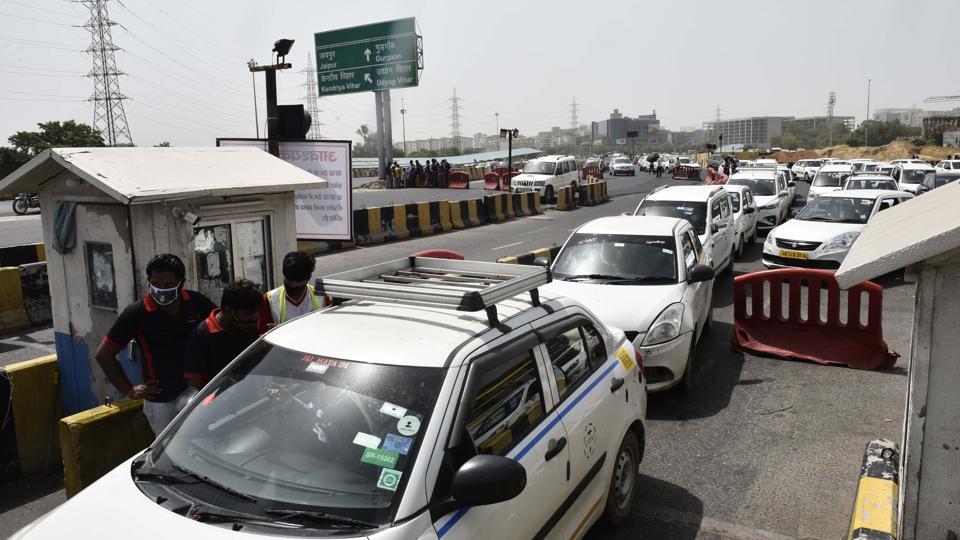
Officials of the concessionaire appointed by the South Delhi Municipal Corporation (SDMC) said that a traffic jam was witnessed from 9.30am to around 1pm, on the second day of digital toll collection, implemented on the orders of the Supreme Court.
A senior official of Sahakar Global Venture JV, concessionaire of the SDMC, said that they are trying to streamline toll collection through FASTags but there were some problems on the first two days. “We are issuing RFID tags on the spot and also asking vehicle operators to maintain [minimum] balance. Due to lockdown and lack of business, the truck owners are reluctant. We are also working with Gurugram and Delhi traffic police to ensure there are no jams,” the official said.
Ravinder Tomar, the deputy commissioner of police (traffic), Gurugram, said that they have asked the concessionaire to collect the toll in lanes dedicated for the SDMC so that traffic is not affected on the main carriageway. “We have also asked them to install signage at different spots so that commercial and other traffic gets segregated. A meeting will be held again on Friday to discuss the matter. The issue of congestion will be resolved in the next couple of days,” said Tomar.
The RFID tags issued by SDMC are meant to collect environmental cess and toll from commercial vehicles entering Delhi. These tags are different from the ones issued by the National Highways Authority of India (NHAI), said officials.
An order issued by Hemant Kumar Fauzdar, additional deputy commissioner (toll tax), SDMC, on July 1, stated that the Supreme Court and Commission for Air Quality Monitoring have directed a cashless collection of environment compensation cess (ECC) and toll for specified commercial vehicles entering Delhi. “It has also been directed that commercial vehicles without RFID tags and sufficient recharge be not permitted to enter Delhi from July 1,” the order stated.
Commuters, meanwhile, said that the traffic situation worsened after 11am as trucks and container vehicles started lining up. “Vehicles were stuck from Sirhaul border up to Shankar Chowk, and even beyond,” said Parvesh Kumar, a commuter.
Another commuter, requesting anonymity, said that many people bound for the airport suffered due to the delay as many vehicles either did not have the RFID cards or did not have sufficient balance. “The jam spills over to the main carriageway and this causes problems to all commuters,” the commuter said.
Bhushan Yadav, a truck driver who was stuck on the service lane, said that he makes only two trips across the border per month, due to which balance is not maintained. “The environment cess, when the truck is empty, is exempted, but despite that, it is being deducted in full through RFID and returned later. We don’t want the money to get stuck in the system as it is easier to pay cash. Also, at some entry points, the payment is manual,” said Singh.


