
 E-Paper



In Bengal, ahead of panchayat polls, Mamata Banerjee and the BJP are back at war
The BJP is gearing up too, having gone through the distress of bagging only 77 of Bengal’s 294 assembly seats in 2021 against an ambitious target of 200.


Kolkata: Since May 2, when Bengal’s ruling Trinamool Congress (TMC) marked the first anniversary of its third successive victory in assembly elections, politics in the eastern state is witnessing a visible change in strategies.
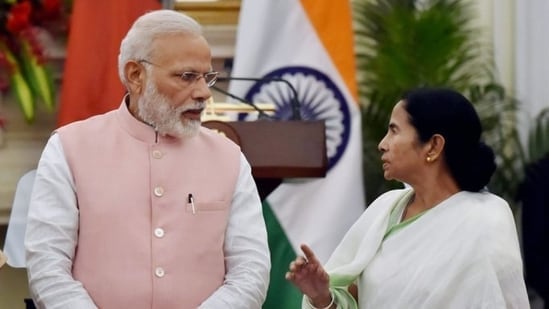
With the crucial panchayat polls scheduled to be held sometime in mid-2023, and followed by the pivotal Lok Sabha contest in 2024, chief minister Mamata Banerjee is simultaneously working on political and administrative measures to counter the Bharatiya Janata Party (BJP).
This comes at a time when many TMC leaders face probes by the Central Bureau of Investigation (CBI) and Enforcement Directorate (ED) in multiple cases. All the probes are being monitored by the Calcutta high court.
After dethroning the Left Front in 2011, Banerjee somehow redefined the concept of proletarian politics that had helped the Communist Party of India (Marxist), or CPI(M), hold on to power for 34 years. She has been perceived as a proponent of populist measures since then. But TMC leaders now say she is tweaking her approach.
“Welfare politics worked wonders for us in every election, barring the 2019 Lok Sabha polls when BJP bagged 18 of Bengal’s 42 seats largely due to the so-called Narendra Modi magic. 2022 has started with a different note. The chief minister is focusing on accountability and results on the ground,” said a senior TMC office-bearer who did not want to be identified.
“She has made it clear that she wants a more proactive administration and a fine-tuned, clean TMC within one year,” the leader added.
The BJP is gearing up too, having gone through the distress of bagging only 77 of Bengal’s 294 assembly seats in 2021 against an ambitious target of 200. The TMC won 213 seats but the numbers have changed since then.
The BJP’s tally in the assembly has effectively come down to 70. Five legislators have joined the TMC although none have resigned from the BJP. After winning four more seats in by-polls and rescheduled elections, TMC now officially controls 217 constituencies. If one takes into account the BJP’s turncoat leaders, TMC’s effective tally has touched 222.
The situation is no different in the civic bodies where polls were held in February.
The TMC swept 1871 of the 2171 seats at 108 municipalities while the BJP ended third in the race with only 63 seats and 12.6 % vote share. The CPI(M), which lost from all parliamentary and assembly seats it contested in four years, regained enough ground to beat the BJP in urban Bengal.
While on his first visit to Bengal since the 2021 polls, Union home minister Amit Shah asked state BJP leaders on May 6 to hit the streets without delay and prepare all organisational units right down to the polling booth level.
“Shah told us to behave like opposition party workers and not as leaders of a party in power at the Centre. He said even Banerjee had to struggle against the Left for years,” a Bengal BJP leader, who attended the closed-door meeting in Kolkata, said.
Mamata Banerjee’s new strategy
The first Bengal chief minister to allow live telecast of all her administrative meetings, especially the ones she holds during her periodic tour of the districts, Banerjee has said during her recent interactions with police and administrative officers that excuses will not be tolerated when it comes to implementation of her social welfare schemes.
Banerjee’s focus is primarily on Swasthya Sathi, the free hospitalisation scheme, and the ones meant for women who comprise almost half of Bengal’s population and a sizeable chunk of her followers.
Prominent among these schemes is the Kanyashree Prakalpa which bagged the United Nations Public Service Award in 2017. Under the scheme, which sanctioned 24.6 million applications till May 26, monetary support is given to girls so that they may continue their studies beyond high school and do not get married till the age of 18, which is also the minimum age for casting the ballot.
Bengal’s population during the last 2011 census stood at almost 91.3 million and is projected to be 101.9 million now. Of this, 68.13 % lives in villages.
An analysis by the census authorities showed in 2013 that 48.92 % of Bengal’s population was born in or after 1986 and nearly 72% of people aged up to 25 years lived in villages, with almost half of them being women. The same analysis showed that Indians aged below 26 years comprised 52.2 % of the country’s population. In short, Bengal and India show the same demographic pattern.
At an administrative meeting held in Jhargram district in early-March,
Banerjee pulled up bureaucrats for not doing enough to provide potable water in some arid zones.
“If you do not start now, the projects will not be complete before the panchayat polls,” Banerjee said, prompting many to speculate that the elections may be held much earlier than expected.
On March 30, while addressing another administrative meeting in Purulia district - where the BJP holds more assembly seats than TMC - Banerjee brought on stage two villagers who were harassed by some government staff and forced to bribe some traders to get ownership of the land left by their father who died in 2011.
“I want immediate action. If anyone threatens these two men for lodging complaint I will have him arrested. I keep track of everything,” the chief minister said, setting an example of instant justice on live television. The traders were held by police within an hour.
Political observers feel that Banerjee is going full steam ahead with the panchayat polls in her cross hairs because a thumping victory at the grassroots will make her job easier in 2024.
“It has been recorded in Bengal’s political history, especially the one inked by the CPI(M) through successful implementation of the Panchayati Raj, that those who control the villages rule the state,” said Kolkata-based political science professor Udayan Bandopadhyay.
In the 2018 panchayat polls, which witnessed widespread violence and around 20 murders, the TMC bagged around 90% seats, of which 34 % were uncontested. TMC leaders say the party intends to maintain this record but without any violence and also ensure that charges of corruption are addressed.
“Many in the party feel that corruption in the panchayats and the violence in 2018 were largely responsible for the TMC’s debacle in the 2019 Lok Sabha elections. You must have seen Banerjee sending a message to TMC leaders at her recent meetings that she is keeping track of all allegations,” said a TMC leader from Midnapore town where Banerjee addressed party workers in early May.
The TMC chairperson is also altering the mode of functioning of her party. A process is on since February to replace aged leaders with younger ones. Also, state-level officer bearers have been asked to meet workers coming from the districts with grievances.
Banerjee is also being cautious about old colleagues who left her for the BJP and are now heading back.
On May 22, Arjun Singh, the BJP Lok Sabha member from Barrackpore in North 24 Parganas district returned to the TMC. He was a four-time legislator before switching camps 38 months ago. TMC national general secretary and the chief minister’s nephew, Abhishek Banerjee, welcomed Singh to the party at his office on Camac Street in Kolkata and not the party’s state headquarters. The TMC uploaded photos of Singh’s joining on social media but Abhishek skipped the press conference.
This was seen as a calculated departure from norm since Singh’s return was not wholeheartedly accepted by many TMC leaders and workers.
“With Singh’s induction, TMC has secured the Barrackpore Lok Sabha seat prior to 2024 and also the Bhatpara assembly seat that his son, Pawan, won in 2021. This is electoral mathematics,” said TMC’s senior Lok Sabha member Saugata Roy.
What Roy did not say was that a sizeable section of voters in Barrackpore are Hindi-speaking industrial workers from Bihar and Uttar Pradesh who shifted allegiance to the BJP in 2019.
With Singh’s exit, the number of BJP Lok Sabha members in Bengal has come down from 18 to 16.
Former Union minister Babul Supriyo resigned as the Asansol Lok Sabha MP last year after being dropped from the Narendra Modi government and joined the TMC. The Asansol seat, which the TMC could never win, was secured for the ruling party by actor-turned politician Shatrughan Sinha in the April 12 by-poll.
“Many important BJP leaders are eager to join us but we will not open the flood gates,” Abhishek Banerjee said at a workers’ rally on May 30.
The BJP’s roadmap for Bengal
Incidents that took place during Amit Shah’s Bengal visit served as a lesson for the party, senior BJP leaders said.
As the unnatural death of a BJP youth wing leader, Arjun Chaurasia, in north Kolkata raised a storm, Shah paid an unscheduled visit to the site and demanded a CBI probe. Based on information provided by local leaders, Shah alleged that it was a political murder and accused the TMC of unleashing terror.
“Days after Shah left, our central leaders got agitated when Chaurasia’s post mortem report indicated that he died by suicide. Clearly, it was a loss of face for the party. The misinformation provided by our local leaders was a sign of disconnect from ground reality,” said a BJP leader.
“National president J P Nadda stepped in immediately. He has been interacting with Bengal leaders almost every day since then. He wants every state Lok Sabha member and legislator to supervise recruitment and organisational matters at polling booth level and be seen among people on the streets every day till the Lok Sabha polls are over,” said a state committee member.
Nadda is scheduled to visit Bengal in the first week of June.
The booth-level programme, named Booth Sashaktikaran Abhiyan, was launched on May 25.
“Nadda Ji has said that all MLAs and MPs must go door-to-door and meet people,” said Suvendu Adhikari, the leader of the opposition in the Bengal assembly who left the TMC and switched camps in December 2020. Adhikari and BJP state president Sukanta Majumdar led the first programme in Nadia district.
“Nadda is equally concerned about the internal squabbles in the Bengal unit,” said a state committee member.
Rumblings against the current leadership touched a high on April 21 when former state president Dilip Ghosh (who is now a national vice-president) called Majumdar, his successor, an “inexperienced” leader who has “come recently.”
Both leaders are also members of the Lok Sabha.
Majumdar, who took over as state president in September last year, shot back saying Ghosh too was inexperienced when he was made state president in 2015, six months after he was loaned to the party by the Rashtriya Swayamsevak Sangh (RSS), the ideological parent of the BJP.
Majumdar has been drawing criticism from sections of the rank and file ever since the Bengal unit witnessed an organisational reshuffle in December. Quite a few old-timers at the state and district levels were replaced. Some of them were known loyalists of Ghosh.
In a major move, BJP central leaders summoned Ghosh to Delhi on May 24 when a five-member national committee was formed to supervise polling booth organisations in states across India till the 2024 polls are over.
Ghosh was given charge of eight states; Nagaland, Mizoram, Manipur, Sikkim, Bihar, Jharkhand, Odisha and Andaman. As an RSS pracharak, he had worked in some of these states.
This is being seen as a move to keep Ghosh away from Bengal so that Majumdar and Adhikari can work independently.
“I have always accepted every responsibility given by the party,” said Ghosh under whose leadership the BJP wrested 18 Lok Sabha seats in 2019, setting an all-time record.
A section of BJP old-timers strongly feels that in a state where Marxist politics focused on the fight between the proletariat and the bourgeoisie for three decades and Mamata Banerjee emerged as an alternative to the CPI(M) principally because of her down to earth image, the BJP should adapt to the ground reality.
Political observers feel the same way.
“The BJP has to imbibe the reality of Bengal which is somewhat Left oriented. Mamata did it too. She became a Leftist within the Congress. The mind of the average Bengali is not calculative. It is emotive and people-oriented. If a party can incorporate this factor in its politics, it can win people’s confidence,” said Udayan Bandopadhyay.
Where the Left and Congress stand
In 2019, a major shift in Left votes was found to be the principal reason behind the BJP’s meteoric rise in Bengal but after the CPI(M) turned around in the civic polls the BJP claimed that this sudden resurgence was “sponsored” by the TMC.
The CPI(M) has started preparing for the panchayat and Lok Sabha polls under the leadership of its new state secretary Md Salim, a member of the party’s Politburo.
“People have realised that BJP and TMC are working as partners. Their so-called conflicts are part of a mock fight meant to fool people. Hence, common people are supporting the Left once again because only we fight for their interests,” said Salim.
Bengal Congress president Adhir Ranjan Chowdhury has so far kept quiet on whether his party will renew its alliance with the Left in the coming polls. The Congress could neither win a seat in the assembly nor secure any civic body in February.
 ABOUT THE AUTHORTanmay Chatterjee
Tanmay Chatterjee has spent more than three decades covering regional and national politics, internal security, intelligence, defence and corruption. He also plans and edits special features on subjects ranging from elections to festivals.Read More


