
 E-Paper



750-km additional roads, parking hubs, skywalk proposed to ease traffic congestion in Lucknow
Comprehensive Mobility Plan has been drawn up to make commuting smoother for a projected population of around 66.5 lakh in the state capital by 2031; it awaits nod

 Prefer HTon Google


Development of nearly 750 km of additional roads, expansion of the city bus network, 1,330 km of footpaths, a pedestrian skywalk between Hussainganj and Burlington crossings, multiple off-street parking hubs and eco-mobility corridors along the Gomti river are part of the Comprehensive Mobility Plan (CMP) that the the Lucknow Municipal Corporation has drawn up to ease commuting for a projected population of around 66.5 lakh in the state capital by 2031.
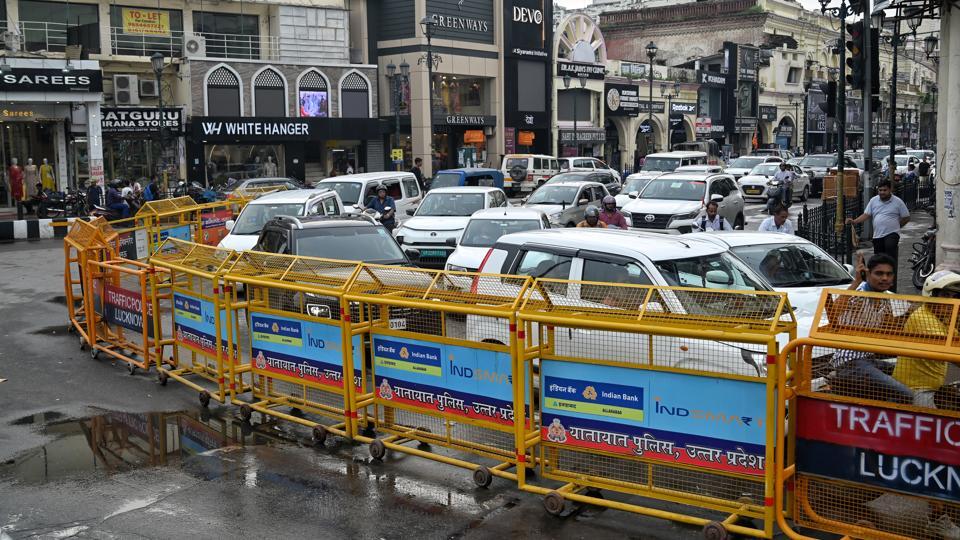
The fresh plan, which has come after years of experiments with various schemes to decongest traffic failed to yield desired results, is likely to be presented before the divisional commissioner on Monday.
“The CMP is a vision document that integrates land use and transport, keeping in mind the challenges of a growing city like Lucknow. It is designed to make mobility safe, sustainable and convenient for all citizens,” said Muzafar Nazmi, executive engineer (traffic) at LMC and in-charge of the project.
According to the draft report shared by the LMC official, the CMP has been prepared by a private agency Urban Mass Transit Company (UMTC).
The agency bagged the tender floated by the state government and signed an agreement with the Lucknow Municipal Corporation after extensive primary and secondary surveys, involving multiple government bodies – Lucknow Development Authority, National Highways Authority of India, Public Works Department, Uttar Pradesh State Road Transport Corporation, Railways, UP Metro, and Smart City project.
“Earlier, various methods were adopted by officials and departments, including free left turn at various intersections along with placing of barricades, use of AI to prevent traffic congestion in the state capital. Now, the LMC is bringing the revised CMP plan. An earlier CMP was introduced in the city in 2013 keeping in mind the traffic congestion back then. But as the city is growing, the new plan has been prepared,” Muzaffar added.
According to surveys conducted for the CMP, the city suffers from inadequate bus supply, over-reliance on e-rickshaws and tempos, absence of cycle tracks and footpaths, and growing use of private cars and two-wheelers. All of these have combined to increase pollution and reduce the efficiency of urban mobility.
What the plan proposes
Road network: Development of nearly 750 km of additional roads, including missing links, elevated corridors, and the Lucknow-Kanpur Expressway link. About 54 km of roads inside the city will be widened by removing encroachments and illegal parking. Another 110 km outside the core city will also be widened.
Grade separators and flyovers: Four new grade separators and two railway overpasses have been identified to reduce bottlenecks at critical junctions.
Public transport: Expansion of the city bus network, creation of high-demand public transport corridors, and rationalisation of tempo and e-rickshaw routes to reduce chaos.
Pedestrian infrastructure: Development of 1,330 km of footpaths in phases, including 32.8 km in the old city, along with 7.1 km of cycle tracks. A pedestrian skywalk between Hussainganj and Burlington crossings and eco-mobility corridors along the Gomti River have been proposed.
Parking management: Establishment of 19 off-street parking hubs to reduce on-road encroachment, in addition to 173 marked on-street locations identified by LMC.
Freight management: A logistics park, freight parking zones, and a low-emission transport zone are planned to decongest roads used by heavy vehicles.
Smart roads: Junction improvement and smart traffic management systems will be implemented at key city intersections.
People-first approach: Citizens stand to benefit directly from the proposals. For pedestrians, over 1,300 km of footpath network will ensure safer walking spaces, particularly in the congested old city. For cyclists, eco-mobility corridors and cycle-friendly streets are planned for long stretches.
Shop owners in core areas such as Aminabad and Qaiserbagh, where roadside parking clogs movement, welcomed the parking proposals.
“Customers avoid coming because of jams. If off-street parking is created, business will also improve,” said Arif Hussain, a garment trader in Aminabad.
The CMP has gone through several rounds of stakeholder consultation. A meeting chaired by divisional commissioner on July 14 this year brought in suggestions from UP Metro Rail Corporation, PWD, Airport Authority, and the Bridge Corporation. After incorporating their feedback, the final CMP was submitted on September 7.
“Lucknow’s biggest challenge has been fragmented planning across different agencies. This plan brings them together under a single vision. Success will depend on timely funding and political will,” said a senior urban planner involved in the study.
An HT report published in July highlighted the CMP is aimed at regulating public transport, managing traffic flow, and improving overall urban mobility under a long-term vision.
A senior LMC official said the CMP focuses on building a safer, more efficient, and sustainable transport system for the city, which has been grappling with growing traffic pressure due to unregulated e-rickshaws and buses, according to the earlier report.


