E-Paper



Amid Opposition protests, UP govt presents ₹59,019.54 crore supplementary budget
Speaker suspends Samajwadi Party MLA for the entire session; Yogi accuses SP of showing disrespect to the House; presented months before the 2027 UP assembly polls, the supplementary budget has significant allocations for the energy, industrial development, health, agriculture and social welfare sectors

 Prefer HTon Google


Amid the Opposition’s vociferous protest over the alleged theft of donations from the Ram temple, the Uttar Pradesh government presented its first supplementary budget of ₹59,019.54 crore for 2026-27 on the second day of the Monsoon session in the state assembly on Tuesday.
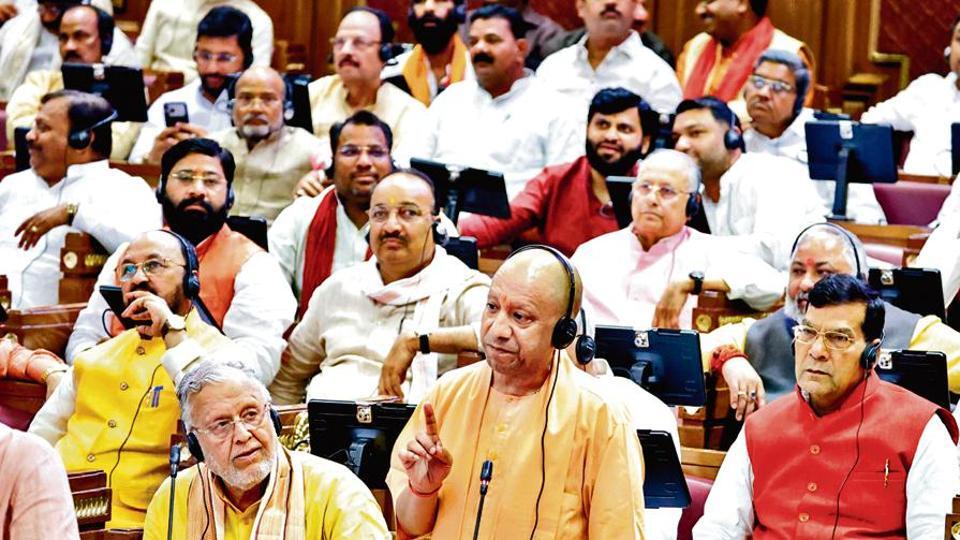
The presentation of the supplementary budget, months before the 2027 assembly elections, by finance minister Suresh Khanna turned into a political showdown inside the House, with treasury and Opposition benches trading sharp barbs.
The supplementary budget is around 6.47% of the annual budget of ₹9,12,696.35 crore presented by the state government in February this year. An allocation of ₹7,854.25 crore has been made for new demands.
All through the day, Opposition MLAs adopted an aggressive posture and intensified their protest, leading to repeated disruptions.
As soon as the House proceedings began at 11am,
Leader of Opposition Mata Prasad Pandey demanded a discussion under Rule 311 on the alleged theft of Ram temple donations but the speaker refused, stating that there was no crisis of such magnitude to warrant it.
At this, SP MLAs stood up from their seats and began shouting slogans. Though the speaker asked the SP MLAs to resume their seats, the sloganeering continued.
Following this, the SP MLAs moved into the Well of the House with placards and staged a sit-in.
Responding to the protests, Suresh Khanna said, “They had ordered firing on Ram Bhakts. They obstructed the construction of the Ram Mandir and fielded dozens of lawyers against the temple in the Supreme Court. We witnessed their true colours in 1990.”
The speaker adjourned the House till 12.20pm but the Opposition members continued the sit-in.
After the House reconvened, Khanna presented the supplementary budget amid continued sloganeering and protests by Opposition members, who accused the government of ignoring their concerns.
Despite the uproar, the government proceeded with the supplementary budget presentation.
The Opposition continued its protest even as chief minister Yogi Adityanath came to address the House. The chief minister could not complete his speech.
Later, addressing the media, he said, “A discussion cannot be held in the House if a matter is in court. At the all-party meeting, the Samajwadi Party had assured they would give proper notice for any discussion, but today they showed disrespect to the House.”
The speaker objected to SP MLA Sachin Yadav for taking pictures and asked the marshall to take him (MLA) out of the House to which the member objected. Mahana then suspended Sachin Yadav for the entire Monsoon session for holding a protest during the CM’s address. The speaker also adjourned the House again, this time for the entire day. The SP MLA later staged a sit-in at the Chaudhary Charan Singh statue on the UP legislature building campus.
Presenting the supplementary budget, the finance minister said, “The size of the proposed supplementary budget for the financial year 2026–27 is ₹59,019.54 crore. Revenue expenditure is ₹17,399.50 crore while capital expenditure is ₹41,620.04 crore.”
The total magnitude of the presented supplementary demands is ₹59,019.54 crore. After deducting the Central share of ₹11,240.97 crore receivable for Central schemes, the net expenditure burden on the Consolidated Fund stands at ₹47,778.57 crore.
“The purpose of the supplementary budget is primarily to ensure the completion of our ongoing schemes and to provide funds wherever necessary for essential works in the public interest. I believe this budget will certainly help accelerate development,” he said.
The supplementary budget has significant allocations for the energy, industrial development, health, agriculture and social welfare sectors, with ₹7,422 crore allocated to the energy sector and ₹1,655 crore earmarked for the social welfare department. The agriculture department has been allocated ₹132.38 crore under the revenue head and ₹159 crore under the capital head.
The health sector emerged as one of the major beneficiaries of the supplementary budget. Allopathic medical services have been allocated ₹1,100 crore under revenue expenditure and ₹96 crore under capital expenditure.
An additional ₹704.25 crore has been provided for family Welfare programmes, while ₹60.65 crore has been earmarked for public health services. The government has also allocated funds for the expansion of Ayurvedic and Unani healthcare facilities.
The Uttar Pradesh government had presented an annual budget of ₹9,12,696.35 crore for FY 2026-27, comprising ₹6,64,470.55 crore revenue expenditure and ₹2,48,225.80 crore capital expenditure. With the addition of the ₹59,019.54 crore supplementary budget, the overall size of the state budget will increase to ₹9,71,715.89 crore.
Meanwhile, as proceedings were adjourned within 10-20 minutes of the start, Question Hour could not be taken up.