
 E-Paper



BHU vice chancellor says learning has a lot of layers, stresses communication with students
BHU vice chancellor Sudhir K Jain says the topmost priority is building the culture and atmosphere where people are motivated and spirited


Professor Sudhir K Jain completed eight months in office as the 28th vice chancellor (VC) of Banaras Hindu University (BHU) recently.
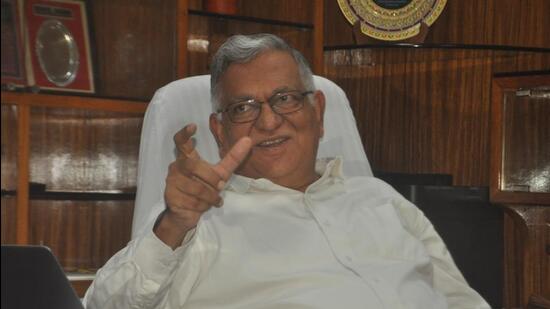
Jain, former director of IIT Gandhinagar, is an internationally acclaimed scholar of earthquake engineering, who was conferred the Padma Shri for his distinguished service in the fields of science and engineering in 2020. Hindustan Times interviewed the BHU VC to find out the challenges he faces as an educational administrator and what are the areas in which he thinks more work has to be done to bring change. Edited excerpts:
Q: You have been in IITs and engineering institutions throughout your life, be it as a student or as an educational administrator. How is it being in a university? Which one do you find more challenging, an IIT or a university?
A: Yes, it’s right that I am new to the university system. I have come from a totally different ecosystem but as I used to tell my students that they must keep learning throughout their lives, the same applied on me, too. Learning has a lot of layers and it never ends. Hence, as I do my job keeping in mind the best interest of the institution, I continue to learn, too. IITs are a different set-up and have their own challenges and requirements. Similarly, the university system has its own set of challenges. So, one can’t just say which one is more challenging and which one is easier.
Q: You have been in office for almost eight months. I am sure you may have already shaped many of your plans. But still, tell us about your topmost priorities as BHU vice chancellor?
A: The guiding principles of running an educational institution have three basic elements. First, getting good and talented people be it students or staff. Second, treating them well by providing resources and infrastructure to work and grow. Third, building a culture of mutual respect and cooperation, which encourages them to work and contribute. Once we achieve the third one, we shall be able to fulfil the first two. Our topmost priority is building the culture and atmosphere where people are motivated and spirited. BHU has enormous talent, it has ample resources in terms of infrastructure. We are now focusing on building a culture and ensuring good governance which makes people strive together.
Q: I have had the opportunity to look at recent initiatives taken by Banaras Hindu University, of course after you took charge. One among them is ‘Teach for BHU’. What made you come up with such a scheme? What’s the progress in that regard?
A: A university is like a human body. You have to work on each part of that body. It’s not like you focus on one limb and ignore others. Similarly, we are working for the growth and empowerment of all the sections of this great institution. This idea was at the core of ‘Teach for BHU’ fellowship scheme as we wanted to make sure that the precious time of our brightest research scholars does not get wasted as there is a huge time gap between the date of submission of their Ph.D. theses and the award of degree. So, those selected under the scheme on the basis of merit and performance, will be offered a fellowship to work and teach in BHU for one year. This will help these brilliant scholars get exposure for their upcoming professional lives. We have already made selections under this fellowship and a number of such fellows are currently working in BHU.
Q: Despite new initiatives, we also see BHU being in the news for unwanted reasons. What do you feel the university can do to address that?
A: Situations which you have described as unwanted or undesirable will not happen if we are consistent. Consistent in our working, be it admissions, selections or other parts of administration and academics. Once we become consistent in our functioning and practise utmost transparency, situations like these will not arise. Secondly, there could be occasions where lack of communication between the university and those protesting, could be one of the reasons. So, we are working to make sure that there is constant communication and interaction with students and other stakeholders. So clearly, we need to improve our systems and we are working on it. Another important aspect is that when certain events get unnecessary limelight, others also get encouraged to join the camp. Hence, there is also a need to highlight the constructive and positive sides.
Q: I read that alumni relations and outreach are your expertise. BHU has a massive alumni base. How do you plan to tap that? Also, when is BHU planning its alumni meet?
A: Yes, we will have an alumni meet when we are prepared for it. BHU’s alumni are its biggest strength. We are trying to connect with as many alumni of BHU. All the more, we have formed a group in the United States and are making efforts to widen this network. We are also in the process of maintaining a proper and detailed database of BHU alumni. The alumni of BHU have a very strong sense of connection with Banaras Hindu University and have a very important role to play in the university’s growth and progress.
Q: You also launched a major donation campaign Pratidana soon after you took charge. How has been the overall response to that? Would you like to share the broad figure of donations BHU received?
A: Mahamana built a university like this from the contribution and donations of people who were not even students of the university and had not been benefited.
BHU now has a massive alumni base and we hope that with their cooperation and guidance we will take the university to newer heights. There is a lot yet to be achieved and we are working on that.
Q: Let’s talk about rankings. BHU has slipped in NIRF rankings. What are the areas you are focusing on to enhance BHU’s rankings, nationally and globally?
A: I feel that rankings anywhere are not a true reflection of the strengths and capabilities of universities. I fail to understand how an institution climbs up several levels all of a sudden in a year and the other slips down sharply. So, there are some flaws that don’t do justice to institutions completely. However, rankings are also a great opportunity for institutions to self assess and look at things that need to be done in a more professional and efficient way. It is also an occasion to prepare and manage data and information about the overall performance and realise what more needs to be done. This is a good thing.
Q: What are the major initiatives Banaras Hindu University has taken in order to improve student facilities and infrastructure?
A: I have been trying to be consistent. I treat everyone in the same way irrespective of their position of designation. We need to earn the confidence and trust of our people. We are working on making things hassle free and easier. Efforts are being made to make things easier so that people do best what they are supposed to do and not get stuck in bureaucracy and administrative hurdles. One key initiative in this regard is the Sponsored Research and Industrial Consultancy Cell, which will be a single point platform for faculty members, researchers and scientists to manage their projects. Earlier they had to run from pillar to post to get things done. Now they don’t need to.
Similarly, we are empowering our students, faculty members and staff. We have started a travel grant for those willing to travel abroad for academic or research purposes. We have also launched a professional development fund which can be used by teachers and staff members for their professional requirements and growth


