
 E-Paper



Breaking stereotypes: Girls shatter gender norms with new skills
Girls in government schools in Uttar Pradesh, India, are breaking gender barriers by learning skills typically associated with boys. As part of the Learning by Doing (LBD) initiative, over 4,800 girls have been trained in various disciplines, including electrical repairs and gardening. The success of the programme has prompted the government to expand it to over 1,700 lower secondary schools. The LBD initiative, established by Unicef in partnership with the Vigyan Ashram and Stars Forum, aims to provide flexible learning opportunities for out-of-school children and those at risk of dropping out.


When Manvi Rawat, a Class 7 student at the Upper Primary School, Aurangabad, Lucknow, makes quick repairs of little problems in electrical appliances or starts to tighten the screws of the doors and latches at home in the just technically correct way, her family feels proud of her. Another girl Lubna Bano, also of Class 7 of the Upper Primary School Machhariya, Kanpur City, has a long list of skills to narrate. She can do blood tests, check blood pressure and do water and soil testing. She knows the basics of gardening and confidently explains the concepts of hydroponics-- the technique of growing plants using a water-based nutrient solution rather than soil.
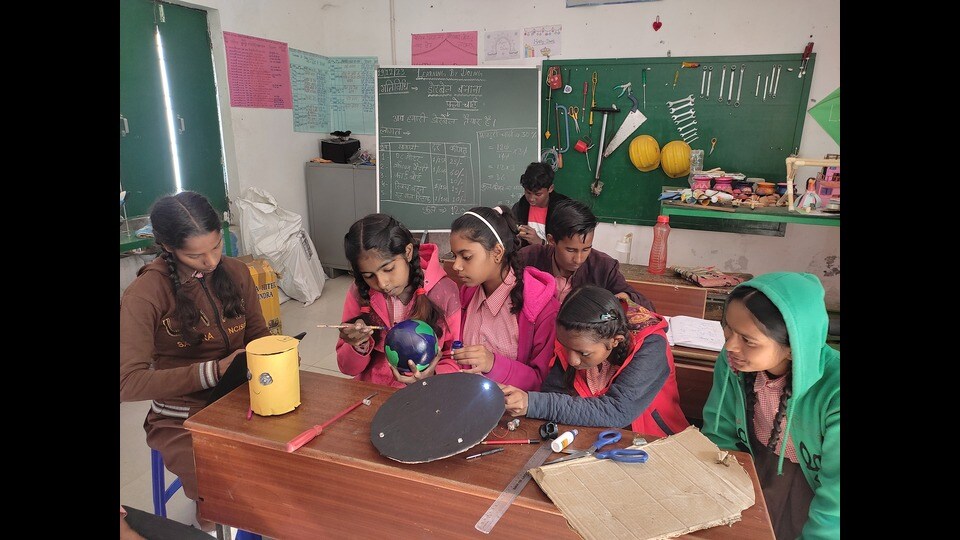
Manvi and Lubna and many other girls of government upper primary and composite schools in Uttar Pradesh have learnt such skills as part of the Learning by Doing (LBD) initiative. Many of the learnings are helping these girls break the gender barrier in their villages, as they are the first ones in their families and vicinity to learn the skills which were otherwise termed as activities and tasks for boys.
As part of the LBD programme 4,841 girls in UP have been trained in different disciplines so far. In all, 9,434 students have been trained as part of the LBD initiative.
Considering the success of the intervention, the government of Uttar Pradesh has decided to upscale the intervention to more than 1,772 lower secondary schools in the coming academic year. Unicef, in partnership with the Vigyan Ashram and Stars Forum established learning laboratories for children in the 11-14 years age-group in government schools.
These labs integrate academic learning with multiple pre-vocational-themed and skills. The intervention, ongoing in 60 schools in 15 clusters of as many cities of Uttar Pradesh, focuses on flexible learning opportunities for out-of-school children, children engaged in income-generation activities and children at a high risk of dropping out of the education system. It also concentrates on accelerated learning for all children, including those enrolled in the schools.
“We are happy that the government of UP is scaling up the Learning by Doing initiative. This will reinforce the mainstreaming of children, especially girls, who are out-of-school, at a high risk of dropping out. Gender stereotypes are being broken as girls are exploring science and technology-based projects,” said Dr Zakari Adam, Uttar Pradesh Unicef chief.
Ritwik Patra, education specialist, Unicef says, “The Learning by Doing initiative has proved that it has a great potential not only for improving the learning levels of children but also transforming their lives through introduction to numerous basic technologies.”
“Initially, when I learnt the concept of circuits and began to repair the basic wires at home whenever there were some issues, my mother looked at me with surprise. She feels proud that I can do many tasks, which were earlier only decidedly male,” said Manvi.
The daughter of a slipper-seller, Lubna, also echoes the same emotion. She says, “We have also been taught to paint walls and do a number of other crafts which we could not even think of doing earlier.”


