
 E-Paper



Chipko Movement needed, but in another form: Chandi Prasad Bhatt
The government must devise a plan to limit the number of people allowed in the hill region each year and stop overuse of land, suggests environmentalist


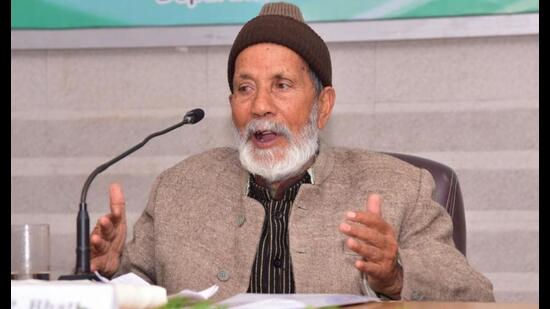
LUCKNOW: Gandhian environmentalist Chandi Prasad Bhatt, 88, is well-known for his outstanding contributions to environmental causes, especially in the Himalayan region. He is the founder of Dasholi Gram Swaraj Mandal, which is regarded as the mother organisation for the launch of the iconic Chipko Movement in the hills. Bhatt is widely regarded as India’s first modern environmentalist, having received the Ramon Magsaysay Award for Community Leadership in 1982, the Padma Bhushan in 2005, and the Gandhi Peace Prize in 2013. In an interview with Aakash Ghosh during his brief visit to Lucknow, he discussed how the Himalayan region is correlated to other parts of India and how it can be kept intact in its original form. Excerpts.
The reason you’re in Lucknow?
I’m here to attend a session titled ‘Preservation of Himalayan Ecology: A current scenario’ as a speaker. The event is organised by the department of sociology, Lucknow University, and Society for Himalayan Environment and People Action (SHERPA).
Is there a need for another Chipko Movement?
The Chipko Movement was a non-violent agitation in 1973 that aimed to protect and conserve trees. The uprising against tree felling and the preservation of ecological balance began in Chamoli district (now in Uttarakhand) in 1973, which quickly spread to other northern Indian states. The name ‘chipko’ comes from the word ‘embrace,’ as the villagers hugged and encircled trees to prevent them from being hacked. We’re in need of such a movement, but in another form as now it’s not only about trees, it is also about rivers, animals, glaciers, etc.
People are not connected to a movement unless it is directly associated with them?
The issues of the Himalayan region are not region specific. Himalayas are the core of India and there would be no India, if there are no Himalayas. Rivers originating from it flow through the entire country and medicines found here are famous worldwide besides religious value attached to the mountains. If something happens in the Himalayas, the entire north to east India will be affected. Recent calamities such as flood, earthquakes are examples of it.
Tourism activity has gone up in the Himalayan region. Does it have any implications?
It has increased, which is good news. Tourism is one of the main sources of income for people of this region. But there must be a balance between supply and demand. We must understand that increase in tourism can have serious consequences, and one may have to pay a high price for it. The government must devise a plan to limit the number of people allowed in the hill region each year and stops overuse of land. Unnecessary infrastructure development, such as roads and highways, as well as tunnels, should be discouraged.
What else can be done?
There is an increase in tourist footfall in Badrinath and Kedarnath. Glaciers are melting at an increasing rate, but we are unable to check pilgrims because it is a matter of faith for them. Vehicular pollution should be checked in the hill region, and if effective steps are not taken, there is always the risk of a natural disaster like the one that occurred in the Uttarakhand region in 2013. According to a 2013 report released by the National Institute of Disaster Management (NIDM), 169 people died and 4,021 went missing who were later presumed to be dead. To avoid such disasters, a committee should be formed that works like one of the important departments of a government. These departments should come out with a solution and its implementation on the ground.
What is your advice to the youth?
Youths are the driving force of any movement. A country with a large proportion of young people has enormous potential. They should now take charge of saving and helping the environment. Growing river pollution is also a major cause of concern. Rivers like Ganga not only represent faith, but also economic prosperity…it must not degrade into a drain.


