
 E-Paper



Consider giving ₹1 cr to kin of poll officials who died of Covid: HC
The bench was hearing a suo motu (on its own) public interest litigation on conditions of quarantine centres and treatment of Covid-19 patients in the state.


The Allahabad high court asked the Uttar Pradesh government to consider giving Rs1 crore to the families of poll officials who succumbed to Covid-19 during the recently concluded panchayat elections and urged the Centre to devise an immunisation plan for the differently abled.
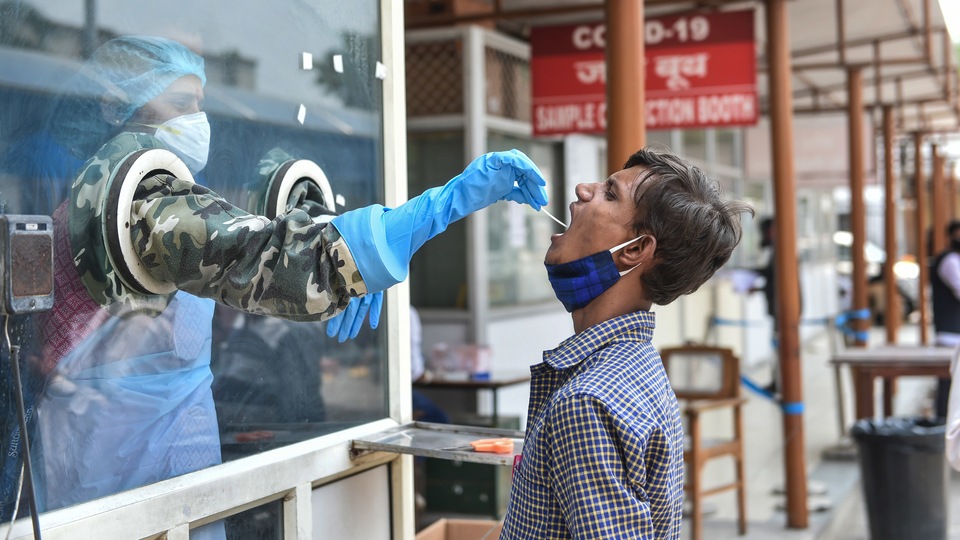
A bench comprising justices Siddhartha Varma and Ajit Kumar also expressed unhappiness about reduced testing, asked the state government to institute within 48 hours a three-member pandemic public grievance committee in every district and said suspected Covid-19 deaths should be treated as coronavirus casualties.
The bench was hearing a suo motu (on its own) public interest litigation on conditions of quarantine centres and treatment of Covid-19 patients in the state.
The four-phase panchayat elections for roughly 800,000 rural body seats was held between April 15 and 29, coinciding with a devastating surge in infections.
The high court and health experts blame the elections for driving the disease in the hinterlands and a prominent teachers’ union claimed that 700 staff died on poll duty. The state government has denied the charges and announced a compensation of ₹30 lakh for the kin of the deceased. But the bench said the amount was too low.
“To compensate the loss of life of the bread earner of the family and that too because of the deliberate act on the part of the state and state election commission to force them to perform duties in the absence of RT-PCR support, the compensation must be at least to the tune of ₹1,00,00,000. We hope that the state election commission and government will rethink over the amount of the compensation and come back to us on the next date fixed,” the bench said in a written order passed on Tuesday but made public on Wednesday.
“It is not a case that somebody volunteered to render his/ her services during election but it was all made obligatory to those assigned with election duty to perform their duties during election even while they showed their reluctance,” the bench added.
The judges also expressed concern about the vaccination of differently abled people and asked the Centre how it will inoculate people who cannot go to vaccination centres or cannot register themselves online. The court then asked the state government if it could form guidelines for inoculating these people even in the absence of central norms. The court said a three-member panel in each district will hear grievances of people related to Covid-19 treatment. Each committee will comprise a chief judicial magistrate or a judicial officer, a professor of a medical college and an administrative officer of the rank of additional district magistrate.
The court was dissatisfied with the government affidavit as no information regarding the number of ambulances in the state or meals provided to Covid-19 patients in government hospitals were provided.
“We want food details with the calories count of each item in respect of the hospitals of all the categories,” it said.
The court said deaths of suspected Covid-19 patients shall be treated as Covid mortality for a limited purpose. “Even if it is the case of suspected death of Covid patients for antigen testing, we are of the view that all such cases of death should be taken as Covid deaths and no hospital can be permitted to hold these cases as non-Covid cases so as to reduce number of Covid deaths in that particular hospital,” said the bench.
“Government officials and the hospitals cannot be permitted to shirk away from their responsibility in ensuring that the dead body of such deceased persons is disposed of strictly as per the Covid protocol. Nobody is admitted to a hospital unless he has landed himself in a condition where the SPO2 level has gone down, ie, below 94 and, therefore, to take such deaths as non-Covid deaths would be a blunder,” said the bench while asking the government counsel to file an affidavit on this issue.
The case will next be heard on May 17.


