
 E-Paper



Hindi, maths, social science to be a must in all madrasas in U.P: Rajbhar
Uttar Pradesh will ensure compulsory teaching of Hindi, maths, and social science in madrasas and plans to improve higher education by affiliating madrasas to a dedicated university.

 Prefer HTon Google


Uttar Pradesh minority welfare minister Om Prakash Rajbhar on Sunday said the government is committed to ensuring compulsory teaching of Hindi, maths and social science in all madrasas in the state.
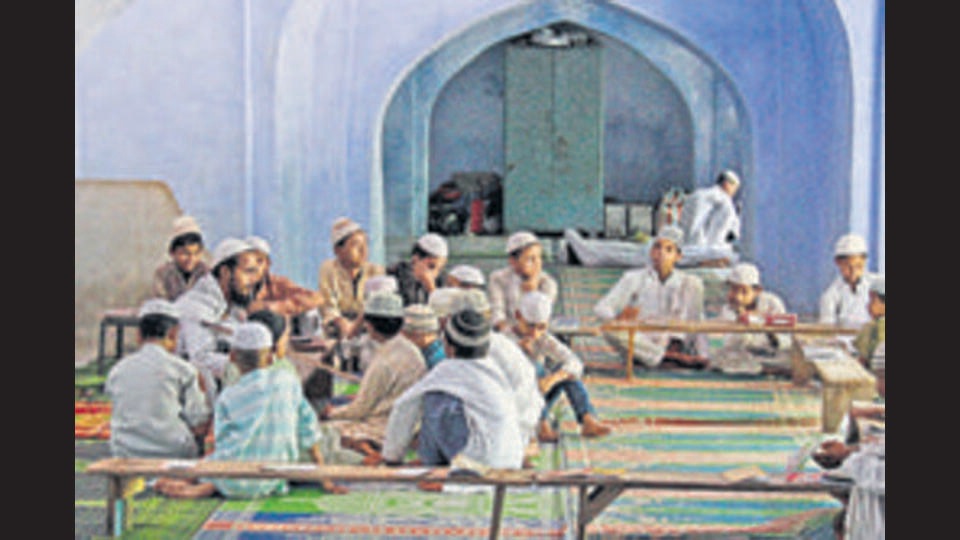
“Madrasas are free to teach Urdu, Arabic and Persian, but the government is committed to ensuring compulsory teaching of Hindi, maths and social science. The later three will be made compulsory for all the madrasas in U.P. The government also wishes to improve the quality of higher education at the madrasas. For that, the department proposes to have a dedicated university for affiliating the madrasas for higher education. Soon, an official proposal in this regard will be made before the government,” Rajbhar said to HT.
Currently, madrasas in the state are recognised by the Uttar Pradesh Board of Madrasa Education.
Uttar Pradesh is home to approximately 25,000 madrasas, of which around 16,500 are recognised by the Uttar Pradesh Board of Madrasa Education. This includes 560 government-aided madrasas. However, a significant number, roughly 8,500 madrassas, remain unrecognised by the board.
On June 7, the National Commission for Protection of Child Rights (NCPCR), sent a letter prompting Uttar Pradesh’s then chief secretary Durga Shankar Mishra to instruct all district magistrates to ensure that non-Muslim children studying in government-funded madrasas be transferred to schools under the Basic Education Council to receive a formal education. Additionally, the NCPCR recommended that children studying in unrecognised madrasas be similarly enrolled in state-run schools.
Maulana Khalid Rasheed Farangi Mahali, a member of the All India Muslim Personal Law Board (AIMPLB) and chairperson of the Islamic Centre of India, said the present Madrasa Board was running the institutions well.
“It’s for the government to sit with stakeholders and discuss before taking any big decision,” he said.


