
 E-Paper



Lots of symbolism, not much authority for ministers of state
Aware of the long history of these ministers of state being relegated to obscurity, chief minister Yogi Adityanath had during a meeting of his ministers urged them to ensure coordination with the “rajya mantris”.


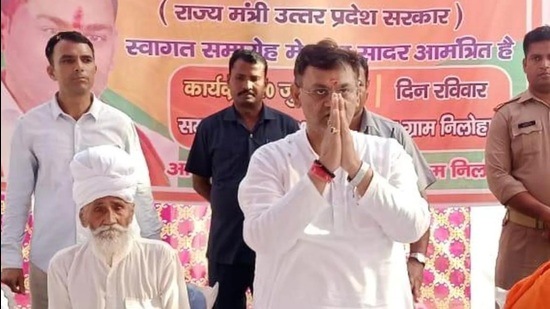
The din around Dalit minister of state Dinesh Khatik’s resignation offer earlier this month and climbdown has reignited an old debate on the “plight” of the “rajya mantris” (ministers of state) and the perception that there has mostly been little work for them.
“The position is mostly ornamental,” agreed Congress veteran Pradeep Mathur.
To be sure, the job of being a minister of state comes with its perks – an official vehicle, a government bungalow, a decent salary and an office.
But that’s about it all – a point that Khatik himself highlighted in his now viral resignation letter in which he had tellingly mentioned a senior bureaucrat rudely disconnecting the line, in the middle of a conversation.
Former U.P. minister Ammar Rizvi said even these perks weren’t there till the 1980s.
“I remember meeting the then chief minister VP Singh to ensure that the junior ministers got a vehicle. I also looked after the estate department then and after the CM’s clearance, I ordered vehicles for these ministers and that has been the practice since,” Rizvi said.
Despite this, the rajya mantris are still mainly dependent on their immediate bosses for authority.
There have been a few exceptions, though. For instance, late BJP minister Brahmadutt Dwivedi got his junior minister to sit alongside him. And the then minister of state for home in the Kalyan Singh government Surya Pratap Shahi (U.P.’s agriculture minister now) had the power to order transfer of police personnel till the level of circle officers in 1991.
Nevertheless, the rajya mantris have usually walked in the senior ministers’ shadow.
“I remember that I had allowed my junior minister the power to transfer officials. But, yes, it largely depends on the cabinet minister,” said Rizvi.
Aware of the long history of these ministers being relegated to obscurity, chief minister Yogi Adityanath had during a meeting of his ministers urged them to ensure coordination with the “rajya mantris”.
The ongoing press conferences of cabinet ministers to detail the 100-day achievements of their departments have featured junior ministers, too.
Yet, as former U.P. minister and Suheldev Bharatiya Samaj Party (SBSP) leader Om Prakash Rajbhar said there is the perception that the junior ministers usually have no work.
“They hardly have any work to do. They just enjoy the perks that come with the post,” said Rajbhar, who was previously a cabinet minister in the first Yogi government from 2017 to 2019.
“There have been stray instances of junior ministers attempting walking up to the chief minister to make themselves heard, as in 1991, when a group of junior ministers went up to the then CM Kalyan Singh seeking job allocation, something that Singh agreed to. Back then, they didn’t have any work, something they got after CM’s intervention. Still, on a regular basis these junior ministers don’t have much work,” said BJP veteran Rajendra Tiwari, who was an MoS in Kalyan Singh’s time.
Barring symbolism, what purpose do these posts serve?
“They bring representation and add value to democratic system where even ordinary people can aspire to become ministers. I think former U.P. chief minister late Veer Bahadur Singh too was a deputy minister once,” said professor Manuka Khanna of Lucknow University’s political science department.
“You, see, in the 1950s and 60s and little beyond, there were four stages of elevation; a parliamentary secretary, a deputy minister, state minister and then a cabinet minister. Perhaps that’s a practice that has continued since though nomenclatures have changed. Now, there are MoS, MoS (independent charge) and cabinet minister,” said Rizvi.
There are interesting anecdotes, like of the time when the then chief minister CB Gupta was travelling and spotted a junior minister moving on an official trip in a train, with a hold-all.
“When asked, the poor minister told the then CM that he was carrying his own luggage so that he can sleep peacefully at night. Perhaps, the circuit houses came up sometime after that, to aid official travel,” said Tiwari.


