E-Paper



Lucknow retains No 3 spot in Swachh rankings, but waste management still a challenge
Mayor attributes city’s inability to climb to 1st or 2nd spot to two key factors: Absence of a functional waste-to-energy plant and the Faizullaganj incident, both of which dented the city’s final survey score

 Prefer HTon Google


LUCKNOW Lucknow retained its third position nationally in the million-plus population category of the Centre’s Swachh Survekshan Awards 2025-26 on Wednesday, becoming the only top-tier city to hold its rank for two consecutive years despite persistent complaints over erratic door-to-door garbage collection, open dumping sites and dusty roads.
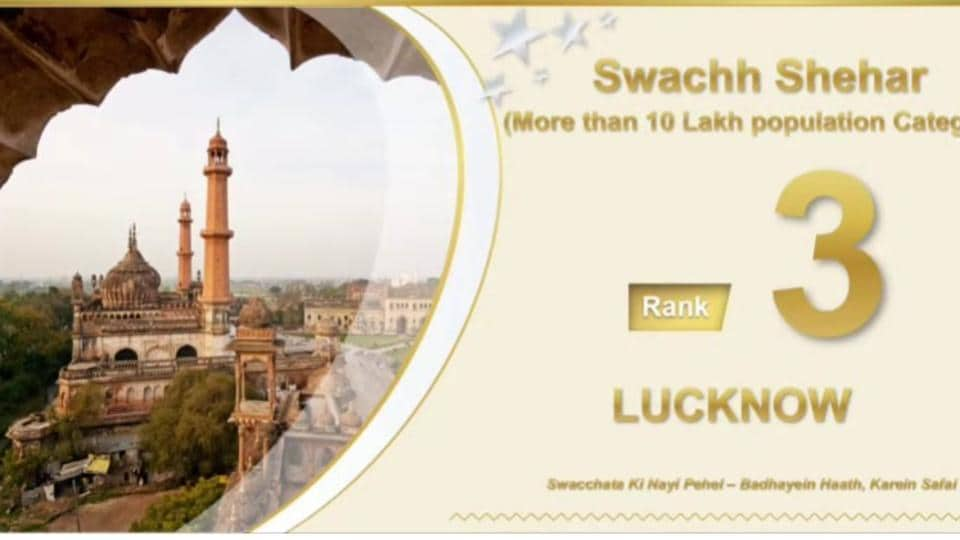
In this year’s rankings, Visakhapatnam (GVMC) bagged the top spot and Jabalpur finished second, displacing last year’s top two finishers, Ahmedabad and Bhopal.
According to the civic body, Lucknow became the only city in the country to retain the third position for two consecutive years. The cities that occupied the first and second positions last year could not retain their respective rankings.
President Droupadi Murmu presented the national award to the Lucknow Municipal Corporation (LMC) at the 10th edition of the awards ceremony at Vigyan Bhawan in New Delhi. Urban development minister AK Sharma, mayor Sushma Kharkwal, principal secretary (urban development) P Guruprasad, and municipal commissioner Gaurav Kumar received the honours on behalf of the city.
Adding to its tally, Lucknow also bagged the first rank nationally among 10-lakh-plus population cities in the Swachh Vayu Survekshan (clean air survey) with 198 points, while Ward 70 (Paper Mill Colony) in Zone 4 was declared the country’s cleanest ward in the above-30,000 population category.
The two recognitions add to the city’s environmental performance record. However, residents continue to face concerns over dust accumulation on roads, construction-related dust and air pollution in several parts of the city. Maintaining cleaner roads and ensuring regular dust suppression remain important challenges for the civic administration.
Gap between rank & reality
The national accolades come amid a stark disconnect between official metrics and the daily sanitation reality encountered by residents. Beyond the city’s VIP zones and prominent stretches, residential colonies continue to grapple with overflowing open garbage dumps, irregular waste collection and severe construction and road dust.
Speaking to HT on Wednesday, mayor Sushma Kharkwal attributed the city’s inability to climb to the first or second spot to two key setbacks: the absence of a functional waste-to-energy plant and the Faizullaganj incident, both of which dented the city’s final survey score.
“We expect to establish the waste-to-energy plant by next year, which will help Lucknow improve its ranking in the next assessment,” Kharkwal said.
Generating over 2,000 metric tonnes (MT) of solid waste daily, the LMC credited its performance to a decentralised collection and centralised processing model, supported by GPS-tracked electric vehicles and digital monitoring dashboards. The civic body also claimed to have scientifically processed two million MT of legacy waste, reclaiming 46 acres of land.
The LMC said it was using electric vehicles to reduce dependence on conventional fuel-powered vehicles and minimise pollution from waste transportation.
However, the effectiveness of these systems ultimately depends on regular door-to-door collection, preventing garbage from accumulating in open spaces and ensuring that collected waste reaches designated processing facilities.
From 269th position to 3rd
Lucknow’s journey in the Swachh Survekshan rankings has seen a significant improvement over the years. The city ranked 269th nationally in 2017, 115th in 2018, 121st in 2019, 12th in 2020 and 2021, 17th in 2022 and 44th in 2023.
In 2024-25, Lucknow secured the third position among cities with a population exceeding 10 lakh and retained the same rank in 2025-26.
3 projects to strengthen waste processing
Currently, while organic waste is turned into compost, the LMC sends refuse-derived fuel (RDF) to cement and paper industries located 400 to 500 km away — a logistically expensive exercise.
The civic body is focusing on three major projects to strengthen its waste management infrastructure. The proposed horticulture waste processing plant will scientifically process leaves, tree trimmings and garden waste generated through landscaping and maintenance activities. The CBG plant will convert organic waste into compressed biogas, providing an alternative source of fuel.
The waste-to-energy plant will process RDF, inert material and non-recyclable waste to generate electricity. The LMC expects the facility to reduce the burden of transporting waste to distant industrial units and strengthen the city’s overall disposal mechanism.
The civic body also reiterated its focus on the zero-dump-site policy, expansion of digital monitoring and greater public participation in waste segregation.
Additional municipal commissioner Arvind Kumar Rao said the LMC has highlighted its achievements in legacy waste processing, waste segregation, electric vehicles, digital monitoring and public awareness campaigns as major contributors to its national ranking.
‘3rd rank reflects stagnation, not achievement’
Congress corporator Mukesh Singh Chauhan questioned the government’s celebration of Lucknow retaining the third position in the Swachh Survekshan for the second consecutive year, calling it a sign of stagnation rather than progress. “Retaining the third position is no achievement when the city has failed to improve its ranking,” he said.
He highlighted garbage accumulation, irregular door-to-door waste collection and poor drainage in several areas. He also demanded details of funds spent on cleanliness, asking the government and municipal corporation to prioritise ground-level improvements over publicity.
In the National Clean City category under Swachh Survekshan, Navi Mumbai secured first rank, followed by Surat in second place and Vijayawada in third place.