E-Paper



North-South Corridor project: Work set to begin on two major highway stretches in Uttar Pradesh
The initiative is aimed at strengthening connectivity between districts along the Indo-Nepal border and southern Uttar Pradesh

 Prefer HTon Google


Uttar Pradesh is set to begin construction on two major highway stretches under its proposed North-South Corridor project. The initiative aims to strengthen connectivity between districts along the Indo-Nepal border and southern Uttar Pradesh.
The North-South project is the first of its kind in the state. Most previous highway developments were planned along east-west routes.
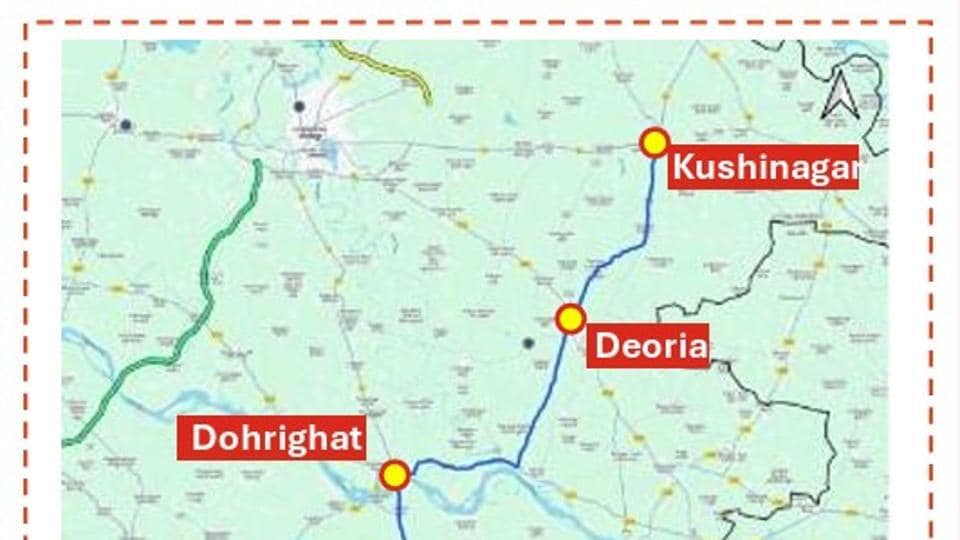
The first corridor to get the go-ahead is the 220-km Kushinagar–Deoria–Dohrighat–Ghazipur–Zamania route. The second is the 295-km Pipri (Indo-Nepal border)–Bansi–Prayagraj stretch. The Kushinagar-Zamania project was sanctioned in the financial year 2025–26, while the Pipri-Prayagraj stretch is scheduled for 2026-27.
“The Kushinagar-Zamania stretch of 220 kilometres has 163 kilometres of national highway/expressway (Purvanchal Expressway). Of the remaining 57 kilometres, a 3.75-km four-lane road already exists and a 53.25-km four-lane stretch was sanctioned last year,” said AK Dubey, chief engineer, UP PWD, headquarters-I.
“Work will begin with land acquisition before the road construction begins. Funds have been sanctioned by the government for the projects,” Dubey said.
The Pipri (India-Nepal border)-Bansi-Siddharthnagar- Prayagraj stretch has 187.6 km of expressway/national highway. Of the remaining 107.40 km, a 9.40-km road was sanctioned last year. For the remaining 98 km (Tanda-Surahupur), 30 km is proposed this year.
The Kushinagar-Zamania route covers 220 km, including 35 km from Kushinagar-Deoria, 22 km from Deoria-Dohrighat, 83 km from Dohrighat-Ghazipur and 80 km from Ghazipur-Varanasi. The last two stretches are functional while the PWD will propose the Kushinagar-Deoria and Deoria-Dohrighat stretches.
The Pipri to Prayagraj via Bansi (Siddharthnagar) corridor will intersect the Shamli-Gorakhpur Expressway, Purvanchal Expressway and Vindhyan Expressway. The total length is 295 km.
In May 2025, the state government asked officials to plan a North-South corridor focusing on connectivity from districts located on the Nepal border to districts in the southern parts of the state.
The other stretches include the 262-km Ikauna (Shrawasti) to Prayagraj via Ayodhya and Sultanpur, divided into four parts, the 502-km Lakhimpur-Sitapur-Nawabganj-Banda route, including seven segments, the 547-km Bareilly to Lalitpur via Agra and Jhansi, the 514-km Mustafabad (Pilibhit Tiger Reserve) to Harpalpur via Shahjahanpur and Orai.
The Lakhimpur-Sitapur and Unnao-Choudagra stretches are already four-lane, while the remaining sections are to be proposed.
The Bareilly-Kasganj-Agra stretch (216 km) will undergo construction and upgradation, while the Agra-Jhansi (234 km) and Jhansi-Lalitpur (97 km) stretches are already four-lane.
The 32-km Mustafabad-Puranpur stretch is proposed, along with Puranpur-Powayan (81 km), Powayan-Shahjahanpur (29 km), and Shahjahanpur-Munder (56 km) stretches.
The Munder-Farrukhabad-Orai stretch will have two segments of 92 km and 125 km via the proposed Farrukhabad Link between the Ganga Expressway and Agra-Lucknow Expressway and via the Bundelkhand Expressway. The Orai-Rath (54 km) and Rath-Harpalpur (45 km) stretches are already four-lane.