
 E-Paper



Ajit Pawar: A career of resilience, controversy and power
He was the first in the Pawar dynasty to make the ideological switch to share power with the BJP.

 Prefer HTon Google


PUNE: For 32 of his 42 years in public life, Ajit Pawar enjoyed power. He was Maharashtra’s deputy chief minister for a record 6 terms across political formulations. But the one position that he openly aspired to—that of the chief minister--eluded him right until the end. His death in an air crash at age 66 has abruptly ended a career marked by resilience, controversy, and an unrelenting drive for relevance at the highest level of power.
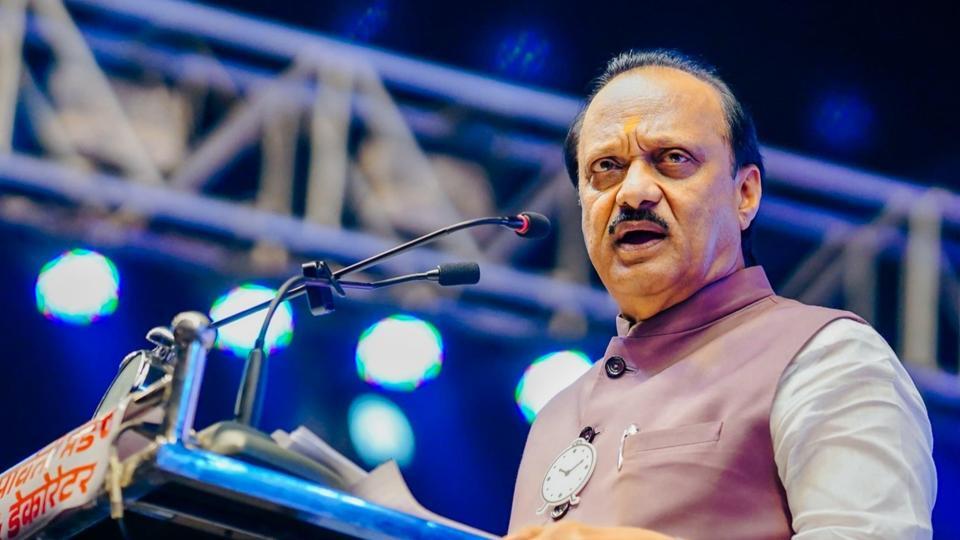
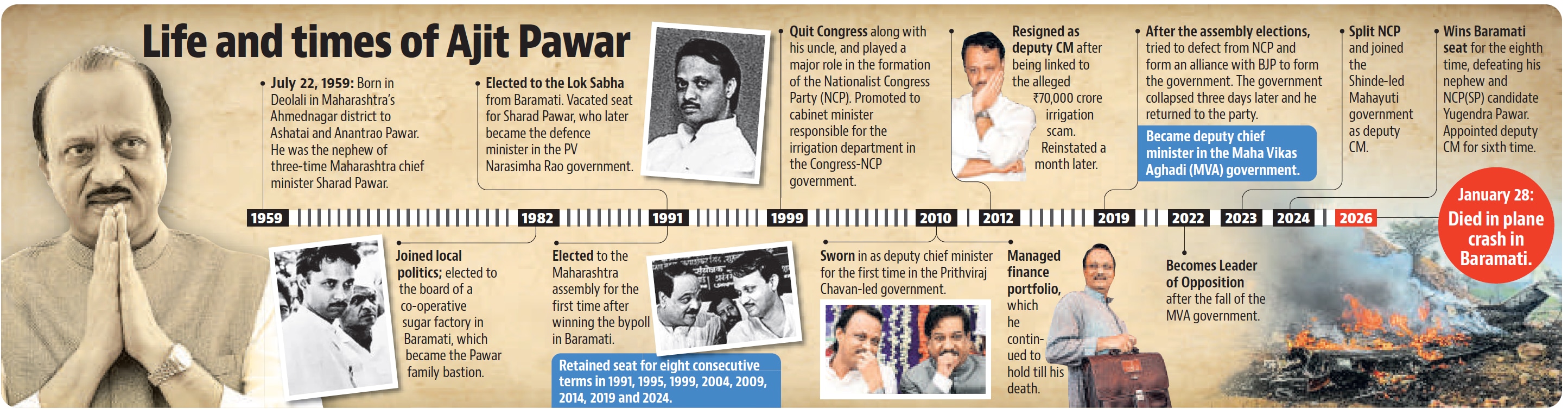
He was the first in the Pawar dynasty to make the ideological switch to share power with the BJP, in the process breaking the party built by his uncle Sharad Pawar, and which was his crucible. The alliance with the BJP-- with its increasingly strident Hindutva tenor--did not always sit naturally with him. But he was also a man dictated by political pragmatism. His brief, 90-hour alliance with Devendra Fadnavis, after the fractured verdict of 2019 assembly elections, was an augury of the events that would eventually define Maharashtra politics.
Also Read | Leader with strong grassroots connect
Ajit Pawar made his first foray in politics when he was elected to the board of a sugar factory in 1982, and was groomed by Sharad Pawar to be his political heir over the years. It was from the uncle that the nephew learnt the virtues of fostering a strong grassroots connection, an unrelenting work ethic so imperative for political success, and administrative chops. But unlike Sharad Pawar, he harboured no national ambitions. “His universe was Maharashtra—especially western Maharashtra—where he was formed in the womb of cooperative politics,” said Mumbai-based political analyst Daniel Francis. “Sugar factories, banks, irrigation boards, and grassroots institutions shaped his political DNA,” wrote Daniel in a post on X.
Ajit Pawar’s political strength came from his deep understanding of grassroots politics and agrarian economy. As western Maharashtra’s rapid urbanisation changed the nature of rural economy, he understood the rural voter’s anxieties and he could also speak to their aspirations. He built networks, controlled resources, managed elections and had the ability to get his colleagues elected or even defeat rivals in their own strongholds. Pimpri Chinchwad and Baramati stand as clear examples of how he combined development with tight political control, transforming these regions in ways which even his political opponents were forced to acknowledge. “In the 1990s, urbanization gained momentum in Maharashtra. Rural areas began tilting toward semi-urbanization, yet the tone of politics there remained rural, even as the nature of their issues started turning somewhat urban. Ajit Pawar had a complete grasp of this kind of politics and the skill to handle it adeptly,” said Raj Thackeray, chief of the Maharashtra Navnirman Sena.
Pawar survived multiple storms in his career, including allegations related to the ₹70,000 crore irrigation scam in 2012 when he was Maharashtra water resources minister and Prithviraj Chavan’s deputy. More recently, he successfully brushed aside the alleged illegalities around his son Parth’s land deal at Mundhwa, Pune. Despite sustained criticism, he retained control over both his party and over key ministries, reinforcing his image as a political survivor.
He did this because of his formidable capacity for hard work, his punctuality—often scheduling meetings at 6 am-- and keen grasp of administrative complexities. The 8-term lawmaker from Baramati also served as Maharashtra’s finance minister for 13 years, and was slated to present his 12th state budget next month.
“I have seen very few leaders who are as disciplined as Ajit Pawar was. In 2010, we took the lead role to run Maharashtra with I being the Chief Minister and Ajit Pawar was my deputy for almost four and half years. We developed some differences but made many decisions in the interest of people. Once he had resigned after a controversy. But after a month, he returned to the cabinet as we managed to convince him. While he presented the state budget multiple times, Ajit Pawar knew the pulse of the cooperative and agriculture sector very well. He had many qualities to lead Maharashtra,” said Prithviraj Chavan.
Affectionately called Dada—a sobriquet he acquired in the 1990s on account of his accessibility and easy demeanor with one and all--Pawar was known as much for his sharp wit as for his blunt and abrasive rhetoric. In 2013, his remarks during a drought and power crisis triggered state-wide outrage. Speaking at a public meeting in Pune district, he had mocked farmers from drought-hit Solapur who were on hunger strike at Mumbai’s Azad Maidan seeking water release. Pawar later apologised for his scatological comment, and even spent a day sitting in penance at the Yashwantrao Chavan memorial at Karad.
Stepping out of the shadow
The limits of his rise however became evident as early as 2004. In the assembly elections that year, the newly formed Nationalist Congress Party won more seats than its ally Congress. By numbers, the NCP had a clear claim to the chief minister’s post. Ajit Pawar later said this was the moment he should have parted ways with his uncle Sharad Pawar. However, Sharad Pawar chose to allow the Congress to take the top post, citing multiple claimants within the NCP and broader alliance considerations. For Ajit Pawar, the decision marked a missed opportunity that shaped the rest of his political career.
“If I have not become a chief minister, it is because of my uncle, but it’s equally true that whatever I am in politics is also on account of my uncle,” he once told a senior journalist in Mumbai. This complicated relationship began to fray further when it became apparent that Sharad Pawar was favouring his daughter Supriya as his heir apparent and not the nephew. The furtive early-morning swearing-in with Fadnavis in 2019 was his first attempt at rebellion against the uncle but which failed, paving the way for Ajit to watch yet another of his peers, Uddhav Thackeray, become chief minister. He had, until then, already served as deputy to Prithviraj Chavan and Devendra Fadnavis.
The most consequential turn in his career came in July 2023 when he finally broke away from his uncle. It was a mark of Ajit’s hold over his party that 40 of NCPs 54 lawmakers chose to leave with him when he joined the BJP–Shiv Sena government, decisively stepping out of Sharad Pawar’s long shadow.
The gamble appeared risky after his party managed to win only one seat in the 2024 Lok Sabha elections and in which his wife Sunetra lost the prestige battle for Baramati to cousin Supriya Sule. But Pawar bounced back months later in the state assembly polls, leading his faction to 41 seats in alliance with the BJP, while the Sharad Pawar-led NCP (SP) could secure just 10 seats. The result consolidated his position within the ruling dispensation and silenced doubts about his political judgment.
After the assembly elections, Pawar focused on strengthening his hold over state finances and planning, especially as Maharashtra’s ruinous populist schemes resulted in the state’s highest-ever budget deficit which he found galling. Despite being part of a coalition with the BJP and the Eknath Shinde-led Shiv Sena, he repeatedly asserted that his decision to join the alliance was driven by development priorities and not a departure from his professed progressive ideology. Even as political circles speculated about tensions within the government — particularly the power balance between chief minister Devendra Fadnavis and deputy chief minister Eknath Shinde — Pawar largely stayed away from public sparring, concentrating instead on his ministries and party organisation.
In the days ahead, attention is likely to turn to the question Ajit Pawar could never fully resolve in his lifetime — whether Maharashtra’s fractured Nationalist Congress Party will remain divided, or whether a reunion is possible without the man who spent his career straddling power and ambition.
Even when internal trust deficit and alliance politics worked against him, Ajit Pawar’s grip on his constituency of Baramati remained intact. In the 2024 assembly elections, despite an all-out effort by Sharad Pawar to defeat him from Baramati, Ajit Pawar emerged victorious with a margin of over one lakh votes. The result reaffirmed his unmatched hold over the seat. His death, as he was about to touchdown at Baramati on Wednesday morning, has sent the town in paroxysms of grief. On Wednesday evening, a visibly moved Sharad Pawar, amid tears, called Ajit Pawar’s death an “irreparable loss for Maharashtra.”


Stay updated with all the Breaking News and Latest News from Mumbai. Click here for comprehensive coverage of top Cities including Bengaluru, Delhi, Hyderabad, and more across India along with Stay informed on the latest happenings in World News.


