
 E-Paper



Festa de Goa brings a slice of the sunny state to Mumbai through art, music, literature
The Festa de Goa celebrates Goa's rich cultural history in Mumbai, featuring music, literature, and art, including fado singer Sonia Shirsat

 Prefer HTon Google


MUMBAI Old Bombay began its rise to Urbs Prima in Indis as a relatively insignificant 16th century province of Portugal’s Estado da India, and administered directly from Goa, where the thriving capital port city on the Mandovi was the first great crucible of East-West globalization in the subcontinent. But three centuries later, with the rise of the Raj, the centre of gravity shifted decisively up the coast, and by the turn of the 20th century at least 20% of Goa’s population had migrated to work in British India, with the bulk in Mumbai.
This cosmopolitan cultural history – with its rich expressions in art, literature, music, food and more – will be celebrated at the Royal Opera House tomorrow, in the inaugural edition of what the curator Asad Laljee promises will become an annual event.
Fittingly, the Festa de Goa begins with Konkani, the state language of Goa with a unique history of dispersal – it is the only language in the world in daily use in five different scripts – and revival. That long road back began in Bombay during World War II, with the founding of the Konkani Bhasha Mandal by Armando Menezes and Shenoi Goembab, and it was expatriates who kept the literary language alive until its contemporary renaissance at the hands of exemplars like Damodar Mauzo, the Jnanpith Award winner who will discuss the ‘Konkani City’ with writer Jerry Pinto and former editor of Art India Abhay Sardesai.
Author and editor Naresh Fernandes will explore ‘Goans in the Musical Conversation between India and the World’ who he says are “heard but unseen.” Journalist Jane Borges and oral historian Malvika Bhatia will share images and stories from their archival project Soboicar, about Konkani Catholics in the making of the city, and author and Art India editor Reema Desai Gehi – whose new book is ‘The Catalyst: Rudolf von Leyden and India’s Artistic Awakening’ – will speak with Dadiba Pundole and myself about Francis Newton Souza, the “boy from Crawford Market” who became one of the great painters of the 20th century. In addition, ‘The Memory Keepers and Future Seekers: Portraits of Heritage Homes in Goa’, a new book of photographs by Ulka Chauhan, will be launched and Chauhan will be in conversation with art critic Samira Sheth and renowned architect Dean D’Cruz.
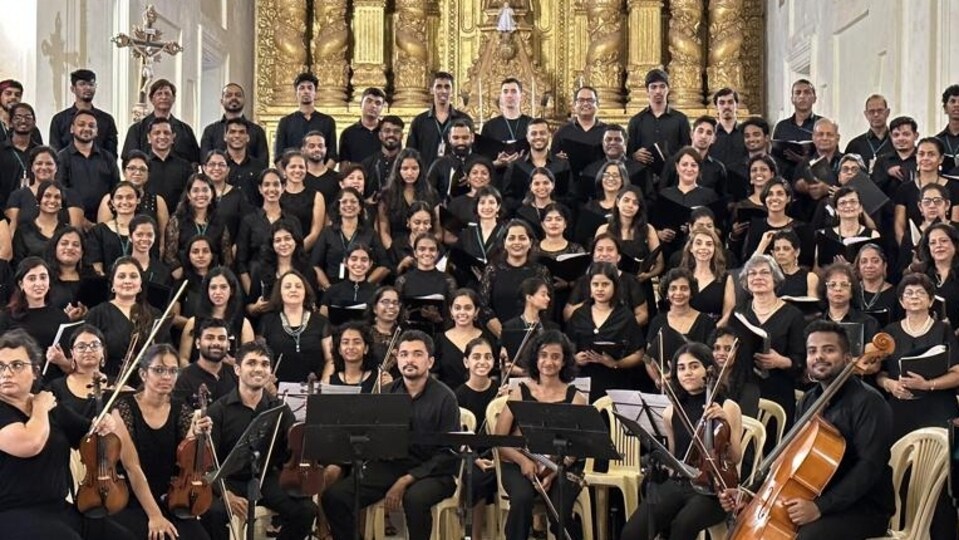
All this is important context for the main event of the Festa de Goa, which is an unprecedented evening of music from Goa featuring the superb fado singer Sonia Shirsat, and the highly impressive Stuti Choral and String Ensemble (they are 88 choristers, 21 string players and three pianists) conducted by Parvesh Java, who was born and raised in Bandra but now lives and works in North Goa.
Said Java, “While it’s very exciting to be a part of Festa de Goa’s fabulous line-up of presentations, I suppose my greatest joy is to finally bring my work from the place I call home to the place I grew up in. It’s peculiar to take something which I believe to be so fundamentally Goan out of Goa. But the music is universal and can bridge any gaps there might be.”
Actually, both Shirsat and Java are important catalysts, who have managed to achieve something new and unique in the Indian cultural landscape. In the case of the great fadista, the Portuguese ethnomusicologist Susana Sardo said that “she doesn’t merely sing fado; she embodies it. However, Sonia is not only an immensely talented performer; she’s also a remarkably creative artiste with an insatiable thirst for knowledge. She continually seeks to expand her horizons [and] what sets Sonia apart is her willingness to share the fado tradition with others, a remarkable trait. In this pursuit, she established the world’s first school of fado. It’s intriguing to note that there has never been a formal school of fado in Portugal, making this situation quite peculiar. For those seeking to learn fado, the most promising avenue may well be to journey to Goa!”
This is also the case with Stuti, about which Java said, “The most significant thing is our ability to do very serious large-scale classical repertoire entirely locally and our commitment to create masterworks with a nearly 100% Indian musician force is significant. I have had the most unbelievable time exploring this rich musical heritage of Goa along with the choristers. We’re especially itching to sing the Konkani music. No choir has ever sung Chris Perry and Lorna songs ever before in four voices! What a thrill!”
(Catch Festa de Goa at the Royal Opera House on October 5, between 4 and 10 pm.)


