
 E-Paper



Mumbai: City’s ‘moderate’ AQI is a result of pollution monitors not working
Mumbai's air quality data is flawed, as many monitoring stations were non-functional, raising concerns over the reported "moderate" AQI levels.

 Prefer HTon Google


MUMBAI: If Mumbai’s air quality has lingered on the “moderate” level lately, it must be known that air quality readings since December 15 have been calculated using data from a limited number of monitoring stations, raising concerns over the legitimacy of the Air Quality Index (AQI) reported.
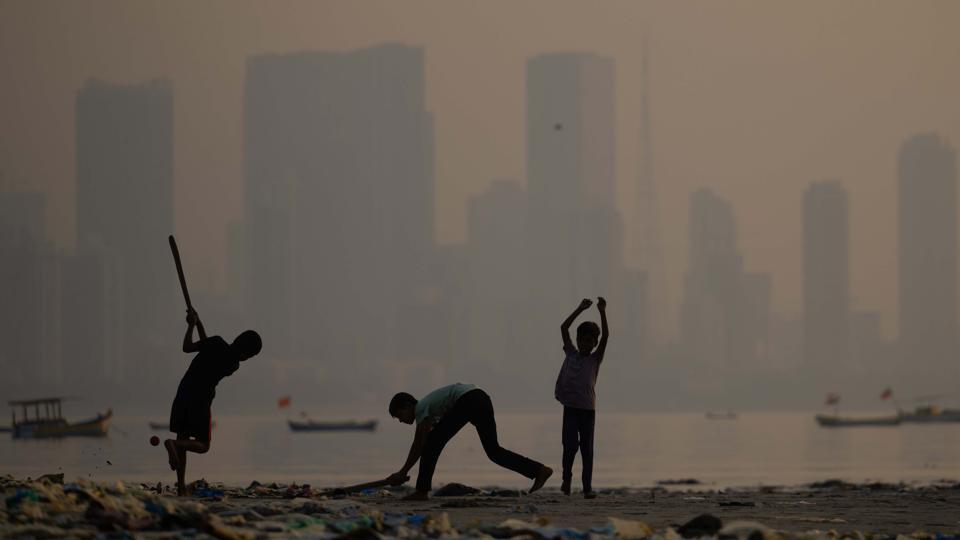
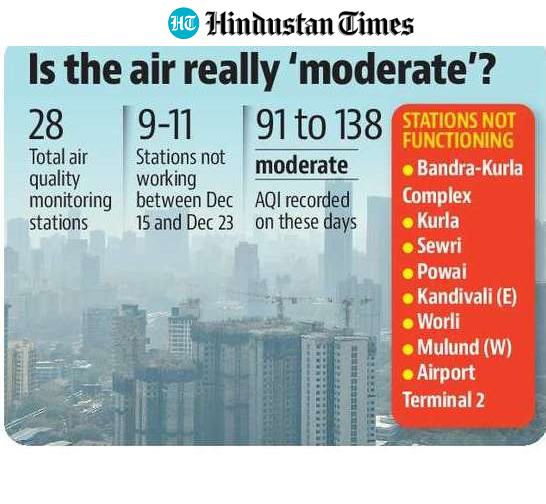
HT has scrutinised data accessed from the Central Pollution Control Board (CPCB) between November 15 and December 23, and has found that of the 28 air quality monitoring stations in Mumbai, only 17 to 19 were functional on most days between December 15 and December 23.
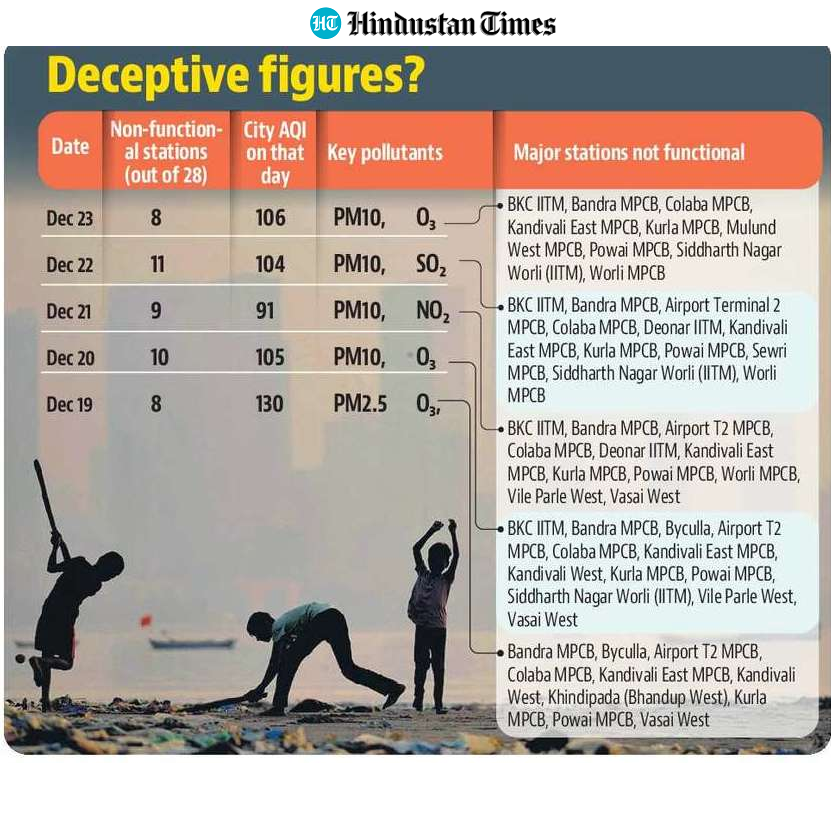
During this period, the city’s AQI fluctuated between 91 and 138, remaining largely in the “moderate” category. However, the averages were drawn without data from several of Mumbai’s chronic pollution hotspots, which include Bandra-Kurla Complex (IITM), Bandra (MPCB), Kurla (MPCB), Sewri, Powai, Kandivali East, Worli (IITM and MPCB), Mulund West and Mumbai airport’s Terminal 2.
Consider this: On December 22 when Mumbai’s AQI stood at 104, only 17 stations were operational. Key locations such as BKC, Bandra, the airport’s Terminal 2, Colaba, Deonar, Kandivali East, Kurla, Powai, Sewri and Worli did not report data. Similar gaps were seen on December 20 and 21, when fewer than 19 stations were functional, even as the city continued to report “moderate” air quality.
Experts say, the absence of data from high-emission zones can significantly skew city-wide averages.
Gufran Beig, chair professor at National Institute of Advanced Studies (NIAS) and founder project director of SAFAR, said, “Most air quality stations are not placed adhering to prescribed norms and do not meet technical siting requirements. In such a scenario, determining a city’s AQI solely based on readings from a handful of stations, without considering missing or non-representative locations, is technically flawed.”
In this period, several stations that remained offline have historically recorded some of the worst air quality in the city. In mid-November, when the city witnessed a sharp deterioration in the quality of air, the BKC IITM station reported AQI levels in the “very poor” category, crossing 280 on certain days.
Kurla and Kandivali east had also recorded AQI levels above 200, driven largely by PM10 and PM2.5 spikes, while Sewri and Worli frequently showed PM10 exceedance linked to construction dust, port activity and heavy traffic.
When this scenario was presented to a senior official at the Brihanmumbai Municipal Corporation (BMC), he emphasised that the civic body’s monitoring stations were indeed functioning normally. “The air quality stations operated by the BMC are working and data is being generated regularly. However, we are informed about issues at other stations from time to time by the concerned agencies,” the official said.
The civic official however, admitted that the stations of some agencies are often located in unideal or remote areas without actually being present at the hotspots.
A former senior official of the Maharashtra Pollution Control Board (MPCB) said prolonged station outages often stem from systemic issues. “In many cases, stakeholders do shut down AQI stations due to persistent monitoring problems and a lack of ownership over maintenance and data quality. When there is no clear accountability, stations remain non-functional for days or even weeks,” the official said.
Sunil Dahiya, founder of Envirocatalysts, an organisation that researches air quality and assimilates data, said, “When local hotspots remain unaccounted for, several loopholes emerge in taking action to curb breaches. The data produced and the subsequent measure of AQI cannot be trusted when stations are shut down.”
Gyan Chaddha, an environmental activist based in Goregaon, said, “The stakeholders are deliberately shutting down monitoring stations where most needed, to claim that the air quality has improved. But in areas such as BKC and Worli, we see that the AQI is bad, but there is no data to prove it.”
Stay updated with all the Breaking News and Latest News from Mumbai. Click here for comprehensive coverage of top Cities including Bengaluru, Delhi, Hyderabad, and more across India along with Stay informed on the latest happenings in World News.


