
 E-Paper



Drawing from Raza and Rothko, Kachchhi artisans have become artists
“Kala cotton is quite well-known today. But at the time, due to mill cotton, the value chain had broken down. Weavers were leaving the craft and taking up jobs in ATMs or factories. A weaver was earning ₹9000 as a security guard, but barely making ₹3000 with his trade,” says Reddy

 Prefer HTon Google


MUMBAI: For the past decade, craft mentor Satish Reddy has been convincing artisans to become artisans again. In 2012, he was working with Khamir, a craft revival organisation in Kachchh, when they asked him to write a white paper on kala cotton. “Kala cotton is quite well-known today. But at the time, due to mill cotton, the value chain had broken down. Weavers were leaving the craft and taking up jobs in ATMs or factories. A weaver was earning ₹9000 as a security guard, but barely making ₹3000 with his trade,” says Reddy.
During his field trips, Reddy discovered that “the weavers were very receptive to me”. So, Khamir entrusted him with setting up the entire value chain, from the making of yarn to dyeing to weaving. “Within a year, about 30 weavers were working with kala cotton full-time. Big designer labels such as Péro, Injiri and 11.11 were also looking for a new material story. So, everything clicked at the same time.”
Since Reddy has been working with Kachchhi artisans, this is a story that repeats itself, whether it’s mochi embroidery, brass work or namda (wool felting). Artisans who could brave the harshest forces of nature — the Rann, the Thar, the 2001 earthquake — could not withstand market forces. Reddy has been getting them back to the drawing board, and getting their work onto gallery walls. At 47-A, in Khotachiwadi, he has curated an exhibition titled ‘Kachchh: Born Again’, which will run till July 9. Twelve artisans from 12 villages are showing original works in ajrakh, kharad (carpet weaving), rabari embroidery, bandhani and clamp dye, among others.
“The main point is to turn the tables,” says Reddy. “Craft is considered a poor man’s art, and artisans are treated with pity. But, our artisans are carrying hundreds of years of skill and knowledge. It’s just about tapping that and elevating them to the level of an artist’s studio. Why can’t they be the people who teach the viewer: this is what beauty is, this is what craft is, this is what art can be?”
Srila Chatterjee, co-founder, 47-A, who has brought the show to Mumbai, says, “When I saw the works in Kachchh, it just blew me away. I had seen masters. But, this was not just mastery, this was incredible design. I think this is the first time that craftspeople have become designers. It’s not outside design input. It’s inspiring them to free their minds, get out of the shackles of market-driven thinking, and become designers who can do anything. For me, this show is very important. Because if it works, it becomes the prototype for anybody, anywhere to do the same.”
The art of artisans
In an indigo kala cotton shirt and sky-blue denims, Reddy, 38, recounts his migration from a family of farmers in Madanapalle, Andhra Pradesh, to sunburnt Kachchh. A mechanical engineer, he was a systems analyst and statistician with firms such as Infosys and Accenture, before he switched careers. “I didn’t even know what craft meant at that time. I had never seen a loom in my life.”
In the subsequent decade, Reddy picked up the tricks of the trade, while working for international textile and product designers, such as Charles Galatis and Simon Marks. “I would go around like a talent management scout, meeting artisans across Kachchh. That gave me a good grounding to understand craft and design. It was like attending an intense design course, while learning on the job.” During this phase, Reddy started asking: “How can we push the boundaries and possibilities of craft? How do we trigger extreme innovation? Who’s going to pay the cost of the innovation?”
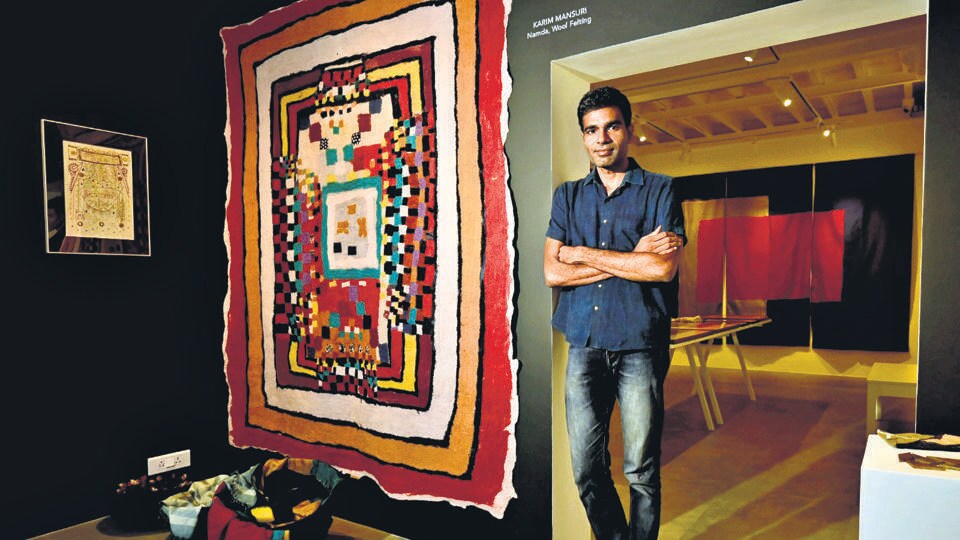
With the help of Kirit Dave from Shrujan, a craft organisation in Bhujodi, he set up Sanchari to co-author new ideas with artisans, a few of which are on display at 47-A. The show opens with Khalid Amin Khatri’s experiments in ajrakh, exploring the five elements (air, earth, water, fire, space) in a Milky Way lookalike. “The motifs came from his imagination,” says Reddy. “He used the traditional techniques and materials — indigo, fermented scrap iron and madder roots — but in a contemporary manner.” Artist SH Raza’s bindu shows up in clamp dye by Jabbar and Abdullah Khatri, and artist Mark Rothko’s colour fields get a spin in shibori and bandhani by Imran and Zuber Khatri. The namda works by Karim Mansuri were inspired by graffiti, Siddi community quilts, and even one Mughal-era coin. “We drew inspiration from all directions,” writes Reddy in his curatorial note. “Old items found in a pile in the bazaar, a documentary about the way people ate in times past, the texture of something.”
Even with all the craft innovations on display, Reddy’s collaborative approach is the true revelation of the show. “Maybe the artisans understand that I don’t come from a privileged background, and can connect with my vulnerabilities and struggles,” he says. “They are very intuitive. They know why they have done something, but won’t be able to articulate it. So, I started picking up nonverbal cues. The best example is the mochi embroidery by the Kasam brothers. They were very angry people in the beginning. They felt let down by the world. The first time I met them, they said, ‘We never want to take up a needle again.’ But, I visited them several times, which made them less guarded. That is when I started earning their trust.”
On a 4x4in fabric, the Kasam brothers have come up with the most exquisite floral border, with hundreds of tiny embroidered details. They had given up on their craft four years ago. This quarter of a fragment is the first piece their hands have birthed, in their own rebirth as artisans.


