
 E-Paper



Cycle track at Powai Lake: Experts, activists not convinced with officials’ assurance
State environment minister Aaditya Thackeray and other officials said the cycle track project’s broader vision also includes restoration of Powai Lake


The past two months have seen a flurry of activities surrounding the construction of a cycle track at Powai Lake by the Brihanmumbai Municipal Corporation (BMC). Citizens have written to Maharashtra chief minister Uddhav Thackeray, asking that the plan be nixed, while political parties have opposed the project. A public interest litigation (PIL) has also been filed in Bombay high court (HC) by two researchers from the Indian Institute of Technology-Bombay (IIT-B), while a Mumbai-based non-governmental organisation (NGO) has petitioned the National Green Tribunal (NGT) against the project. There have been multiple protests by citizens at the site, and the forest department has responded to the controversy by saying, for the first time, that the lake is a wetland and must be protected as such.
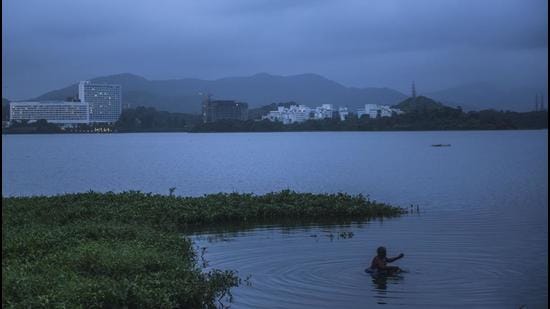
State environment minister Aaditya Thackeray, along with officials and experts involved, are urging environmentalists to reconsider their stance, pointing out that the project’s broader vision also includes restoration of the water body – a long-standing public demand – and the first ever baseline study of Indian marsh crocodiles, which inhabit the lake. Thackeray has also publicly said that not a single tree – of the about 71 that lie in the path of the cycle track – will be cut. Adverse impacts to biodiversity have been a foremost concern of environmentalists.
Speaking to HT, additional municipal commissioner (projects) P Velarasu described the cycle track proposal as a place-making exercise, which will lead to the creation of valuable public space in the city’s eastern suburbs.
“If you look at south Mumbai, there is Marine Drive and Worli Seaface. In western suburbs, there is Juhu and Bandra. But the eastern and central suburbs – where real estate development is concentrated and population is booming – do not have an equivalent space. That’s what we are trying to create, as an alternative to malls and other forms of indoor recreation,” he said.
Officials also cited the example of other Indian cities with prominent urban lakes, such as Hyderabad, Bhopal and Bangalore, which have been developed into free, accessible public spaces.
“Every lake in every city around the world has been protected by making use of it as an urban, open space that is natural. It is a model of sustainable development,” said Thackeray, in response to a question by HT.
Emphasising that the ecological integrity of Powai Lake is paramount, Thackeray added, “I’m an environmentalist too, and that’s what the Powai Lake rejuvenation project is about. Currently, the lake is dead ecologically. It has sewage ingress from properties surrounding it, and certain illegal constructions have been brought to our notice. The cycle track will be an important intervention. Contrary to what is being alleged, it will protect the lake from encroachments and incentivise proper environmental management. To refuse to see the project in this light, and then to spread lies, is a disgraceful act in the name of environmentalism.”
Of about 38 inlets currently letting raw sewage into the lake, six have already been closed by BMC. The cycle track, which consists of a gabion structure made of rocks, will also be lined with over 2,000 indigenous trees. Instead of gabion structures, BMC had considered using other materials such as timber, steel and concrete, but decided against them owing to the disturbance they might cause to the environment. As per an estimate provided by BMC to the heritage conservation committee, the project will stand to benefit around 10 million citizens. BMC has also deployed six devices to monitor the lake’s oxygen levels, in addition to one aeration barge. Another seven aeration fountains are proposed to be installed.
A senior expert involved with the project, seeking anonymity of name, highlighted that Mumbai currently has only 0.9 square metres (sq m) of developed open space per person, far lower than the 10-12 sq m recommended in the Centre’s Urban and Regional Development Plans Formulation and Implementation Guidelines.
“The existing land use study for Mumbai, undertaken pursuant to the 2034 development plan, shows that we can increase this to about 1.1 sq m per person if certain open spaces are developed to allow public access. Powai Lake is one such space,” the expert said. For comparison, the United Kingdom has about 20 sq m of developed open space per person, while in the United States of America, it is 24 sq m. “In a city where we are so strapped for room, the Powai Lake project will serve a greater public good,” the expert added.
Environmentalists and even urban planners, however, remain staunch in their scepticism of the project, which can be traced back to 2016 proposal by BMC, titled ‘Green Wheels Along Blue Lines’. This proposal involved building a 39-km long, fenced jogging and cycling track to replace informal housing settlements along the Tansa pipeline, which were demolished in 2016 as per an HC order. In fact, the Powai Lake cycle track will be connected with an older track that exists parallel to the Tansa pipeline, as per drawings accessed by HT.
Hussain Indorewala, architect and researcher with the Collective for Spatial Alternatives, highlighted that the project does not promote sustainable transport.
“It will encourage only cycling for leisure. It’s not the same as building cycle tracks on arterial city roads, which would be a more effective way of reducing vehicular pollution. So perhaps the purpose is recreation and beautification, not sustainable mobility. But even for such projects, there has to be a careful study and mapping of existing land uses, socio-ecological impacts and cost-benefit analysis. Have the project proponents studied whether the cycle track will disrupt existing land use, such as fishing or collecting fodder? These assessments should be done beforehand, not only because it’s required by law, but as a matter of good practice,” he said.
Others pointed out that despite BMC’s “noble” intentions, important details regarding the project have been shrouded in mystery. Official plans and budgets have not been placed in the public domain, and BMC has not solicited any public feedback or hearings, as it would mandatorily have to for any other project covered under the Centre’s environment impact assessment (EIA) notification.
“Our fear is that the cycle track will reduce the contours of Powai Lake and open up lands around the lake for development. If the project is truly in public interest, then why should BMC be reluctant to take citizens into confidence? It is being built using taxpayers’ money after all,” said Amrita Bhattacharjee, environmentalist who has worked with the Save Aarey movement and has been campaigning against the cycle track.
Stay updated with all the Breaking News and Latest News from Mumbai. Click here for comprehensive coverage of top Cities including Bengaluru, Delhi, Hyderabad, and more across India along with Stay informed on the latest happenings in World News.


