
 E-Paper



Deep-sea pipeline to carry industrial effluents from MIDC Tarapur to be ready in 2 months
At present, an older pipeline is discharging effluents from the industrial complex only 500 metres away from the HTL at Navapur beach


Mumbai: An under-construction deep-sea pipeline to carry treated industrial effluents from MIDC’s Tarapur complex about 7 km away from the high-tide line at Navapur beach in Palghar district will be operational within the next two months, said officials familiar with the matter.
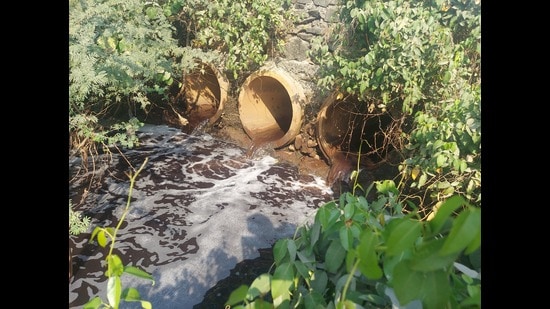
At present, an older pipeline is discharging effluents from the industrial complex -- regarded as India’s most polluted by the Centre’s Comprehensive Environmental Pollution Index (CEPI) -- only 500 metres away from the HTL at Navapur beach (which is about 8 km away by road), adversely impacting the local ecology and upending the lives of fisherfolk.
The existing pipeline, which has been operational since the 1970s when the industrial area was first set up by the Maharashtra Industrial Development Corporation (MIDC), suffers from frequent leakage and maintenance issues.
The area of Tarapur MIDC, spread over 15 villages in the Palghar district, is crisscrossed by a network of creeks, lakes and rivers leading to the sea.
These natural resources are key to sustaining the traditional livelihoods practised by the area’s largely indigenous population, which is involved in artisan fishing, agriculture and salt-making.
The Akhil Bhartiya Mangela Samaj Parishad, an organisation representing local fisherfolk, approached the NGT in 2016 with the grievance that water resources were being subjected to “grave degradation” at the hands of respondents through the discharge of untreated industrial effluents.
“As per data available with local fisherfolk societies, there has been a huge reduction in the number of families dependent on fishing in these villages surrounding the industrial complex. We have presented the numbers to the NGT. From 21,742 fisherfolk families in 1975, the number fell to 9,182 in 2016 and is likely to be even lower today. More and more people are being pushed out of their traditional livelihood. Pollution from the industries is one of the main reasons for this,” said Narendra Naik, a representative of the ABMSP.
An official with the Tarapur Environment Protection Society (TEPS), which operates two common effluent treatment plants (CETP) in the MIDC complex, said on the condition of anonymity, “The existing pipeline is made of concrete and was commissioned in the 1970s. It is serviced by about 60 km of pipelines which carry effluents to our CETPs. Maintaining the discharge pipeline has become a problem. There are frequent leaks during which industries have to be shut down for two or three days at a time.”
“In the last 10 to 15 years, effluent profile of Tarapur has also changed. Around 50 percent of the units currently operating are now into manufacturing drugs or chemicals, whereas it was earlier textiles and steel units. Textile industries still contribute about 80% of all daily effluent, but it is pharma waste that is more harmful to the environment. This has caused some agony to local fisherfolk,” the official added.
Hindustan Times recently visited the outfall point of Tarapur MIDC’s existing effluent pipeline at Navapur beach during low tide and observed that it was emitting wastewater with a distinguishable colour and odour, which accumulated in dark pools on the sandy shore along the length of the pipeline.
Satellite images also show that a significant area of the Palghar coast is affected by this discharge, with a large black plume stretching out along an otherwise blue coastline, from Navapur in the north to Murbe in the south.
To be sure, the pipeline is not the only route that effluents take to the sea. HT also observed multiple outfall points discharging effluents onto mudflats and intertidal water bodies in the area, which are part of a network of creeks that crisscross the landscape. These include the Kharekhuran-Murbe Creek, the Saravalli Creek and the Dandi-Navapur Creek.
At a nearby temple in Kumbhavali village, where locals are engaged in fishing and salt making, HT observed a dug well being diluted with a supply of municipal tap water, due to seepage of effluents into the groundwater table.
Exacerbated by poor functioning of the CETP and frequent leakages, effluent pollution has severely hindered fishing activities in these creeks. At Murbe village, fishers say they rarely take their boats out to sea.
“The nearshore area is so polluted we cannot fish there, and you don’t find fish in the creeks anymore either. Going into the deep sea is very costly. The price of diesel alone is too high. My boat has been parked for four months,” said Eknath Patil, a fisherman.
The impact of industrial pollution in the area was comprehensively detailed in a January 21 judgement of the National Green Tribunal (NGT), which fined 103 industries to the tune of ₹260 crore as environmental compensation and sought an action plan to remediate public health and the ecology. However, it has been alleged by villagers that despite the recent NGT order, industrial units are continuing to dump untreated or partially treated effluents into the creeks and water bodies. The TEPS official cited above refuted this claim.
“Our new CETP began operations in November last year and both plants -- 25MLD and 50MLD -- are operational. Once our new pipeline is commissioned, all other outfall points in nearby villages will be sealed. The new pipeline is also made from a high-density polymer instead of concrete, which will ensure no leakages. About 1,200 metres of the 7km pipeline are still to be laid. The nearby outfall points you have seen are discharging treated effluent. The new pipeline has been built as per the recommendation of the National Institute of Oceanography, and the rate of dilution in the deep sea will be 150 times that at the current discharge point. Over time, the environment around the Navapur outfall will also improve,” said the official from TEPS.
Experts, however, remained sceptical of this claim.
“TEPS has a proven history of failing to maintain discharge standards of Tarapur’s industrial effluents. Dumping the pollutants 7 km out at sea is an ‘out of sight, out of mind’ approach, which will make it harder to ascertain whether the effluent is meeting prescribed discharge standards. The pollutants may be sufficiently diluted to mask their presence, but they will remain in the environment for a very long time,” said Dhwani Shah, an independent environment researcher who studies critically polluted areas and their impact on communities.
Court proceedings revealed that a CETP operated by the Tarapur Environment Protection Society (TEPS) was found to be operating at a max capacity of 25MLD, as against the required capacity 37-40MLD discharge which is being let into water bodies.
A court-appointed expert committee also found the presence of heavy metals (mercury, lead, chromium, and cadmium) at the outfall points, and highlighted the “general failure in maintenance of standards” of effluent treatment plants. These violations have also harmed public health.
As per information placed on record by the medical superintendent, Rural Hospital, Boisar, the establishment reported a high incidence of 4,000 cases of skin diseases in one year between January 2015 and January 2016. The Ground Water Surveys and Development Authorities (GSDA), Palghar, and sub-divisional water testing laboratory have also analyzed 86 water samples from marked borewells and 535 water samples from private bore wells, of which five government and 61 private samples were found unfit for consumption due to presence of iron and turbidity.
A more sustainable approach, Shah suggested, would be to ensure zero liquid waste discharge and mandatory recycling of wastewater by industries. This will also ensure efficient use of fresh water from the Surya River, from where Tarapur MIDC draws water for operations.
HT attempted to contact Prashant Gaikwad, the Maharashtra Pollution Control Board’s officer at MIDC Tarapur, but he was not reachable despite efforts. Yashwant Sontakke, joint director (water), at MPCB did not respond to requests for comment.
Stay updated with all the Breaking News and Latest News from Mumbai. Click here for comprehensive coverage of top Cities including Bengaluru, Delhi, Hyderabad, and more across India along with Stay informed on the latest happenings in World News.


