
 E-Paper



Employees of state-run power utilities join nationwide strike
Energy minister Nitin Raut reached out to the striking employees on Monday and appealed to them to call off their protest.


Mumbai: Despite the state government’s efforts to broker a truce, the employees of the three state-run electricity utilities on Monday joined the two-day nationwide strike to protest against the economic policies of the union and state governments. After the unions refused to heed the appeal to call off their strike, the state government hardened its stance. Energy minister Nitin Raut called off his proposed meeting with the unions on Tuesday and threatened to crack the whip on striking employees.
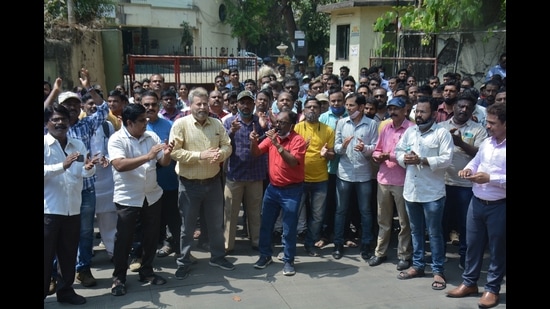
Though the employee unions claimed that the impact of their strike was near-total and had affected the working of the utilities, the state government said that 70 percent of officials and employees had reported to work in the power generation, transmission and distribution companies. However, the strike partially affected the working of the public sector banks, and consequently, the financial sector to some extent.
Power sector unions are upset that the draft Electricity (Amendment) Bill, 2021, seeks to delicense the distribution business and allow the entry of private electricity distribution companies. While introducing competition, the initiative will also dismantle the presence of the public utilities in the sector.
Raut had reached out to the striking employees on Monday and appealed to them to call off their protest. Raut said that the state had no plans to privatise any of the three companies in the power sector.
Though the unions refused to call off their strike, they had agreed to meet Raut in Mumbai on Tuesday. The state government has already imposed the Maharashtra Essential Services Maintenance Act (MESMA), 2017, on the striking workers. The refusal to backdown on the strike led Raut to call off the meeting late on Monday. He threatened to implement the MESMA stringently to crackdown on the striking workers. Under the MESMA, the police can detain or arrest workers engaged in delivery of essential services without a warrant if their strike affects these services.
Asking agitators to call of the strike, Raut said, “Farmers have standing crops in their fields... the Standard X and XII exams are underway and students need power supply at night to study. The temperature is also rising and the coal supply position is also precarious.”
Krishna Bhoyar, general secretary, Maharashtra State Electricity Workers Federation, said the strike had led to the stoppage of power generation at 500 MW set at the Chandrapur super thermal power station. Similarly, the operations at the Nashik thermal power plant and at the hydroelectric power projects were also affected.
“Around 95 percent of workers and officials, including contractual workers, are on strike,” claimed Bhoyar, adding that 39 unions, including 27 permanent employees and 12 contractual labourers, had joined the protest.
The three companies have 85,000 permanent and around 42,000 contractual workers.
Bhoyar charged that the state was eager to bid out power distribution in 16 cities and towns to private distribution franchisees. He demanded that apart from scrapping the plan, the state also revoke the franchisees operational at Bhiwandi and Malegaon. The state government is also trying to involve private operators in running six hydroelectric power stations like that at the Veer dam, which have been given on lease by the water resources department to the Maharashtra State Power Generation Company Limited (MahaGenco). The unions are also demanding that recruitments be completed for the around 42,000 vacant positions in the utilities and that the jobs of contractual employees be protected till they reached the age of 60.
When asked about the inconvenience to people because of the strike, Bhoyar said that they had given notice for the strike two months ago and had also protested at the Azad Maidan in Mumbai. However, Raut had refused to meet them. “We do not want to hold the people to ransom. We are not protesting for salaries and bonuses, but to ensure that the people continue having a stake in the power sector,” he added.
Dinesh Waghmare, principal secretary, energy, said just around 30 percent of workers had joined the strike. Though two 210 units at Nashik had stopped generation due to manpower shortage and technical issues, one of them had later come on to the grid, with the other expected to be online late on Monday.
Waghmare said that the state government would take action against the striking workers. “We have appealed to them to withdraw the strike as their major demands have been met. We have assured that there will be no privatisation and… vacant posts will be filled,” he explained.
The power demand in Maharashtra has touched 27,000 MW due to the onset of the summer. “Though we faced some staff shortage, electricity generation has not been affected. The MahaGenco has generated over 8,000 MW,” said an official from the company.
Vijay Singhal, managing director, Maharashtra State Electricity Distribution Company Limited (MSEDCL), said they had managed the situation well despite the strike. Marginal load shedding of around 20 to 25 MW had been undertaken, he added.
The nationwide strike partially impacted the financial sector with the functioning of many nationalised banks being affected. “Our bank official Union asked us to strike or else our jobs will be at stake. Hence, we joined the strike,” said a senior officer of a nationalised bank in Lalbaug.
Some banks did operate with skeletal staff but most of the services were curtailed. Private banks functioned normally. Even the insurance sector employees struck work. The labour unions agitated at Azad Maidan. The transport sector functioned normally across the state.
“There is tremendous resentment among the workers against the hire-and-fire policy of this Government. Our whole labour class is angry and will agitate till these repressive laws are repealed,” said Vishwas Utagi, Joint Convenor, Trade Unions Joint Action Committee (Maharashtra).
A joint forum of central trade unions has given a call for a nationwide strike on March 28 and 29 to protest against the government policies affecting workers, farmers, and people. Their demands include the scrapping of the labour codes, no privatisation in any form, scrapping of the National Monetisation Pipeline (NMP), increased allocation of wages under MNREGA (Mahatma Gandhi Rural Employment Guarantee Act) and regularisation of contract workers.
Late on Monday, there were reports of power supply failing in areas like Badlapur. Officials however said that they did not anticipate a major supply disruption on Tuesday.
Stay updated with all the Breaking News and Latest News from Mumbai. Click here for comprehensive coverage of top Cities including Bengaluru, Delhi, Hyderabad, and more across India along with Stay informed on the latest happenings in World News.


