
 E-Paper



For Mumbai’s East Indians, singing competitions a way of preserving their culture
There are around 88 East Indian associations in Mumbai and surrounding areas like Vasai, Bhaindar, Uttan and Gorai, and almost every one of them holds a singing competition, or more


Mumbai: Julie Shinde, a 50-year-old Marol resident, has been to at least 15 singing competitions this year – either as a guest of honour, or a singer and performer, or at times, just a spectator. She has travelled far and wide for these programmes, from old neighbourhoods in Mumbai to its distant suburbs. Yet, she is excited about a few more competitions lined up for the remaining weeks in the year.
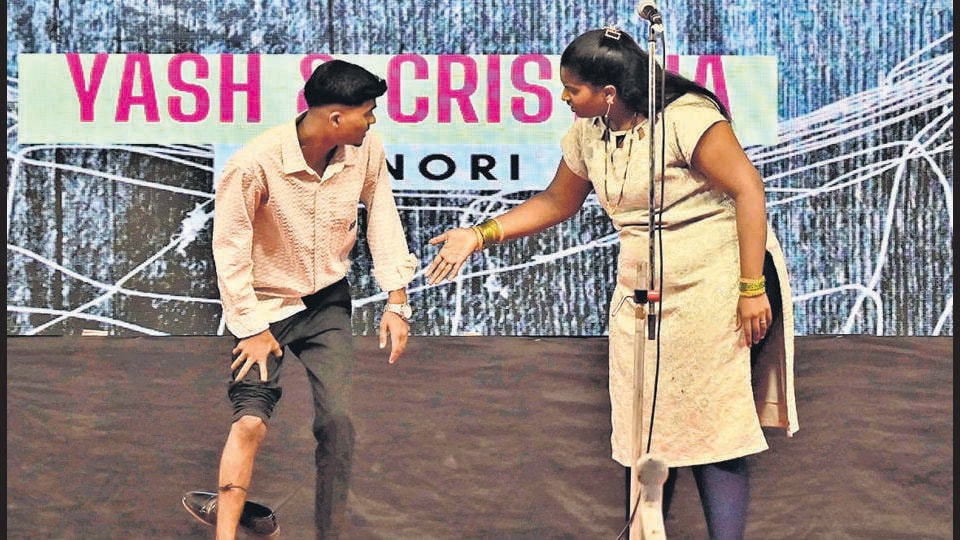
The reason: The competitions are all organised by associations of East Indians, a community of Catholics who claim to be original inhabitants of the former seven islands of Bombay that were given to the British as dowry by the Portuguese. Their aim is not only to encourage creativity and music, but also to celebrate the language and culture of the community.
Shinde said there are around 88 East Indian associations in Mumbai and surrounding areas like Vasai, Bhaindar, Uttan and Gorai, and almost every one of them holds a singing competition, or more.
The competitions are held round the year, except for the monsoon months and the period of Lent, when they are put on pause. They are organised by goathans or their churches, and they take place in church grounds or schools. Singing takes centre stage at these events – only new, freshly written songs in East Indian Marathi, a dialect peppered generously with Konkani, are allowed. Their subjects are wide-ranging, from religion to culture to renowned individuals and icons. But some subjects are deliberately kept outside their purview.
For instance, the poster of a November 25 competition in Versova organised by the Catholic Welfare Association of Versova Gaon stated, ‘Strictly no song to be sung on any Versova incident or issue’.
“People used to sing songs about good people or landmark events in the community. But, some songs got insulting, and sometimes people paid others to sing about them, which led to fights. So we had to stop people from taking names in songs,” explained Shinde, who has been organising the competition in her gaothan in Marol for the past 20 years, barring the years of the pandemic; this year, it was held on November 19.
The competitions are divided into two or three categories – one for solo acts; one for duets featuring male and female participants; and one for ‘urta,’ which refers to comedy. They are judged on the basis of lyrics and singing, but often combine some acting and dance.
The practice among East Indians of organising neighbourhood singing competitions is not a new phenomenon. In fact, the competition organised by the St Joseph’s Confraternity in Juhu, held on November 14 this year, has completed 140 years.
“I started playing the band around 40 years ago, after an uncle of mine passed on the mantle to me,” said Alwyn Gomes, whose band ‘Alwyn and the band’ accompanies singers on stage at these competitions. Participants usually attend a tuning session weeks ahead of the event, where the lineup and arrangement for keyboards, guitars and drums is decided.
When he started out, said Alwyn, bands were few and far between, and competitions were also fewer. Shinde concurred, saying there were around 25 community associations in and around Mumbai in 2006, which have now mushroomed to 88.
Some goathans, like Parel, have been organising up to three competitions in a year, while others have joined in more recently.
“We decided to start the competition in our gaothan in Sahar because we wanted to do something for our community,” said Aston Gonsalves from the Bamanwada East Indian Association, which held its first competition on November 11 this year. The event was a success, attracting many sponsors, corporators and rich businessmen who contributed to the event. “We had around 400-450 seats, but around 600 people turned up so there was some shortage,” said Gonsalves, adding that they planned organise such a competition every alternate year.
Performers look forward to the competitions as they have much to gain. Especially in terms of prize money that comes from sponsors, which reaches upto ₹25,000 for solo performers and ₹30,000 for duet performers.
“Earlier, performers used to be given gifts like a musical instrument called ghummat, a chicken, a goat, or an alcohol bottle. Money replaced the gifts gradually, starting from ₹100 or so, which kept increasing,” said Shinde.
At times, performers take the help of experts and community elders to write and compose new songs. Some take their cut, which can go up to half the prize money amount, whereas many others like Francis Baptista from Pond gaon in Vile Parle West come ahead to help the children of their own accord.
“We coach kids from Manori, Uttan, Gorai, Kalina, Dongri and other places, teaching them the proper pronunciation of words, tone and pitch. A lot of them do know the language, especially from villages farther away from Mumbai as their elders don’t know English, but there’s a growing inclination towards English. We want our culture to remain intact,” said Baptista.
Men and women dress in their traditional attire at these competitions, and organisers try to encourage this in various ways. For instance, a poster for this year’s competition in Vidyavihar read, ‘Free Entry for ladies wearing East Indian lugra’. The lugra is a nine-yard or 10-yard sari with two pallus, which was once the preferred gift that brides received from their grooms for the wedding ceremony.
“So many children in our community do not know the language, as they study in English medium schools and speak in English at home,” said Gladwin Baptista, explaining the need for Mumbai’s first kids only East Indian singing competition. Organised by the St Francis Xavier’s Men Confraternity, the competition is slated for December 3.
Shinde, meanwhile, echoed Baptista’s concern, recounting how her two children learnt East Indian Marathi quite late in life and not as well.
“I’m not making the same mistake again, so I’m ensuring that my five-year-old granddaughter learns the language including the religious hymns. I’m hoping to get her to participate in the competition in two years’ time,” said Shinde.

Stay updated with all the Breaking News and Latest News from Mumbai. Click here for comprehensive coverage of top Cities including Bengaluru, Delhi, Hyderabad, and more across India along with Stay informed on the latest happenings in World News.


