
 E-Paper



‘Getting LPG cylinder refill is like a lucky draw’: Mumbai local amid global energy crisis
Gas agencies are flatly denying that a crisis exists. A gas agency in Borivali claims that crisis perception is being manufactured to benefit black marketeers.

 Prefer HTon Google


For three days in a row, 45-year-old digital marketer Ratanlal Dubey made the same trip to the Lokhandwala-Kandivali circle at dawn, an empty LPG cylinder in hand, returning each time without a refill. By 7am on Wednesday, over 200 residents had queued up, many arriving before sunrise, driven by rumours of early deliveries after a truck had come the previous morning.
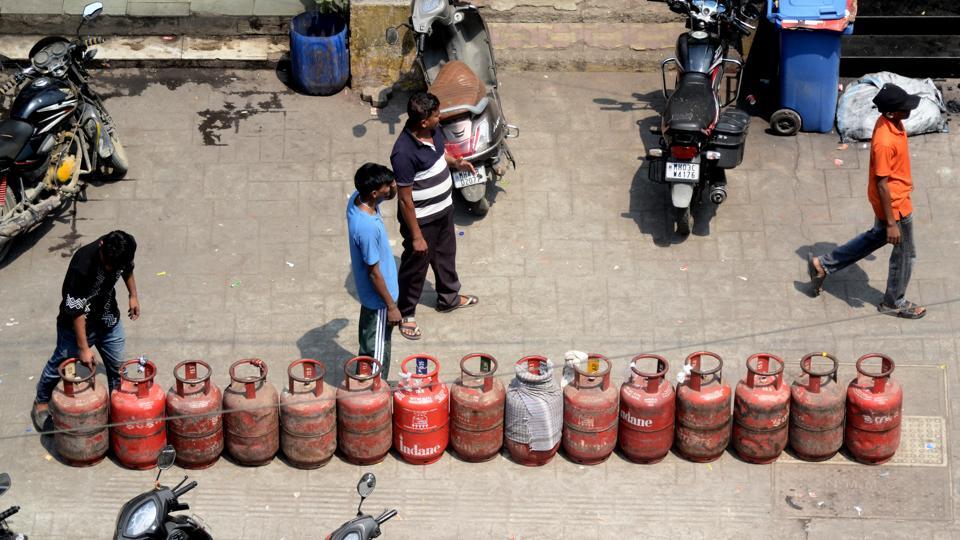
When the LPG tempo finally arrived at 5pm, it brought just 42 cylinders, well short of the residents waiting in line. Only those who had endured the nine-hour wait secured a refill. Dubey, a father of three, who had been without LPG for three days despite booking in advance, was among them.
“It’s like taking part in a lucky draw,” says Dubey. “No one knows if they’ll get a refill even after an impossible wait.” He adds, “The system is loaded in favour of those who have more than one cylinder. People like me have to wait for gas to run out completely before booking another cylinder. And now this crisis. What are we to do?”
In the queue was Anita Jaiswal, 28, a domestic worker chasing a refill for over two weeks. Despite booking a fortnight days ago, she never got one. “I suspect cylinders are being sold on the black market,” says Jaiswal. Her complaints at the dealer’s shop were brushed aside. On Wednesday, after lining up for nine hours , she was rewarded.
ALSO READ | Switch to PNG if available or lose LPG supply: Govt's order to households amid shortage concerns
The crisis has spared neither the elderly nor the ailing. Bharati Tasgwakar, 66, said her husband, a diabetic and heart patient, queued up for eight hours a day, on three consecutive days, returning empty-handed each time. Their refill has still not arrived and follow-ups have yielded no response. “There’s a tiny bit life in our cylinder. I use it to cook, disconnect the cylinder, and brings it to the queue. Like Dubey, Tasgwakar was one of the “lucky” ones on Wednesday.
Chandni Shaikh, 23, a resident of Mosa Killedar Road in Byculla, said she has long relied on the black market for LPG cylinders to support her household, which includes her two small children. On Eid, however her LPG ran out. “I paid ₹500 to a dealer to reserve a cylinder, but when I followed up, the man denied having taken any money. The next day, I realised, he had sold the same cylinder to someone in my neighbourhood for ₹2,500,” says Shaikh.
ALSO READ | 35-days LPG wait rolled back in Thane to avoid panic
Gas agencies are flatly denying that a crisis exists. Ramlata Gas Agency in Borivali claims the perception of a crisis is being manufactured to benefit black marketeers. “Confusion may have stemmed from a recent ₹60 price rise, and the mandatory 25-day policy , which has been misinterpreted as a sign of scarcity,” claims the dealer.
Navi Mumbai food chain disrupted
An acute LPG supply crisis is rippling across Navi Mumbai, Panvel and Uran, disrupting industries, eateries and households, and exposing a widening gap between official assurances and ground reality.
At Turbhe Janata Market, the crisis is being felt at the most basic level—food. Solehu Yadav, 45, from Basti in Siddharth Nagar, Uttar Pradesh, said, “We didn’t get gas even after standing in line after work. Some nights, we just drink water and sleep,” he said. “We come back at 10–11pm, but hotels are shut.”
ALSO READ | Shifting from LPG to PNG: What It means for households and how to make the switch | Step-by-step process
Anarjit Yadav, 22, also from Siddharth Nagar, lives in a cramped rented room shared with five others, where cooking itself has become a challenge. “The small cylinder we used has not been available for five to six days. Earlier, it cost ₹500, now they are asking for ₹2,000,” he said. “One cylinder is being used by eight to ten people.”
With multiple workers sharing a single room and a single fuel source, even basic cooking is difficult, forcing many to depend on increasingly unreliable eateries. In Sanpada, residents were seen carrying empty cylinders and queuing outside gas agencies, with police deployed to manage crowds.
Rahul Kadam, 35, a resident of Koparkhairane, said the shortage has also fuelled a sharp rise in black market prices. “Earlier, a commercial cylinder cost ₹1,300 in black,” he said. “Now it is costs ₹3,000 to ₹4,000, and even then you have to wait.”

Stay updated with all the Breaking News and Latest News from Mumbai. Click here for comprehensive coverage of top Cities including Bengaluru, Delhi, Hyderabad, and more across India along with Stay informed on the latest happenings in World News.


