
 E-Paper



HC orders release of 50 seafarers stranded on 3 ships off Mumbai coast for 3 months
A division bench of justices Ravindra V Ghuge and Hiten S Venegavkar also slammed the owners of the three ships—MT Asphalt Star, MT Stellar Ruby, and MT Al Jafzia—for “prioritising money over human lives”


MUMBAI: The Bombay High Court on Tuesday ordered the release of around 50 Indian seafarers who were stranded on three arrested ships off the city’s coast since early February with limited food and water supply.
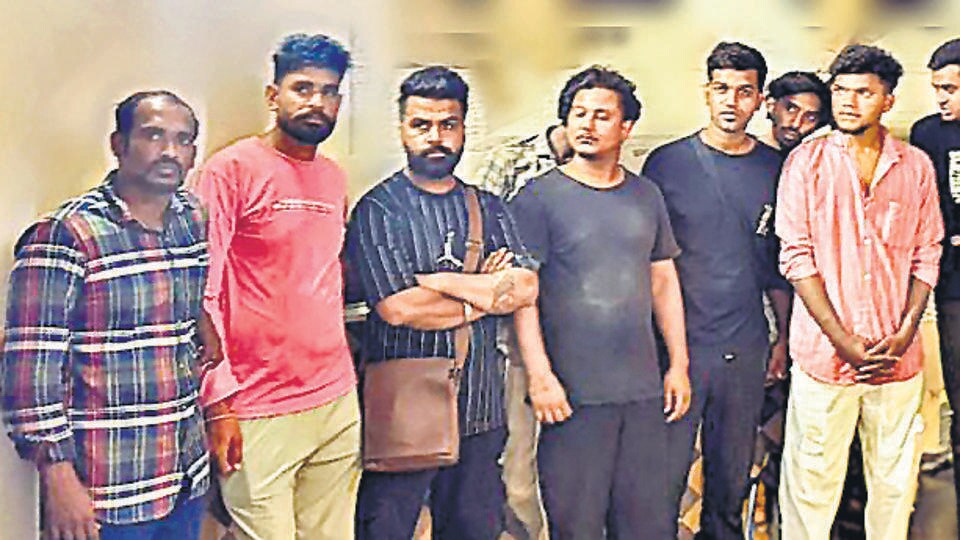
A division bench of justices Ravindra V Ghuge and Hiten S Venegavkar also slammed the owners of the three ships—MT Asphalt Star, MT Stellar Ruby, and MT Al Jafzia—for “prioritising money over human lives,” noting that the crew had been surviving on only 300 ml of water per day and minimal food.
“Your conduct doesn’t value human life. If you don’t give them adequate water, their kidneys will fail. Your money will come and go; you’re a rich man. For them, life comes only once,” the bench said.
The Indian Coast Guard had intercepted the three ships off Mumbai’s coast on February 4 after they were allegedly found to be engaged in unauthorised ship-to-ship (STS) transfer operations. Following the interception, the ships’ owners allegedly abandoned the vessels, leaving the crew stranded for over three months.
Seven of the stranded seafarers filed a habeas corpus petition in the high court on April 22, challenging their “unlawful and continued confinement” for nearly three months. The petition highlighted the “extreme dire” and “dehumanising” conditions the seafarers were living in, saying they were “victims of a high-seas humanitarian crisis”.
The petitioners stated that their food and potable water stocks were nearly exhausted, forcing them to survive on just 300 ml of water per day. They were also allegedly forced to cook with seawater and burn wood for fuel because there was no electricity or fresh supplies on board.
During the hearing on Tuesday, the seafarers told the court that due to the absence of electrical power, there is no lighting, no functioning of essential equipment, no mechanical ventilation in the living quarters, and no refrigeration facilities available for the preservation of perishable food items. “The conditions amount to cruel, inhuman, and degrading treatment,” they said.
The petitioners, represented by advocate Rakesh Tiwari, also stated that they have “no role, knowledge, involvement” in the alleged acts of the ships’ owners and are being “unjustly subjected to the consequences arising therefrom”. They sought urgent judicial intervention for their immediate release from unlawful confinement and directions for their sign-off, disembarkation, and repatriation.
Allowing the plea, the court remarked that the situation has reached its “boiling point”, triggering a natural instinct to survive. It asked the seafarers, who were present in court, whether they wanted to return to their vessels; all 50 of them unequivocally refused. “Since all of them are adults, we cannot detain them or compel them to go back,” the court observed, before directing the Yellow Gate police station to complete the formalities and release them.
While the vessel owners sought time to arrange a replacement crew, the court refused to delay the seafarers’ release, stating that a person cannot be left without food and water. “We can’t hold them. Now, the owner has to decide how the ship is to be taken care of. We are constitutional courts; we cannot ignore this. We will release them; you take your own recourse,” the court concluded.
Survived on boiled seawater: Seafarer
Nasiruddin Mujibar Rahaman Mandal, 28, one of the stranded seafarers who was present in court on Tuesday, told HT that the entire crew had been forced to survive on extreme scarcity for months.
“We were using seawater to bathe and clean. Between the last week of February and the first week of March, we were provided with only 180 litres of drinking water, which was shared among 18 crew members for two months. Later, when the water got over, we were forced to boil seawater for consumption, which further led to severe abdominal illnesses among some of us,” he said.
Mandal said that due to fuel shortage, the generators could not run, making cooking impossible. “The crew largely survived on limited supplies and ate only chapatti and pickles for months. With no diesel, we had to resort to burning wood to cook a single meal a day. We suffered a lot,” he added.
He also stated that his daughter got married on April 25, but he could not attend her wedding due to the ongoing investigation. “Initially, the wedding was postponed because of me. But it eventually took place without me,” he said, adding that their communication with families and lawyers was also restricted as their mobile phones could not be sufficiently charged.
“We could use one generator only for 30 minutes a day, when we would charge our phones to communicate with the company and the lawyer. However, we never received any help from the authorities. The whole crew has suffered a lot, but now we are just happy the court has granted us relief and given us our freedom,” he said.
Stay updated with all the Breaking News and Latest News from Mumbai. Click here for comprehensive coverage of top Cities including Bengaluru, Delhi, Hyderabad, and more across India along with Stay informed on the latest happenings in World News.


