
 E-Paper



High pollution levels turn giant lung billboard at Kharghar, near Mumbai black in a day
A giant pair of artificial lungs fitted with filters and fans to mimic the human lungs, which was fitted in Kharghar by an environmental organisation on Friday, has started turning black within a day


A giant pair of artificial lungs fitted with filters and fans to mimic the human lungs, which was fitted in Kharghar by an environmental organisation on Friday, has started turning black within a day.
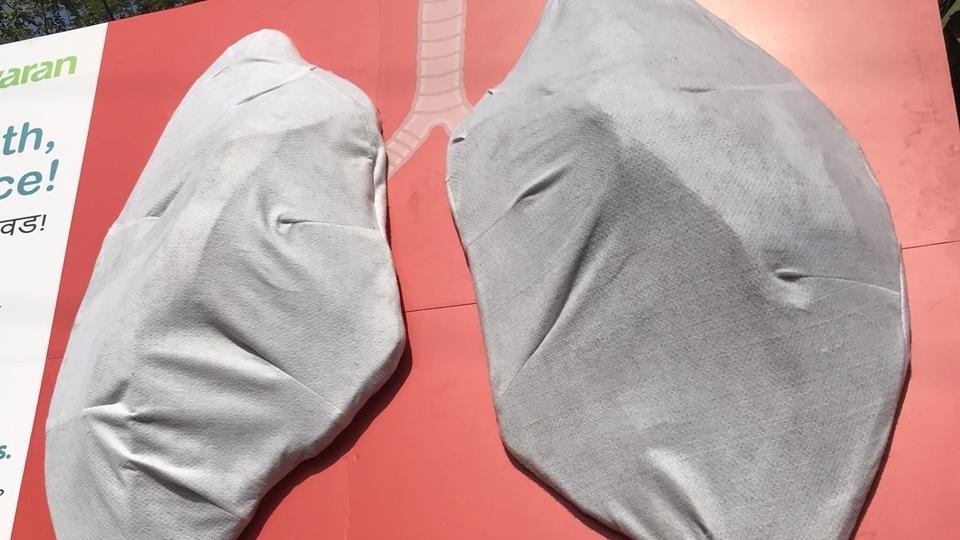
A similar installation was set up in Bandra last January but it took 14 days to turn completely black. The installation changing colour within a day of being set up has caused concerns about increasing pollution levels among residents.
This comes four weeks after a study found that air pollution levels on the outskirts of the Mumbai Metropolitan Region (MMR) along the Kharghar-Panvel-Taloja belt are above safe limits for nearly two-thirds of the day, with peak pollution during early morning hours posing a threat to morning walkers and joggers.
Kavita Choutmal, mayor of the Panvel City Municipal Corporation (PCMC), who visited the site, has demanded the setting up of an expert committee to study the deteriorating air quality in the area.
“There is an urgent need to understand the cause of such high levels of air pollution in this belt and then work on solutions. However, the PCMC and MPCB (Maharashtra Pollution Control Board) needs to immediately take strict action against industries in Taloja MIDC as well as nearby areas that are not following norms and causing air pollution,” said Choutmal.
The artificial lungs, called the lung billboard, was installed to demonstrate the effect of pollution levels on the lungs by the Waatavaran Foundation, a non-government organisation. The installation is placed near the Bank of India Chowk at Sector 7.
Designed by the digital advocacy group Jhatkaa.org, the artificial lungs are made up of a white filter medium. A pair of fans are fixed at the back of the billboard to suck in the air, in a bid to mimic the functions of lungs while breathing.
“Such visuals (like the billboard) are important methods to raise awareness about finer particles bringing out a vivid image on how they impact the lungs. Air quality spikes could be mostly due to vehicular emissions in these areas. The impact needs to happen across all stakeholders to understand how various sources of pollution are contributing to this issue,” said Sudhir Srivastava, chairman, MPCB.
“Over the next few days and weeks, particulate matter from different sources will begin getting trapped in the filters. This will lead to the lungs changing colour- from chalk-white to brown to black. The billboard is also fitted with a digital air quality monitor that will record and display the real-time Air Quality Index (AQI),” said Bhagwan Kesbhat, founder of Waatavaran.
On Saturday, even as the overall air quality of Mumbai remained in the moderate category, in Navi Mumbai it was in the very poor category with an AQI of 365.
BOX:
A study released by Waatavaran in December 2020 found extremely high levels of PM2.5 in the air, especially between 6am and 8am, and average air quality above safe standards for 17 hours every day in the Kharghar-Panvel-Taloja belt.
The data from five locations – Maharashtra Industrial Development Corporation (MIDC), Taloja; Sector 13, Panvel; Navade, Taloja; Sector 7 and 36, Kharghar, showed average PM2.5 levels over 31 days was 101.12 microgrammes per cubic metre (μg/m3), which is almost twice the national safe standard (60μg/m3), and four times the World Health Organization (WHO) standard (25μg/m3).
The highest PM2.5 concentration was at 7am at 141.1μg/m3 (average data from five monitors). MIDC Taloja had the most polluted air among five locations at 197.4 μg/m3 at 7am. PM2.5 data was accessed using five low-cost air quality monitors between November 13 and December 13 and then analysed.
Stay updated with all the Breaking News and Latest News from Mumbai. Click here for comprehensive coverage of top Cities including Bengaluru, Delhi, Hyderabad, and more across India along with Stay informed on the latest happenings in World News.


