
 E-Paper



Hope and despair in the race at Agnipath recruitment camp
Mumbai: 19-year-old Omkar Rajole’s dream as a child was to serve as a soldier in the Indian army


Mumbai: 19-year-old Omkar Rajole’s dream as a child was to serve as a soldier in the Indian army. On September 28 noon, Rajole, who had travelled from his village Pimprisayad in Nashik reached the Shri Abdul Kalam Azad Sports Stadium, Mumbra, to realise his dream.
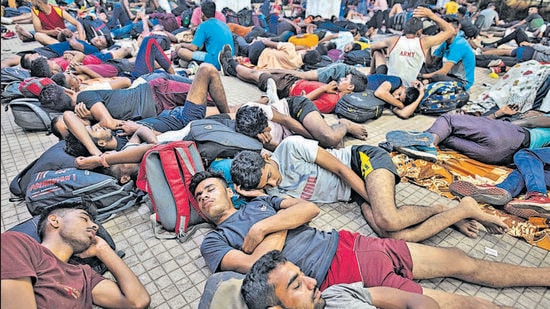
Rajole, a first year B.Sc student, is one of the thousands of young men queueing up at the Agneepath recruitment rally.
It’s 3 am, and Rajole is among the day’s 3,000 candidates limbering up in the grounds of Thane Municipal School for the physical that involves completing a 1600 metre run (1.6kms) in 5.30 minutes.
Rajole, has come to Mumbra as part of a group of 15 men from different villages in Nashik. He says he has been practising for the physical test for the last two years. “I run around 5kms every day, followed by pull-ups-and-push-ups and sit-ups in my college. My family is into farming but I have always aspired to be a soldier,” he says.
After nearly three years of no new recruitments due to Covid-19 pandemic, the Indian Army started its drive to recruit candidates as ‘Agniveers’ for a period of 4 years under the new Agnipath Scheme. After completion of the four- year- tenure, 25% of the Agniveers will be absorbed as regular cadre of the Indian armed forces based on the organizational requirement. The 75 per cent not selected in the regular cadre, will get a corpus of Rs. 11.71 lakhs each which will be tax exempt.
In Maharashtra, the recruitment is being conducted at four locations – Thane, Nagpur, Kolhapur and Pune. The recruitment drive at Mumbra, which commenced on September 20 and will end on October 10, is enlisting candidates from eight different districts – Mumbai city and suburbs, Nashik, Raigad, Palghar, Thane, Dhule and Nandurbar.
The recruitment drive has so far seen an average of 3000 candidates coming in from different parts of Maharashtra every day. A large number of these candidates belong to the same or neighbouring villages in Nashik and Dhule districts – the two districts that were on the schedule on the day of HT’s visit to the Mumbra camp.
The young men are at billeted on the ground floor of a municipal school campus but there’s not enough space for all of them, so many of them have colonized the under-construction road outside where they sleep without any sheets. There is bonhomie no doubt, but also an air of exhaustion that pervades the camp. The travel to Mumbra has been hectic, and most candidates are either catching a nap or giving one another foot massage before the all-important physical exam starts. A local NGO, Umeed Foundation, has volunteered to feed them at a nearby premises with the help of local Gurudwara Nanak Darbar Trust, Robin Hood Army and Ummeed Foundation’s in-house kitchen.
Nashik resident Sharadchandra Handge is one of the few parents who have accompanied their ward to Mumbra. Hangde who is hanging outside the iron barricades that separate the road from the stadium entrance where the physical is expected to start any moment, is visibly tense. His 18-year-old son Atharva was inspired to join the army after he watched ‘Uri,’ says the father. “Ever since my son saw ‘Uri’ he has been wanting to join the army and serve the country. He has seen me also work in the defence services, and now it’s his dream as well,” says Sharadchandra, a retired employee of the defence department. “I hope he will be recruited in regular cadre after 4 years if he is selected here.”
While one candidate, who does not wish to be identified, tells HT that he would want to sell milk after he buys two cows with the remuneration that he will receive after four years, another aspirant Ishant Devkar, says, “We will have various opportunities to get government jobs after this. We will apply in the police and the CRPF. There is also an opportunity to join army in the regular cadre if we perform well.”
A third candidate, Jay Shelar, adds, “This is a good scheme. There are similar schemes in other countries too. You work in the army for four years and then return to civilian life to do whatever you wish. It brings discipline in one’s life.”
Certain other candidates who are listening in express their disappointment that the scheme envisages a short-term tenure, but they do not want to be quoted. All their hopes, they say would be pinned on the police and the CRPF for a permanent job after the completion of four years.
“We are not happy with the scheme, but what can we do? We have no employment in the village. Farming is not doing well because of the unpredictable weather these days. Here, you give physical test, medical exam, clear the written exam and you will have your recruitment letter and employment. At the end of four years, we will also have some ₹11 lakhs to start our own business.”
Another candidate who is part of the group from Nashik says, “Who knows what will happen four years down the line. Governments can change, rules and schemes can also change. We just want to focus on the present.”
The present though is fraught with difficulties. The TMC-run school asked the Agniveer aspirants to get out of their classrooms a week after the camp started saying they were dirtying the campus. There are insufficient toilets, drinking water, and when night falls, insufficient light. Several of the candidates could be seen doing last-minute cramming in the light of their cell phones but there aren’t enough charging points for them.
Parvez Farid, founder president of Ummeed Foundation says, “Aspirants do not eat anything till their physical exam is done, which happens post-midnight. So, we arrange food from our kitchen for them to come and eat. We have also taken help from nearby Gurudwara to feed food to as many candidates as possible.”
Last week, an aspirant from Dhule had died tragically as he waited to return to his village after the exam—he felt nauseous and ran to the edge of the platform to vomit but missed the speeding train that came and hit him.
In the meanwhile, Omkar Rajole fails to clear the physical—he fell halfway through and though he picked himself up and ran again, he could not make it in time. “I will try yet again in February,” he says gamely. At the Mumbra camp, hope and despair are fellow travellers. The race is to see who trumps the other.
BOX
Indian Army’s recruitment drive under the new Agnipath Scheme
Recruits candidates as ‘Agniveer’ for a period of 4 years
Candidates from 17.5 years to 21 years are eligible to apply. But for this first year, Government of India allowed application from candidates who are between 17.5 years to 23 years of age.
The recruitment drive records an average of 3000 candidates every day.
The test usually begins after midnight and can go on till 5am. In the physical test, candidates have to run for 1600 meters (1.6 kilometres) in 5 minutes and 30 seconds or 5 minutes and 45 seconds, depending on their category.
Those completing this are selected for next round, which is a medical examination followed by a written exam.
BLOW OUT QUOTE
“Despite Maharashtra being a highly industrialised and urbanised state, the employment prospects for the youth have not been growing at the pace required to absorb the yearly additions to the labour force. Moreover, it is estimated that around three quarters of the labour force in the state is either semi-skilled or with minimum skills further restricting their employment opportunities in fast growing sectors such as organized retail, banking, financial services and insurance. Under the circumstances, it is not surprising that the response to the employment opportunity offered by the Agniveer Scheme has been overwhelming. For the youth who are faced with uncertain employment prospects, this offers a quick solution, even if it is for four years, as it opens up other vistas of employment in the future.”
-K. Seeta Prabhu, Visiting Professor, Tata Institute of Social Sciences and former Head Human Development Resource Centre, UNDP, said the good response to the
Stay updated with all the Breaking News and Latest News from Mumbai. Click here for comprehensive coverage of top Cities including Bengaluru, Delhi, Hyderabad, and more across India along with Stay informed on the latest happenings in World News.


