
 E-Paper



International team of astronomers studies rare Tidal Destruction Event
Mumbai: In what is being described as the most powerful flash from 8

 Prefer HTon Google


Mumbai: In what is being described as the most powerful flash from 8.5 billion light years away and the farthest ever detected from the earth, a multinational team of astronomers studied a bright optical Tidal Destruction Event (TDE) where a black hole ejects a rare luminous jet—beams of matter travelling close to the speed of light.
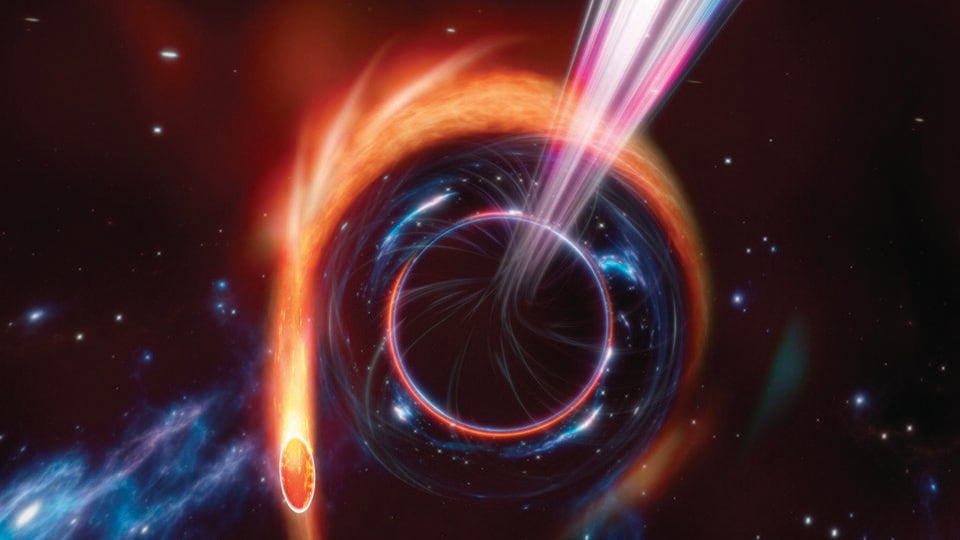
“When a dying star flies too close to a supermassive black hole, it doesn’t end well for the star,” said Varun Bhalerao, an astrophysicist at IIT-Bombay. “The star gets violently pulled apart by the black hole’s gravitational tidal forces. The shreds of the star form a spinning disc around the black hole, and are eventually consumed by it. Such events are called Tidal Disruption Events.”
The results of the study, done jointly with a large international team, were published in the journal ‘Nature’ on November 30.
A significant part of the study used the GROWTH India Telescope (GIT), which is a 70-cm telescope with a 0.7-degree field of view, set up by the Indian Institute of Astrophysics (IIA) and IIT-B. GIT is located at the Indian Astronomical Observatory (Hanle), operated by IIA. India’s AstroSat also gathered valuable data with its Soft X-Ray Telescope and Ultraviolet Imaging Telescope which were used for the analysis.
It was IIT-B PhD student Harsh Kumar who triggered the notice of the international collaborators, including University of Maryland astronomer Dr Igor Andreoni. “We started obtaining daily observations with the GROWTH-India Telescope,” said Kumar. “Our data showed that the object was fading at a unique, unexpected rate that set it apart from dozens of other sources we study daily.”
To supplement GROWTH-India, observations were also obtained from Radio telescopes, X-Ray telescopes, large ground-based optical telescopes and even the Hubble Space Telescope.
Astronomers said that not all TDEs launch jets, and only two previously known jetted TDEs were discovered through gamma-ray space missions, which detect the highest-energy forms of radiation produced by these jets—the last one being ten years ago. This was the first discovery in optical and also the farthest TDE ever found.
Andreoni said, “Without GROWTH-India observations, we would probably not have undertaken these observations, which revealed the extreme nature of this object.”
While there is no clarity why only some TDEs launch jets, Andreoni and his team concluded that “black holes in AT2022cmc and other similarly jetted TDEs are likely spinning rapidly so as to power the extremely luminous jets. This suggests that a rapid black hole spin may be one necessary ingredient for jet-launching—an idea that brings researchers closer to understanding the physics of supermassive black holes at the centre of galaxies billions of light years away.”


