
 E-Paper



‘Leopard collared in SGNP travelled to Tungareshwar and back’
One of the aims of this study, researchers explained at a press conference on Wednesday, is to understand the movement of the leopards across urban and forest landscapes, and to identify movement corridors between the protected areas of SGNP and TWLS.


Researchers have successfully traced the journey of a leopard from Sanjay Gandhi National Park (SGNP) in Mumbai to Tungareshwar Wildlife Sanctuary (TWLS) in Thane district, using radio-collars or radio-telemetry this month. The leopard, officially known as L93 and nicknamed Maharaja, was fitted with a radio-collar on February 23 as part of a two-year-long study by SGNP administration and Wildlife Conservation Society, which commenced in June last year.
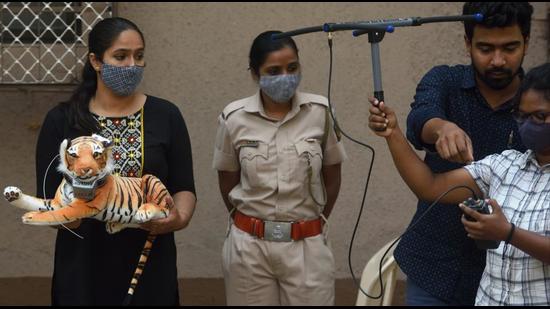
One of the aims of this study, researchers explained at a press conference on Wednesday, is to understand the movement of the leopards across urban and forest landscapes, and to identify movement corridors between the protected areas of SGNP and TWLS.
In case of L93, the animal was found to use a “chicken-neck” corridor connecting the two forests, just ahead of Nangla forest block of SGNP. The animal, researchers explained, has been seen frequently in the northern, Yeoor range of the national park and was likely to have been crossing roads while roaming about the area.
The animal, as evidenced by GPS data and camera trap photos, navigated his way across two linear intrusions that cut across this corridor —Chinchoti-Bhiwandi Road and an existing railway line that runs parallel to it. “We found that the animal crossed this path four times during his journey from SGNP to TWLS and back. While he only crossed the road at a single location, the railway tracks were traversed at multiple spots,” said Nikit Surve, wildlife biologist and one of the researchers of the study.
This is the third time in nearly a decade that the movement of a leopard across SGNP and TWLS has been documented, and the second time using radio-collars. Radio-collar allows scientists to triangulate the GPS location of the animal in real time.
The first such instance was that of a leopard named Ajoba, whose 125km journey from Malshej Ghat to SGNP in 2010 has been widely cited in press reports. At the time, Ajoba had entered SGNP through Vasai Creek.
A male leopard, L59, was later photographed in 2017 crossing high-traffic barriers such Ghodbunder Road, Vasai Creek and Diva-Kaman railway line to get to TWLS. It was found dead at Kaman-Bhiwandi Road in January 2018.
As per preliminary results from Phase-1 of the radio-telemetry study, researchers said L93’s journey to TWLS traversed a total of 62 km in six days. About 8 km was covered during the day time, while the remaining 54 km was covered during the night. Researchers also found the remains of a chicken killed by L93, and were able to identify areas where he sleeps and rests.
Pugmarks of a female leopard were also found close to that of L93. Researchers said more data needs to be acquired before inferences can be made about their companionship. L93 spent a total of seven days in TWLS during his first visit, venturing up to the highest point of the sanctuary. The second time, stayed for only about 30 minutes before returning to SGNP. The particular location he used to cross over into TWLS,
Forest department officials and researchers pointed out that the particular area chosen by L93 to cross over into Tungareshwar is about to undergo a rapid urban transformation, with three major infra projects set to come up in the area. These include the MMRDA’s Virar-Alibaug multimodal corridor, the High Speed Rail Corporation’s Diva-Panvel bullet train line, and Delhi-Mumbai dedicated freight corridor.
“Of these, the latter two have already been given forest and wildlife clearance, while the multi-modal corridor’s clearances are being processed. The project proponents have agreed to jointly build a 1-km long, 30-metre wide overpass for animals across this corridor between SGNP and TWLS,” said G Mallikarjuna, CCF, SGNP. This mitigating measure had been proposed by a State Wildlife Board sub-committee in January last year, and is awaiting a green light from the board, officials said.
Sunil Limaye, addition principal chief conservator of forest (wildlife), SGNP, said, “These preliminary findings reinforce the importance of this chicken-neck between TWLS and SGNP. They also justify the need to create safe passage for these animals between these protected areas, which may be affected due to upcoming development projects. Wildlife clearances for these projects include strict conditions that mitigating measures be put in place first.”
Researchers also shared information about another female leopard, three-year-old L115 (nicknamed Savitri), who is seen to be using the southern, Tulsi range of SGNP, often crossing into Thane subdivision. Notably, on March 17, L115 began waking up around 7:30pm and completed a circular route around Tulsi Lake, travelling about 4.5 kms in 11 hours. Phase-2 of the study, which will involve tracking another three leopards with radio-collars, is set to begin toward the end of 2021.
Stay updated with all the Breaking News and Latest News from Mumbai. Click here for comprehensive coverage of top Cities including Bengaluru, Delhi, Hyderabad, and more across India along with Stay informed on the latest happenings in World News.


