
 E-Paper



Manual scavenger used for BMC’s pre-monsoon clean-up
Heavily intoxicated manual scavengers, without any safety gear, were found entering and cleaning nullahs in Govandi, Bandra East and Juhu on Thursday. Hindustan Times has video and photographic evidence of this.


Mumbai: The city may be building coastal roads, metros, shiny skyscrapers and sprawling malls. However, all this will not mean much if the city also has labourers, who are cleaning choked-to-the-brim and often overflowing drains and nullahs bare-handed. Manual scavenging is prohibited, but it is being practised.
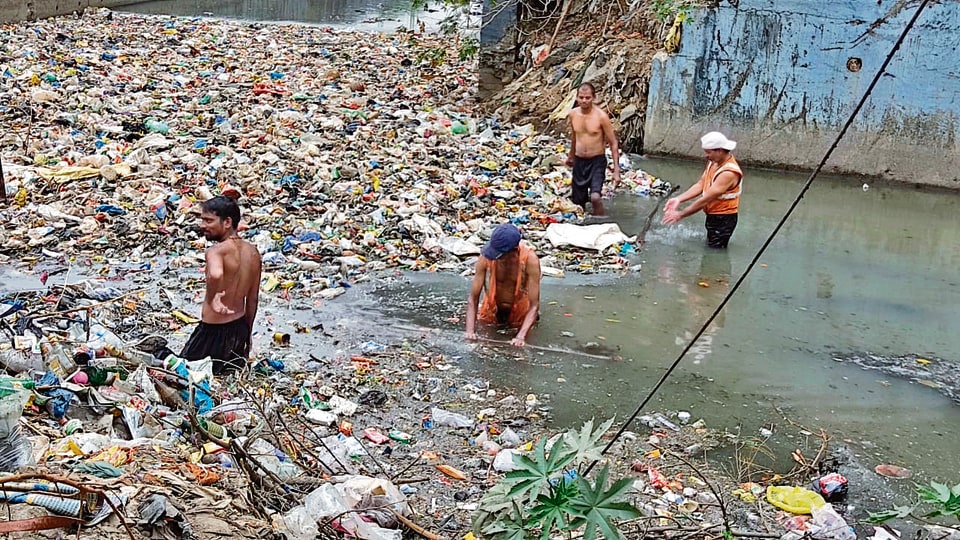
Heavily intoxicated manual scavengers, without any safety gear, were found entering and cleaning nullahs in Govandi, Bandra East and Juhu on Thursday. Hindustan Times has video and photographic evidence of this.
Labourers, hired by contractors or NGOs, are manually scavenging to clean nullahs (drains) as a part of pre-monsoon work by the Brihanmumbai Municipal Corporation (BMC).
Manual scavenging is a prohibited practise and is in violation of the state government’s notification of December 2022, which stated that all the local bodies in Maharashtra should stop manual cleaning of septic tanks and sewage lines by safai kamgars and go for 100% mechanisation.
On Thursday Yashodhra Salve, an activist, filmed the labourers deployed to do manual scavenging for a big nullah between Govandi and Chembur. “The labourers are appointed through contractors. I spoke to a few of them, and they told me that they were paid ₹400 per day,” said Salve.
The manual scavengers are residents of Limboni Baug basti in Chembur and were cleaning a big nullah near Acharya College, which is between Govandi and Chembur. “Men were deployed for this big nullah, which runs from Mankhurd to Kurla. Early in the morning, these men were in an inebriated state. They get drunk so that they can withstand the stench,” said Salve.
Salve added that the stench alone is not their problem — the labourers must immerse themselves in sewer water while cleaning big nullahs.
“Yet the BMC continues to hire contractors, who recruit such labourers to do these jobs at a measly sum. They are made to manually get into a big nullah and clean it with bare hands and without any safety equipment,“ said Salve.
“Last year, BMC used JCB machines and had cleaned big nullahs. They do have machinery. They have a fund for cleaning big and small nullahs. Yet, they make use of manual scavengers. We just want this inhuman practise to stop,” said Salve.
Shubham Kothari, president of Jan Haq Sangarsh Samiti said that irrespective of whether the labourers were on BMC’s payroll or not, it is a civic body-monitored work.
Kothari said that his NGO did try to communicate with the labourers but they were in no condition to speak.
“Usually, the labourers are heavily intoxicated and are also closely observed by the contractors. There were four labourers near Acharya college and a few more a little ahead,” said Kothari adding, “In other areas, women were employed. Basically, BMC is trying to save money on JCB machines by allowing manual scavenging.”
Milind Ranade, general secretary of Kachra Vahtuk Shramik Sangh said that all the obligations to ensure the safety of labourers lies with the BMC.
“I am sure they are being paid less than the minimum wages (MW). They are supposed to get ₹731 as per MW but get paid ₹400 per day. There is no washing facility, no safety gear like shoes. They are treated as lesser humans with no rights. They are economically in such a bad condition that they agree to do this kind of work. MW for men and women is the same but women get paid less than men for the same kind of job,” said Ranade.
Bilal Khan, president, Kamgar Saurakshan Samman Sangh had filed an FIR a few months back against the manager of a showroom in Vile Parle for allowing a few people to do manual scavenging of the drain.
“Last week, I spotted manual scavenging outside H west ward officer in Khar West and informed the civic chief but no cognizance was taken of my complaint,”said Khan.
In March 2022, three men had died during manual scavenging work after inhaling toxic fumes in a septic tank of a public toilet on Charkop Link road in front of Atharva complex in Ekta Nagar.
They were allegedly hired by a contractor, who was later booked under IPC section 304 (II) under culpable homicide not amounting to murder and section 9 of the Prohibition of Employment as Manual Scavengers and their Rehabilitation Act, 2013.
Salve said their families didn’t get any compensation from the BMC but were infact told to hush up the matter.
“The BMC had blamed the contractor. When the labourers die of manual scavenging nobody takes responsibility for them. The BMC should also ensure that the safety gear is of use. I was told by the labourers that water enters their gum boots and ruins their feet,” she added.
Chanda Jadhav, deputy municipal commissioner (solid waste management) and Alka Sasane, assistant commissioner of M east ward in Govandi remained unavailable for comment.
BOX:
The state urban development department issued a government resolution in December 2022 to stop the practise in three months and appoint mechanised cleaning for the job.
As per the Prohibition of Employment as Manual Scavengers and their Rehabilitation Act, 2013, manual scavenging means manually cleaning, carrying, disposing off,or handling in any manner, human excreta in an insanitary latrine. The Act prohibits states and Union territories from employing workers for manual scavenging of sewage and drainage lines.


