
 E-Paper



Morbe reserves may last only 82 days, warns NMMC
At present, Navi Mumbai draws around 476.85 million litres per day (MLD) of raw water from Morbe dam, while nearly 415.40 MLD of treated drinking water is supplied daily through over 1.27 lakh water connections. Supplementary supply is received from the Barvi system

 Prefer HTon Google


NAVI MUMBAI: With reservoir levels falling sharply and the India Meteorological Department (IMD) forecasting a delayed and below-normal monsoon under El Niño conditions, the Navi Mumbai Municipal Corporation (NMMC) has issued an early warning over the city’s water situation, saying usable reserves in the Morbe dam may last only around 82 days at the current rate of consumption.
El Niño is a climate pattern characterised by the unusual warming of surface waters, occurring every 2–7 years.
The civic administration on Monday indicated that policy decisions regarding future water distribution may soon become necessary if rainfall conditions fail to improve in the coming weeks.
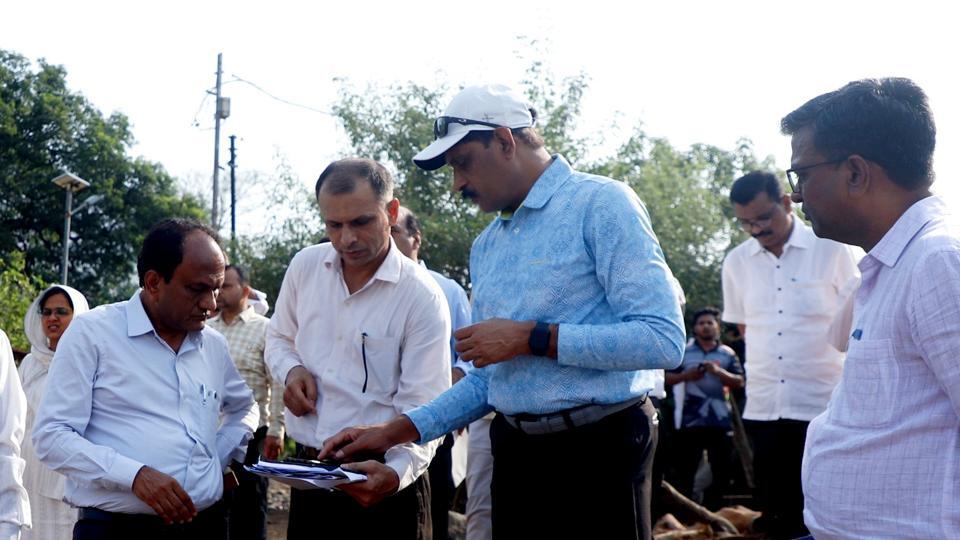
Municipal commissioner Kailas Shinde on Saturday inspected the Morbe dam project area in Raigad district to assess reservoir storage, catchment conditions, land protection measures and contingency planning ahead of the monsoon. The review gained urgency after the IMD’s long-range forecast projected the southwest monsoon at 92% of the Long Period Average (LPA), with the onset likely delayed till around June 10 or 11.
Morbe dam, owned by the NMMC, is Navi Mumbai’s primary drinking water source. Civic data shows the reservoir has a gross storage capacity of 190.890 million cubic metres (MCM), of which only 72.262 MCM, or 37.85%, currently remains. After reserving the mandatory emergency stock for one month, the actual usable storage is estimated at just 41.662 MCM, barely 21.82% of total capacity.
“At the present drawal rate, the available reserve is sufficient for 82 days, which calls for immediate caution and planned use,” Shinde said.
He also hinted that decisions regarding future supply planning, including possible restrictions, may have to be taken depending on rainfall trends.
“Depending on the rainfall situation, decisions regarding future water supply planning may have to be taken after discussions with municipal officials and civic representatives,” Shinde said.
Officials said the civic body is now preparing a summer contingency management plan as water levels continue to decline ahead of the monsoon. Although no official water cuts have been announced yet, reservoir depletion, consumption patterns and rainfall forecasts are being monitored on a daily basis. Senior civic officials said a major policy decision may become unavoidable if storage levels continue falling at the current pace.
The warning comes even as the NMMC prepares for a scheduled 24-hour water shutdown on May 13 and 14 across several parts of Navi Mumbai for critical maintenance works.
The shutdown has been planned for repairs at the Bhokarpada water treatment facility and leak rectification on the main Morbe pipeline near Agroli bridge and beneath the bridge near Chikhale village. The works will also include installation of major valves, SCADA-related upgrades and pre-monsoon infrastructure maintenance.
Areas likely to be affected include Belapur, Nerul, Vashi, Turbhe, Sanpada, Koparkhairane, Ghansoli and Airoli, along with Cidco nodes such as Kharghar and Kamothe.
At present, Navi Mumbai draws around 476.85 million litres per day (MLD) of raw water from Morbe dam, while nearly 415.40 MLD of treated drinking water is supplied daily through over 1.27 lakh water connections. Supplementary supply is received from the Barvi system.
Officials said replenishment remains a major concern this year. Historical data shows the Morbe catchment receives an average annual rainfall of 3,617 mm, while around 3,500 mm is generally required for the reservoir to fill completely. However, given the current depletion levels, civic officials estimate nearly 3,600 mm rainfall may now be necessary for full replenishment.
“If rainfall remains at 92% of normal, the catchment may receive only around 3,327 mm. The possibility of Morbe dam filling this year is low, and we must plan for next year from this year itself,” Shinde said.


Stay updated with all the Breaking News and Latest News from Mumbai. Click here for comprehensive coverage of top Cities including Bengaluru, Delhi, Hyderabad, and more across India along with Stay informed on the latest happenings in World News.


